M6.9 Earthquake Strikes Russia's Kamchatka Peninsula
A 6.9 magnitude earthquake hit Russia's Kamchatka Peninsula, with outlets largely agreeing on the basic facts but differing in emphasis, from routine seismic reporting to concern over the area's volcanic and seismic history.
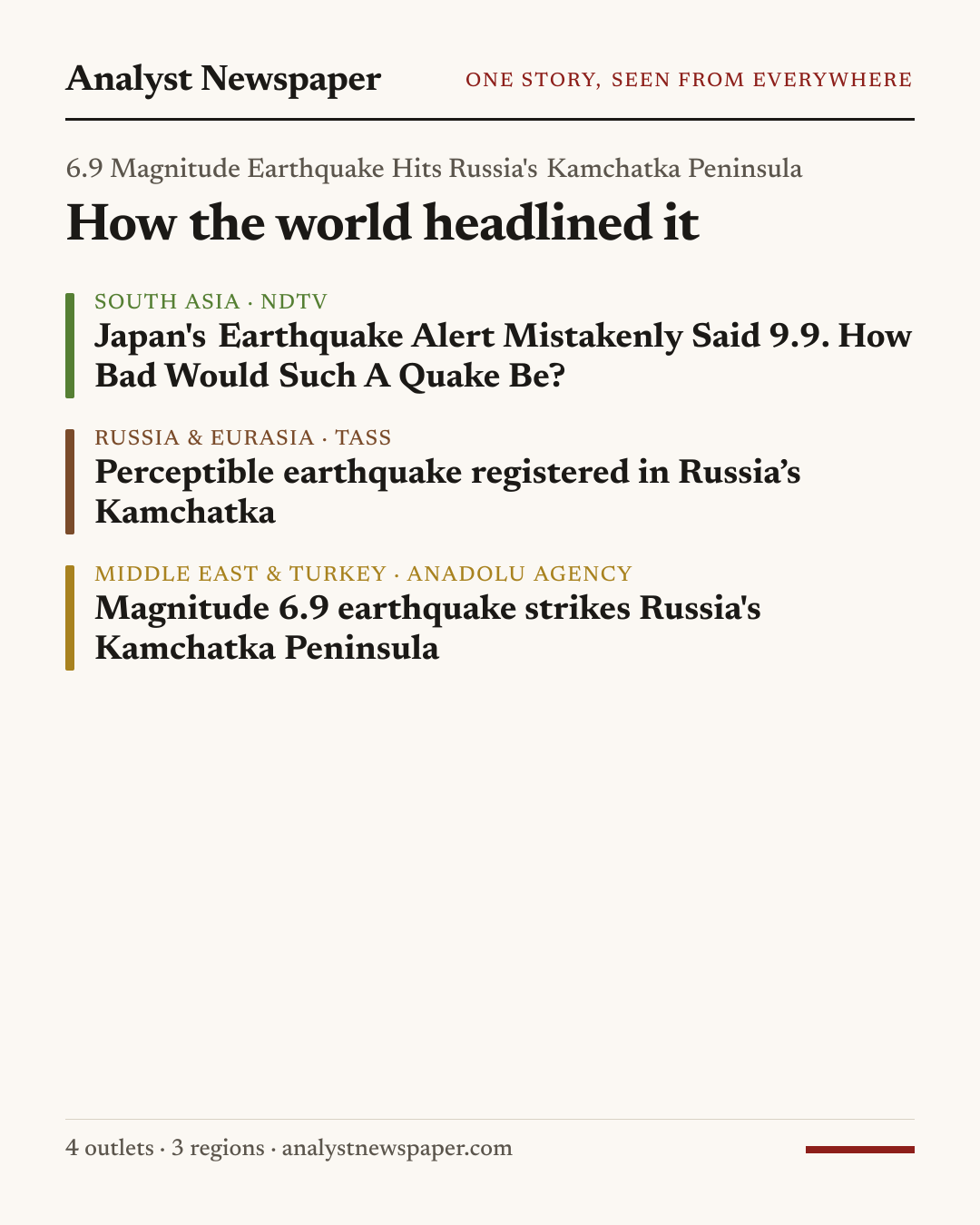
What happened
A magnitude 6.9 earthquake struck the Kamchatka Peninsula in Russia, with some reports specifying the epicenter near Ozernovskiy in the southern part of the peninsula.1346
Scientists initially estimated the quake's magnitude at 6.5 before revising it upward to 6.9, according to TASS and The Hindu.26
Anadolu Agency and Clarín reported that no tsunami warning was issued and no casualties or damage were reported.34
Clarín noted the epicenter's location between the Opala and Ksudach volcanoes and its proximity to the site of an 8.8 magnitude earthquake in the past year, framing the event with concern.3
What's agreed
Reported consistently by outlets in more than one region.
How it's framed
What each perspective puts first, based on headlines and summaries.
| Perspective | How it reads | What it puts first |
|---|---|---|
| Chinese and Russian state mediaEast Asia | CGTN and TASS reported the earthquake in brief, neutral terms, focusing on the magnitude figure and its revision without additional context or alarm.12 | magnitude figure, neutral tone, no elaboration |
| Turkish state mediaMiddle East & Turkey | Anadolu Agency emphasized the absence of tsunami warnings, casualties, or damage, framing the event as contained and non-destructive.4 | no casualties, no damage, no tsunami warning |
| Latin American private pressLatin America | Clarín used alert language and highlighted the quake's proximity to volcanoes and a prior major 8.8 earthquake in the same area, framing the event with heightened concern despite noting no tsunami alert was issued.3 | alert framing, volcanic proximity, recent major quake history, concern |
| South Asian private pressSouth Asia | NDTV and The Hindu took a more analytical and comparative approach, with NDTV using the event context to discuss a separate mistaken 9.9 magnitude alert in Japan and the science of earthquake magnitude, while The Hindu focused on the discrepancy between the quake's measured magnitude and how it was felt locally.56 | scientific explanation, comparison to Japan alert, felt magnitude versus measured magnitude |
What the coverage leaves out
- None of the outlets reviewed reported on any evacuation orders, emergency response, or official statements from Russian authorities.
- None of the outlets reviewed detailed the depth of the earthquake or specific seismological data beyond magnitude.
- None of the outlets reviewed provided information on population or infrastructure near the epicenter.
Why it matters
The quake struck in a seismically active region; Clarín noted the epicenter lies between the Opala and Ksudach volcanoes and in an area that saw a magnitude 8.8 earthquake in the past year.3
Coverage of the event coincided with separate reporting on a mistakenly issued magnitude 9.9 earthquake alert in Japan, which outlets used to discuss seismic risk on the Pacific Ring of Fire.5
Sources (6)
Every outlet we drew on, grouped by where it is based. Read the originals for the full reporting.
Latin America
- 3ClarínARPrivate
Alert: an earthquake of magnitude 6.9 shook southern Kamchatka, in Russia
Translated from Spanish: Alerta: un terremoto de magnitud 6,9 sacudió el sur de Kamchatka, en Rusia
Russia & Eurasia
- 2TASSRUState-controlled
Middle East & Turkey
- 4Anadolu AgencyTRState-controlled
Magnitude 6.9 earthquake strikes Russia's Kamchatka Peninsula
South Asia
East Asia
- 1CGTNCNState-controlled