A year after Gaza ceasefire, strikes and stalemate persist, reports say
A year after the US-backed ceasefire took effect, outlets across regions agree that fighting, displacement and stalled reconstruction persist in Gaza, though they differ sharply in how they describe responsibility and the scale of continued Israeli military action.
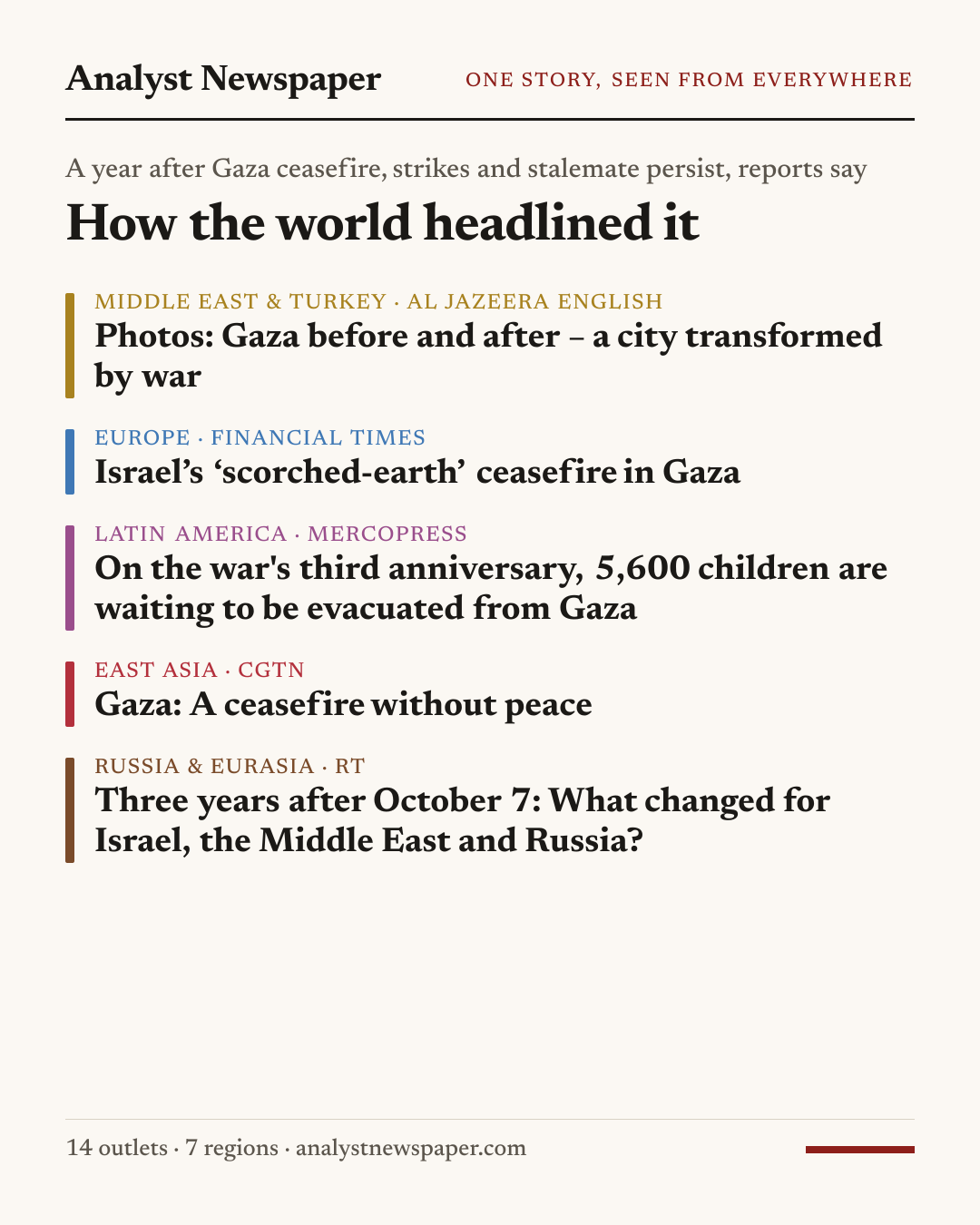
What happened
One year after a US-backed ceasefire took effect in Gaza on October 10, 2025, multiple outlets report that Israeli air strikes and military operations continue, causing ongoing deaths despite the formal truce.121314
Outlets across regions describe Trump's broader plan to end the war as stalled, with Hamas still armed, Israeli forces holding large parts of the territory, and reconstruction barely underway.6891314
Humanitarian conditions remain severe, with the WHO citing overwhelming health needs for nearly 2 million people and thousands of children reported by Gaza's Hamas-run Health Ministry as awaiting medical evacuation.410
Photographic and on-the-ground reporting shows Gaza's urban landscape transformed by three years of war, with residents described as living amid devastation and in cramped tent cities.5811
What's agreed
Reported consistently by outlets in more than one region.
- A year after the ceasefire took hold, Trump's broader plan to end the Gaza war remains stalled, with reconstruction barely underway.6891314
- Israeli forces continue military operations and strikes in Gaza despite the ceasefire, which continue to cause deaths.389121314
- Conditions for Palestinians in Gaza remain dire, with many still living in tent cities and reconstruction blocked.681314
- Israeli forces continue to hold or occupy a large share of Gaza territory.91314
- Three years of war have dramatically transformed Gaza's physical landscape.511
Where accounts differ
Each account is attributed to who makes it. We do not judge between them.
Extent of Israeli territorial control in Gaza
Characterization of Israeli military activity since the ceasefire
Financial Times
Describes Israeli operations as a relentless military campaign under a 'scorched-earth' ceasefire.3
Arab News and Jerusalem Post
Describe near-daily Israeli attacks and fire continuing, with Hamas still armed.1314
BBC News
Reports daily killing of Palestinians despite the ceasefire, per local accounts.8
Responsibility for the stalled peace process
RT, Russian state media
Frames the situation as Netanyahu's military gains failing to secure Israel's future, leaving the region in turmoil.2
CNA
Attributes the stalemate to analysts citing differences over disarmament, Israeli withdrawal and Palestinian statehood, without assigning blame to one side.7
Jerusalem Post
Frames the stall partly around Hamas remaining armed, alongside Israeli forces holding most of Gaza.14
How it's framed
What each perspective puts first, based on headlines and summaries.
| Perspective | How it reads | What it puts first |
|---|---|---|
| Chinese and Russian state mediaEast Asia | Emphasize failure of the ceasefire to produce genuine peace and frame Israeli and US-backed efforts as unsuccessful or destabilizing.12 | prolonged stalemate, Netanyahu's gains have not secured Israel's future, regional turmoil |
| Middle East outletsMiddle East & Turkey | Qatari, Turkish, Saudi and Israeli outlets detail specific terms of the stalled plan, including disarmament, territorial control and humanitarian needs, with Al Jazeera emphasizing visual transformation and Anadolu highlighting WHO humanitarian warnings.5101314 | near-daily attacks, occupation of two-thirds of Gaza, Hamas still armed, overwhelming health needs, unrecognisable urban landscape |
| Western outlets (US and European)North America | US and European coverage focuses on bleak humanitarian conditions, blocked reconstruction, and Netanyahu's domestic political position, often using strong descriptive language about destruction.36811 | war-ravaged, frozen in misery, scorched-earth, stalled US plan, tent cities |
| Latin American outletsLatin America | Brazilian and Uruguayan outlets emphasize ongoing civilian harm, citing UN humanitarian data and specific figures such as children awaiting medical evacuation and daily bombing reports.4912 | daily bombings, UN humanitarian office findings, children awaiting evacuation, peace plan failing to advance |
| Southeast Asian state mediaSoutheast Asia | CNA offers an analytical, relatively neutral framing centered on structural obstacles identified by unnamed analysts rather than attributing blame.7 | disarmament disputes, Israeli withdrawal, Palestinian statehood, elusive peace |
What the coverage leaves out
- None of the outlets reviewed reported detailed casualty figures from the past year of continued strikes, only that deaths continue.
- None of the outlets reviewed reported the Israeli government's official response to allegations of continued strikes or occupation figures.
- None of the outlets reviewed reported Hamas's official position on disarmament or its current military status in detail beyond being described as 'still armed.'
- None of the outlets reviewed provided a detailed account of mediators' (US, Qatar, Egypt) current diplomatic efforts to revive the stalled plan.
Why it matters
The ceasefire followed Hamas's October 7, 2023 attack on Israel, which killed around 1,200 people and saw 251 taken hostage, triggering the war; the ceasefire's initial phase secured release of the last hostages and freedom for hundreds of Palestinian prisoners.413
Analysts cite unresolved differences over disarmament, Israeli withdrawal and Palestinian statehood as factors blocking further progress.7
What to watch
- Whether disputes over Hamas disarmament, Israeli withdrawal and Palestinian statehood are resolved, as cited by analysts as the core obstacles to progress (S7).
- Whether reconstruction efforts in Gaza move forward, which multiple outlets report has barely started (S6, S14).
Sources (14)
Every outlet we drew on, grouped by where it is based. Read the originals for the full reporting.
North America
- 6The Washington PostUSPrivate
War-ravaged Gaza is frozen in misery, a year into Trump’s peace plan
Latin America
- 4MercoPressUYIndependent
On the war's third anniversary, 5,600 children are waiting to be evacuated from Gaza
- 9Agência BrasilBRPublic broadcaster
"Peace plan" for Gaza has daily bombings 3 years after start of war
Translated from Portuguese: "Plano de paz” de Gaza tem bombas diárias 3 anos após início da guerra
- 12Folha de S.PauloBRPrivate
A year after ceasefire, deaths continue in Gaza, and stalemate locks post-war
Translated from Portuguese: Um ano após cessar-fogo, mortes continuam em Gaza, e impasse trava pós-guerra
Europe
- 3Financial TimesGBPrivate
- 8BBC NewsGBPublic broadcaster
- 11France 24FRPublic broadcaster
Devastation in Gaza: Three years of war reshape the enclave beyond recognition
Russia & Eurasia
- 2RTRUState-controlled
Three years after October 7: What changed for Israel, the Middle East and Russia?
Middle East & Turkey
- 5Al Jazeera EnglishQAState-controlled
- 10Anadolu AgencyTRState-controlled
WHO urges 'constant and uninterrupted flow of supplies’ into Gaza
- 13Arab NewsSAPrivate
One year on, Trump’s Gaza plan has not stopped Israeli fire or disarmed Hamas
- 14The Jerusalem PostILPrivate
One year on, Trump's Gaza plan has not stopped Israeli fire or disarmed Hamas - explainer
East Asia
- 1CGTNCNState-controlled
Southeast Asia
- 7CNASGState-controlled