AI Deepfakes and Chatbots Raise Election Integrity Concerns in Israel
German and French outlets highlight the unprecedented scale of AI-generated deepfakes in Israel's election campaign, while an Israeli outlet argues authorities are overlooking a bigger threat from AI chatbots. Similar concerns about AI's role in elections are also being raised in Nigeria and Taiwan.
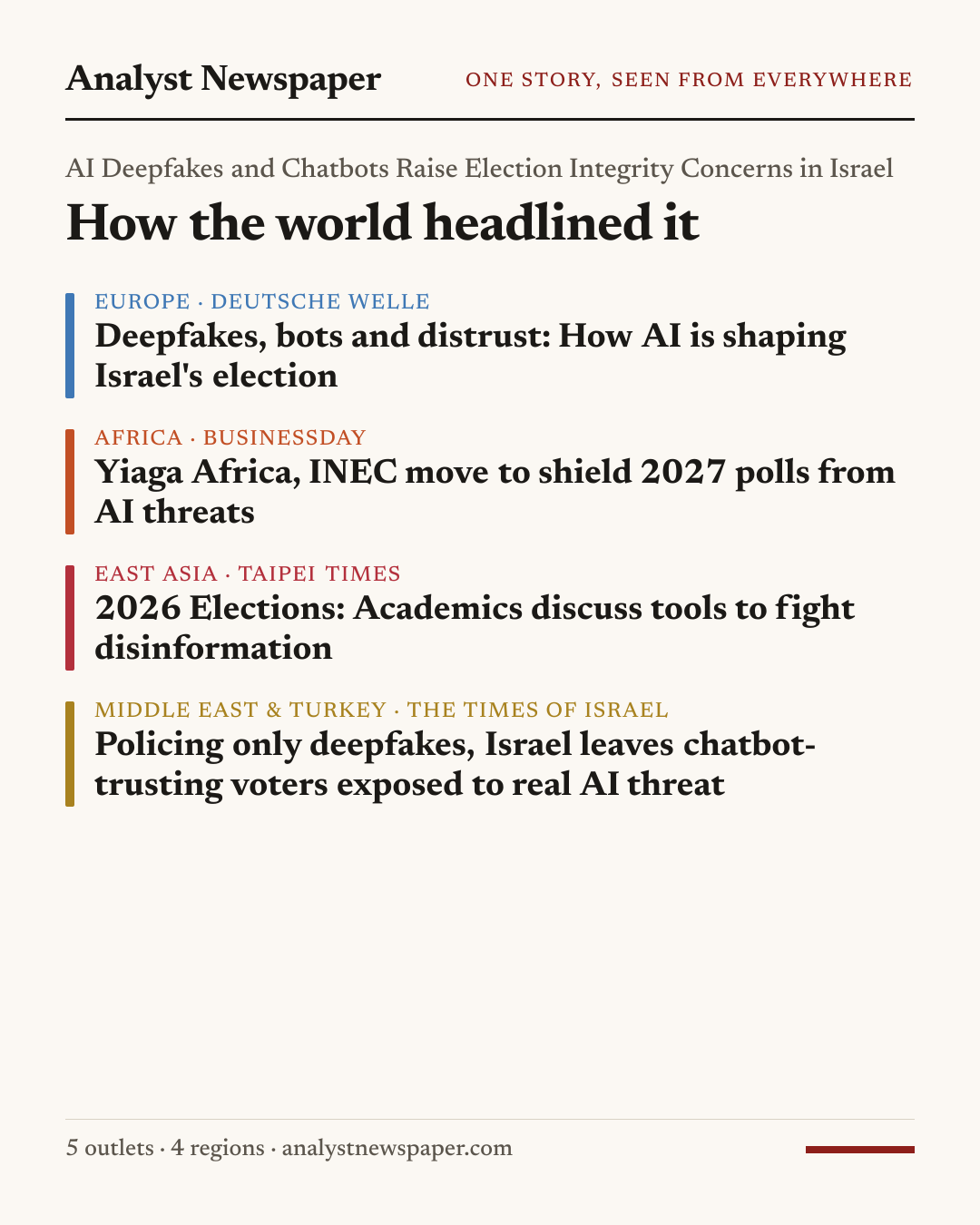
What happened
Ahead of Israel's October 27 legislative election, AI-generated deepfakes are being used by competing political parties at a scale described as unprecedented in Israeli politics.5
Deutsche Welle reports that AI is playing a major role in Israel's election for the first time, with observers warning that deepfakes, bots and influence campaigns could sway voters.3
The Times of Israel reports that while Israeli authorities are focused on policing deepfake videos, experts warn that AI chatbots such as ChatGPT and Gemini pose a greater and less monitored risk, capable of swaying opinions, suppressing turnout, and fueling claims that the vote lacks legitimacy.4
Concerns about AI's role in elections extend beyond Israel, with Nigerian electoral authorities and civil society planning defenses against AI threats ahead of 2027 polls, and Taiwanese academics discussing disinformation countermeasures ahead of 2026 elections.12
What's agreed
Reported consistently by outlets in more than one region.
Where accounts differ
Each account is attributed to who makes it. We do not judge between them.
Which AI threat poses the greatest risk to Israeli voters
Israeli authorities, as described by The Times of Israel
Authorities are focused on policing deepfakes (fake videos) as the primary AI threat.4
Experts cited by The Times of Israel
Chatbots like ChatGPT and Gemini pose a greater, underappreciated risk than deepfakes, capable of swaying opinions, suppressing turnout, and undermining perceptions of vote legitimacy.4
Deutsche Welle, citing unnamed observers
Deepfakes, bots and influence campaigns collectively are highlighted as the key threats to voter influence in Israel's election.3
How it's framed
What each perspective puts first, based on headlines and summaries.
| Perspective | How it reads | What it puts first |
|---|---|---|
| European outletsEurope | Both German and French coverage emphasize the unprecedented scale and novelty of AI deepfake use across Israel's political spectrum, framing it as a significant new phenomenon in the election.35 | unprecedented scale, deepfakes flooding campaign, all parties involved |
| Israeli domestic outletMiddle East & Turkey | The Times of Israel frames the story around a critique of authorities' response, arguing the focus on deepfakes misses a more pervasive and harder-to-detect threat from AI chatbots.4 | chatbot vulnerability, policy gap, real AI threat vs policed threat |
| African electoral stakeholdersAfrica | Nigerian coverage focuses on proactive institutional preparation, with INEC and civil society groups like Yiaga Africa planning defenses against AI threats ahead of 2027 polls, rather than reporting on an ongoing campaign.1 | institutional preparedness, dedicated AI division, future threat prevention |
| East Asian academic coverageEast Asia | Taiwanese coverage centers on academic discussion of disinformation countermeasures ahead of 2026 elections, in a more neutral, forward-looking register compared to the alarmed tone seen in coverage of Israel.2 | academic debate, disinformation tools, forward planning |
What the coverage leaves out
- None of the outlets reviewed specify which Israeli parties or candidates are responsible for producing the deepfakes described.
- None of the outlets reviewed report on any official Israeli government or electoral commission response to the chatbot threat raised by The Times of Israel.
- None of the outlets reviewed provide data on how many voters have been exposed to or influenced by AI-generated content in Israel's election.
- None of the outlets reviewed detail what specific policies or detection measures Israeli authorities have implemented against deepfakes.
Why it matters
Observers and experts warn that AI tools could sway voters, suppress turnout, or be used to challenge the legitimacy of the vote, raising concerns about election integrity beyond Israel, as seen in parallel AI-related election preparations in Nigeria and Taiwan.3412
What to watch
- Whether Israeli authorities expand their response beyond deepfakes to address chatbot-related risks before the October 27 vote.
- How Nigeria's INEC develops its planned dedicated AI division ahead of the 2027 polls.
- Outcomes of academic discussions in Taiwan on disinformation tools ahead of the 2026 elections.
Sources (5)
Every outlet we drew on, grouped by where it is based. Read the originals for the full reporting.
Europe
- 3Deutsche WelleDEPublic broadcaster
Deepfakes, bots and distrust: How AI is shaping Israel's election
- 5Le MondeFRPrivate
Legislative elections in Israel: candidates flood the campaign with AI-generated 'deepfakes'
Translated from French: Elections législatives en Israël : les candidats inondent la campagne de « deepfakes » générés par l’IA
Middle East & Turkey
- 4The Times of IsraelILPrivate
Policing only deepfakes, Israel leaves chatbot-trusting voters exposed to real AI threat
Africa
- 1BusinessDayNGPrivate
Yiaga Africa, INEC move to shield 2027 polls from AI threats
East Asia
- 2Taipei TimesTWPrivate
2026 Elections: Academics discuss tools to fight disinformation