Alberta voters reject move toward independence from Canada
Albertans voted by a wide margin to stay in Canada in the province's first referendum on separation, a result reported worldwide as a win for Prime Minister Mark Carney, though outlets differ on how they frame the vote's wider significance.
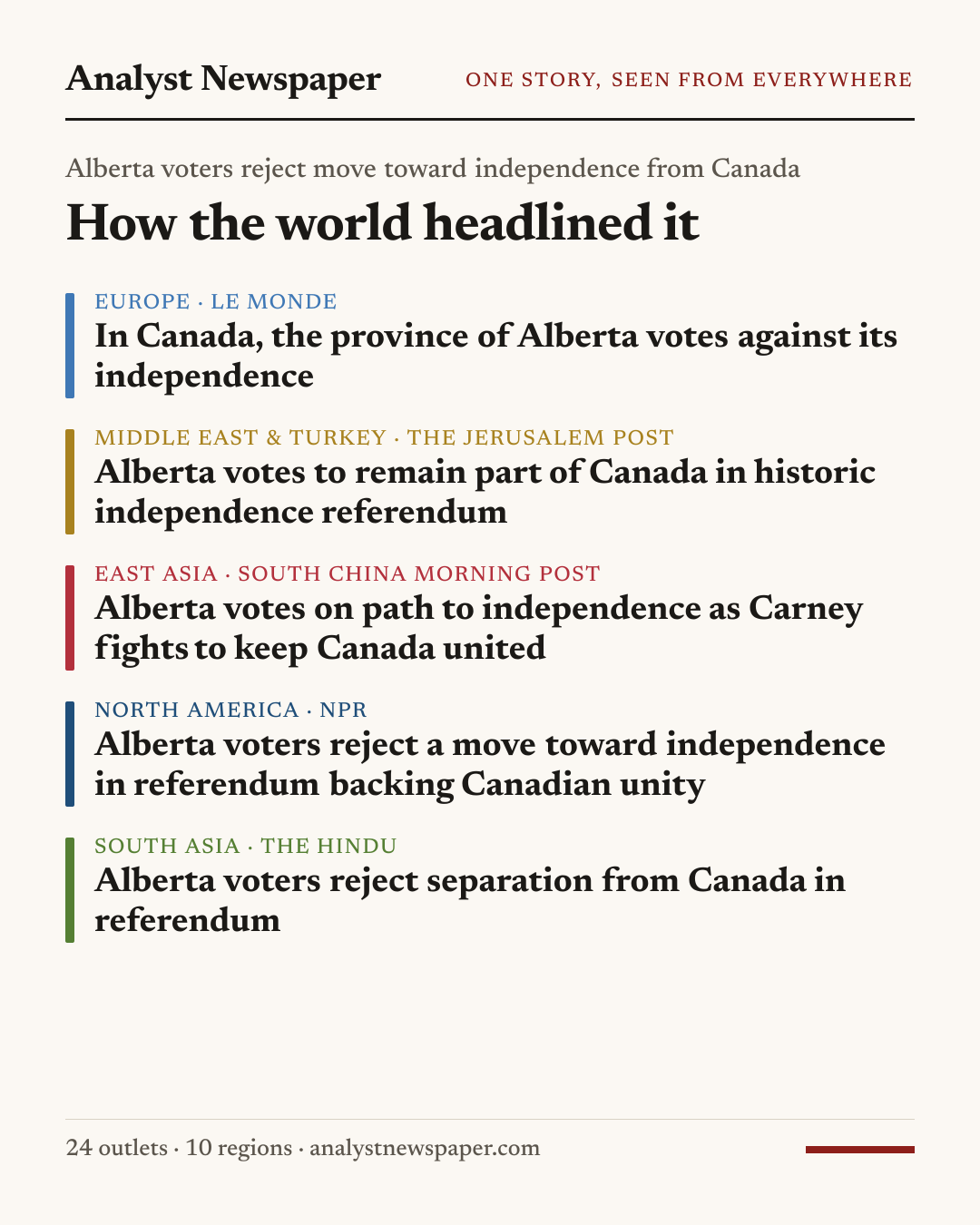
What happened
Alberta held a referendum Monday on its future within Canada, its first-ever vote on the question of separation; sources describe the precise ballot question somewhat differently.15222
Early and projected results showed about 76 percent of voters supported remaining in Canada, with roughly a quarter backing a move toward separation.349121319
The referendum was nonbinding, and the vote was widely reported as a victory for Prime Minister Mark Carney and supporters of Canadian unity.61972124
Coverage linked the vote to the broader context of a US trade war and President Donald Trump's remarks about Canada becoming the 51st US state.258
What's agreed
Reported consistently by outlets in more than one region.
- Alberta held its first-ever referendum on separation on Monday.1522
- About 76 percent of voters supported remaining in Canada, according to counted votes and projections.349121319
- The referendum was nonbinding.61920
- Outlets across multiple regions described the result as a win for Prime Minister Mark Carney and Canadian unity.721824
- Alberta is an oil-rich province.267
- Pre-vote polling consistently showed a majority of Albertans opposed separation.1517
Where accounts differ
Each account is attributed to who makes it. We do not judge between them.
What exactly the referendum asked voters to decide
South China Morning Post
The vote was not a direct referendum on independence but on whether to begin a legal process that could lead to a future independence decision.2
The New York Times
Voters were asked whether to remain in Canada or hold another vote on breaking away.14
El País
Voters were deciding whether to reject holding a future consultation on the province's secession.12
RTÉ News
Alberta rejected a plan to hold a binding independence referendum.18
Exact vote percentage for remaining in Canada
TASS, citing Canadian TV
76.4% of voters supported staying in Canada.3
El País
76.5% of voters rejected holding a future secession consultation.12
Anadolu Agency, citing CBC News projections
76.2% support for remaining in Canada.19
The Hindu and Al Jazeera English
About 76% supported remaining in Canada, with about 23% backing a process toward separation, based on more than one million votes counted.913
Le Monde
More than 75% of voters voted to keep Alberta within Canada.4
Political backing of the separatist side
How it's framed
What each perspective puts first, based on headlines and summaries.
| Perspective | How it reads | What it puts first |
|---|---|---|
| NPR (US public broadcaster)North America | Reports the result straightforwardly as a rejection of independence and a victory for Canadian unity, without reference to Trump or separatist backers.7 | victory for unity, setback for separatists |
| RTÉ News (Irish public broadcaster)Europe | Frames the separatist push as backed by allies of US President Donald Trump, a detail not found in other outlets reviewed.18 | setback for separatists, Trump-aligned backers |
| State-controlled outlets reporting vote figuresRussia & Eurasia | TASS and Anadolu Agency report the vote largely as a factual result with specific percentages, with minimal interpretive framing about Carney or Trump.319 | vote percentages, nonbinding status, projections |
| European outletsEurope | Contextualize the vote against Quebec's separatist history or frame it as a split outcome, noting separatist leaders' vow to continue despite defeat.424 | comparison to Quebec, separatist resentment toward Ottawa, continued separatist defiance |
| Outlets covering Trump/trade war context (Hong Kong, Brazil, Australia)East Asia | Frame the referendum within the broader story of US trade pressure and Trump's annexation remarks, presenting the vote as part of Canada's response to external threats; outlets span multiple regions rather than one.258 | Trump trade war, 51st state threats, national unity under pressure |
| South Asian outletsSouth Asia | Focus on vote mechanics and figures, including the referendum's multiple ballot questions and polling trends ahead of the vote.91521 | vote percentages, ballot questions, polling trends |
What the coverage leaves out
- None of the outlets reviewed reported detailed reaction from Alberta's provincial government or premier beyond general references to separatist leaders.
- None of the outlets reviewed explained in detail what the legal process toward separation would have involved had the vote succeeded.
- None of the outlets reviewed provided demographic or regional breakdowns of how different parts of Alberta voted.
- None of the outlets reviewed detailed the specific nature of the alleged ties between separatist leaders and Trump allies beyond RTÉ News's claim.
Why it matters
The vote took place amid a US trade war and remarks by President Trump about Canada becoming the 51st US state, which several outlets linked to the unity debate.258
Alberta holds most of Canada's proven oil reserves, described as the fourth largest in the world, which some coverage tied to the province's economic leverage in the separation debate.2
Alberta's separatist movement was described as distinct from Quebec's longer-running independence debate, which has recently returned to political discussion.4
What to watch
- Whether separatist leaders in Alberta continue organizing despite the referendum defeat.
- Whether divisions within Alberta's governing UCP party over the separation issue develop further.
Sources (24)
Every outlet we drew on, grouped by where it is based. Read the originals for the full reporting.
North America
- 7NPRUSPublic broadcaster
Alberta voters reject a move toward independence in referendum backing Canadian unity
- 14The New York TimesUSPrivate
- 20Fox NewsUSPrivate
Alberta holds non-binding separation vote as independence fight grips Canada
Latin America
- 5Folha de S.PauloBRPrivate
Canadian Prime Minister says external threats attempt to divide country before vote on independence
Translated from Portuguese: Premiê do Canadá diz que ameaças externas tentam dividir país antes de votação sobre independência
Europe
- 4Le MondeFRPrivate
In Canada, the province of Alberta votes against its independence
Translated from French: Au Canada, la province de l’Alberta vote contre son indépendance
- 12El PaísESPrivate
Alberta citizens vote in referendum to remain in Canada
Translated from Spanish: Los ciudadanos de Alberta votan en referéndum permanecer en Canadá
- 18RTÉ NewsIEPublic broadcaster
- 22Sky NewsGBPrivate
- 24EuronewsFRPrivate
‘Albertans chose Canada’: Carney hails vote to reject referendum
Russia & Eurasia
- 3TASSRUState-controlled
Middle East & Turkey
- 6The Jerusalem PostILPrivate
Alberta votes to remain part of Canada in historic independence referendum
- 13Al Jazeera EnglishQAState-controlled
Alberta voters reject separation from Canada, early results show
- 19Anadolu AgencyTRState-controlled
Canada's Alberta votes to remain in federation, projections show
- 23Arab NewsSAPrivate
Carney campaigns for Canadian unity before Alberta secession vote
Africa
- 1Daily MaverickZAIndependent
South Asia
- 9The HinduINPrivate
- 15DawnPKPrivate
What does Alberta's referendum on separation from Canada mean?
- 21The Economic TimesINPrivate
East Asia
- 2South China Morning PostHKPrivate
Alberta votes on path to independence as Carney fights to keep Canada united
- 11Taipei TimesTWPrivate
- 17The Japan TimesJPPrivate
Alberta votes on leaving Canada, separatist movement likely to outlast expected defeat
Southeast Asia
- 10The Straits TimesSGPrivate
- 16CNASGState-controlled
Vote count begins in Alberta secession referedum, testing Canada unity
Oceania
- 8The Sydney Morning HeraldAUPrivate
‘Albertans chose Canada’: Voters reject move towards independence in victory for Carney