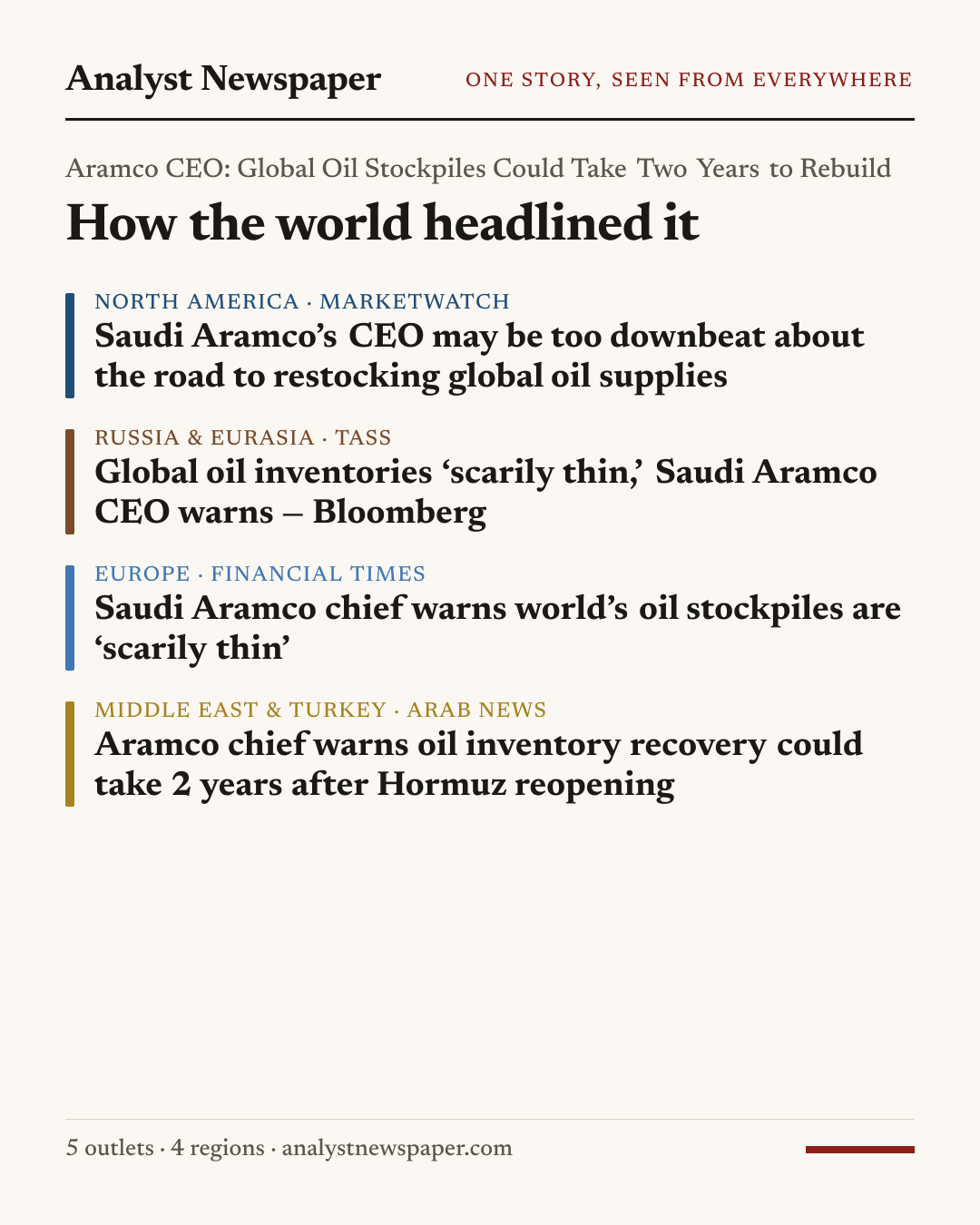
Aramco CEO: Global Oil Stockpiles Could Take Two Years to Rebuild
Saudi Aramco's chief warned that global oil stockpiles are critically low, but some analysts and outlets questioned how dire the outlook really is.
What happened
Saudi Aramco CEO Amin Nasser said global oil inventories are critically low and that rebuilding them could take up to two years.125
Nasser, speaking at the Energy Intelligence Forum in London, linked the depletion to Middle East conflict and said full recovery depends on the Strait of Hormuz reopening and market confidence returning.3
CNBC reported Nasser's warning that the inventory squeeze could worsen if the U.S.-Iran war continues.5
MarketWatch reported that some observers consider Nasser's outlook too pessimistic, pointing to record oil production and alternative delivery routes.4
What's agreed
Reported consistently by outlets in more than one region.
Where accounts differ
Each account is attributed to who makes it. We do not judge between them.
How severe the oil inventory shortage is and how long recovery will take
Saudi Aramco CEO Amin Nasser, via TASS, Financial Times, Arab News and CNBC
Global oil inventories are scarily thin and depleted by Middle East conflict, with rebuilding taking up to two years and potentially worsening amid the U.S.-Iran war.1235
Unnamed market observers, via MarketWatch
Nasser's outlook may be too downbeat given record oil production and the availability of alternative delivery routes once the Strait of Hormuz fully reopens.4
What triggers or conditions the inventory rebuilding timeline
Arab News account of Amin Nasser's remarks
The two-year rebuilding timeline is tied to the Strait of Hormuz fully reopening and market confidence returning.3
CNBC account of Amin Nasser's remarks
The inventory squeeze could worsen the longer the U.S.-Iran war continues, without specifying Hormuz reopening as a precondition.5
How it's framed
What each perspective puts first, based on headlines and summaries.
| Perspective | How it reads | What it puts first |
|---|---|---|
| Russian state-controlled mediaRussia & Eurasia | TASS relays Bloomberg's reporting on Nasser's warning with emphasis on the alarming characterization of inventory levels and rising consumption.1 | scarily thin inventories, rising global consumption, two-year replenishment need |
| European financial pressEurope | Financial Times frames the story around Middle East conflict as the direct cause of inventory depletion.2 | conflict-driven depletion, two-year rebuilding timeline |
| Middle East-based outletMiddle East & Turkey | Arab News provides the most detailed account, tying the timeline to Strait of Hormuz reopening and Nasser's call for international coordination on energy resilience.3 | Strait of Hormuz reopening, market confidence, government-industry alignment, energy resilience |
| US financial and business pressNorth America | US outlets present a mixed picture: CNBC emphasizes the warning and its link to the ongoing U.S.-Iran war, while MarketWatch features skepticism about how pessimistic Nasser's assessment is, citing production levels and alternative routes.45 | U.S.-Iran war impact, record oil production, alternative delivery routes, skepticism of downbeat outlook |
What the coverage leaves out
- None of the outlets reviewed reported specific inventory figures or data supporting the 'scarily thin' characterization.
- None of the outlets reviewed detailed which alternative delivery routes MarketWatch's sources refer to.
- None of the outlets reviewed reported a response from governments or other oil producers to Nasser's call for alignment.
- None of the outlets reviewed clarified the current status of the Strait of Hormuz at the time of Nasser's remarks.
Why it matters
The comments come as conflict in the Middle East, including reported disruption around the Strait of Hormuz, has affected oil supply routes and global inventory levels.235
What to watch
- Whether the Strait of Hormuz fully reopens and its effect on oil supply routes
- Developments in the U.S.-Iran conflict and its impact on oil markets
- Whether governments and oil suppliers respond to Nasser's call for closer alignment
Sources (5)
Every outlet we drew on, grouped by where it is based. Read the originals for the full reporting.
North America
Europe
- 2Financial TimesGBPrivate
Saudi Aramco chief warns world’s oil stockpiles are ‘scarily thin’
Russia & Eurasia
- 1TASSRUState-controlled
Global oil inventories ‘scarily thin,’ Saudi Aramco CEO warns — Bloomberg