China proposes export controls on AI, biomedicine and solar technologies
Beijing has proposed draft export controls on dozens of strategic technologies, including AI, biomedicine and solar manufacturing. Outlets differ in whether they frame the move as a shift in China's tech policy, a national security measure, or a challenge to rivals' industrial ambitions.
What happened
China has unveiled draft export controls covering roughly 40 strategic technology systems, including AI chips, large language models, biomedicine and solar-manufacturing technology.356
Beijing said the controls are intended to curb misuse of the technologies, while most items would still be exportable with simplified licensing.3
The move comes as the US-China trade truce is described as fraying, and as countries such as India attempt to build domestic manufacturing capacity to reduce reliance on China.34
What's agreed
Reported consistently by outlets in more than one region.
- China has proposed new draft export controls covering strategic technologies including artificial intelligence, biomedicine and solar manufacturing.123456
- The proposed rules would give Beijing oversight of around 40 technology systems, including roughly 23 linked to AI such as chips and large language models.36
- Solar-manufacturing technology is among the areas targeted by the proposed export controls.1348
Where accounts differ
Each account is attributed to who makes it. We do not judge between them.
The primary motivation behind the export controls
China, via The National
The controls are aimed at curbing misuse of the technology.3
Analysts, via The Hindu
China is seeking to preserve its dominance in solar manufacturing as countries like India build domestic capacity.4
The Express Tribune
China is citing national security and the growing use of solar technology in aerospace and defence.8
Financial Times
The restrictions reflect Beijing's determination to prevent transfer of its most advanced technology overseas.5
How it's framed
What each perspective puts first, based on headlines and summaries.
| Perspective | How it reads | What it puts first |
|---|---|---|
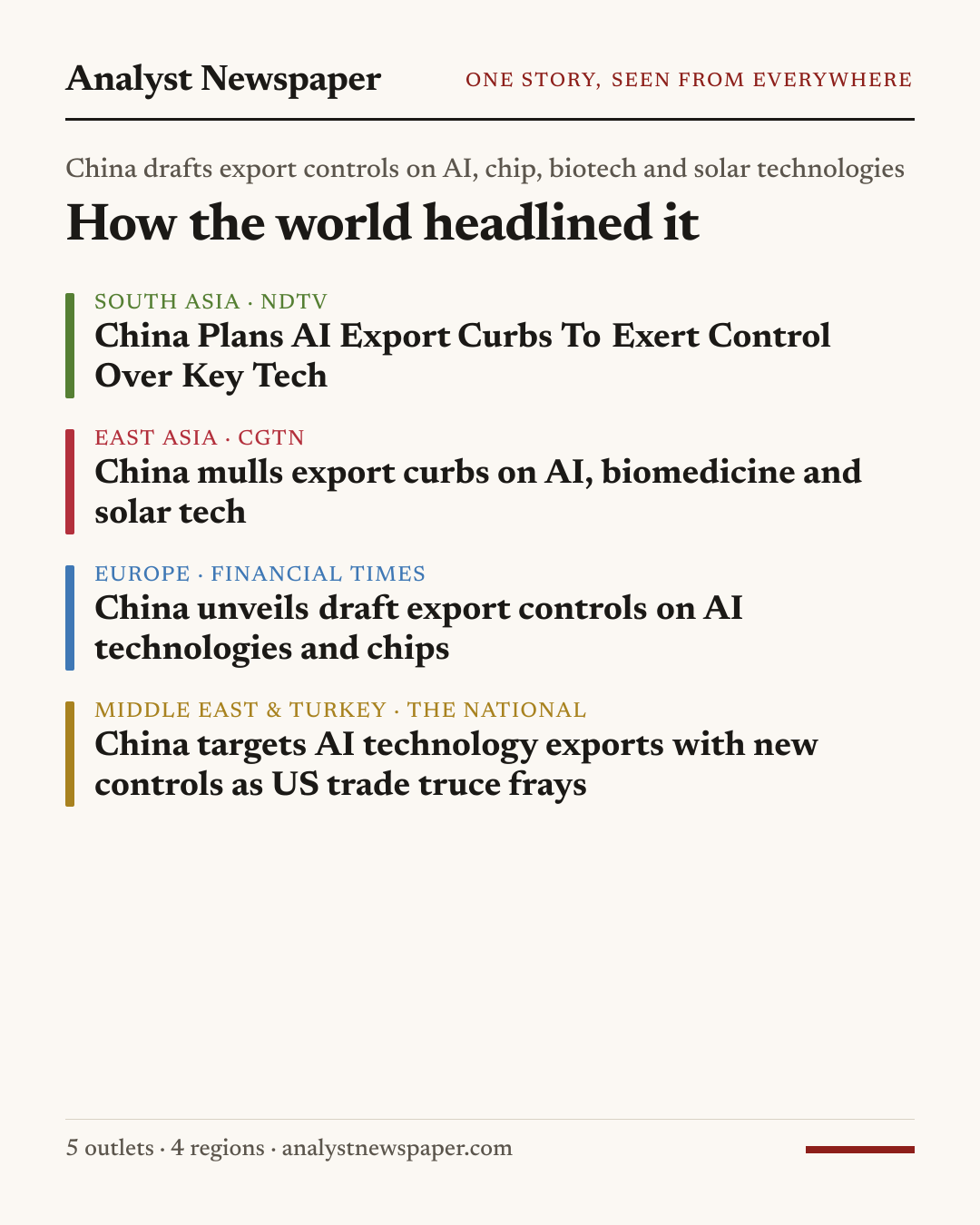
| Chinese state mediaEast Asia | Presents the proposed export curbs as a straightforward policy consideration spanning AI, biomedicine and solar technology, without framing it in terms of rivalry or dominance.1 | policy consideration, technology scope |
| European outletsEurope | Frame the move as a notable shift in China's stance, from an open approach to AI toward tighter control, and link it to Beijing's broader determination to prevent advanced technology transfer.25 | policy shift, technology control, AI and chips |
| Middle East-based outletMiddle East & Turkey | Emphasizes the scale of the controls (40 technologies, 23 AI-linked) and situates them within fraying US-China trade relations and deepening rivalry.3 | scale of controls, US-China trade truce, rivalry |
| South Asian outletsSouth Asia | Focus heavily on the solar-manufacturing dimension and its implications for countries like India trying to reduce reliance on Chinese supply chains, while some also cover the broader 40-technology scope and national security justification.4678 | solar manufacturing, India's domestic industry, national security, defence applications |
What the coverage leaves out
- None of the outlets reviewed reported a timeline for when the draft rules might take effect or go through further revision.
- None of the outlets reviewed reported detailed reactions from the US government or other foreign governments to the proposed controls.
- None of the outlets reviewed reported specific examples of licensing simplification mentioned by The National beyond the general statement that most technologies could still be exported.
Why it matters
The draft rules come as China's trade truce with the United States is described as fraying, raising questions about how the controls might affect US-China technology relations.3
India is seeking to build up domestic solar manufacturing and reduce reliance on China, giving the proposed curbs particular relevance for South Asian coverage.4
What to watch
- Whether the draft export control rules are finalized and how broadly they are applied.
- Any response from the United States or other trading partners to the proposed controls.
- How countries such as India adjust domestic manufacturing plans in response to potential solar technology export restrictions.
Sources (8)
Every outlet we drew on, grouped by where it is based. Read the originals for the full reporting.
Europe
- 2Le MondeFRPrivate
China wants to control the export of its AIs abroad
Translated from French: La Chine veut contrôler la sortie de ses IA à l’étranger
- 5Financial TimesGBPrivate
China unveils draft export controls on AI technologies and chips
Middle East & Turkey
- 3The NationalAEPrivate
China targets AI technology exports with new controls as US trade truce frays
South Asia
- 4The HinduINPrivate
China proposes export controls on solar-manufacturing technologies
- 6NDTVINPrivate
- 7The Economic TimesINPrivate
- 8The Express TribunePKPrivate
China proposes export controls on solar-manufacturing technologies
East Asia
- 1CGTNCNState-controlled