Colombia deploys troops to Santa Marta after armed group's retaliation over leader's killing
Coverage agrees troops were sent to Santa Marta after an armed group's retaliation for a leader's killing, but outlets differ on how much emphasis to place on the president's broader security strategy versus the immediate threat.
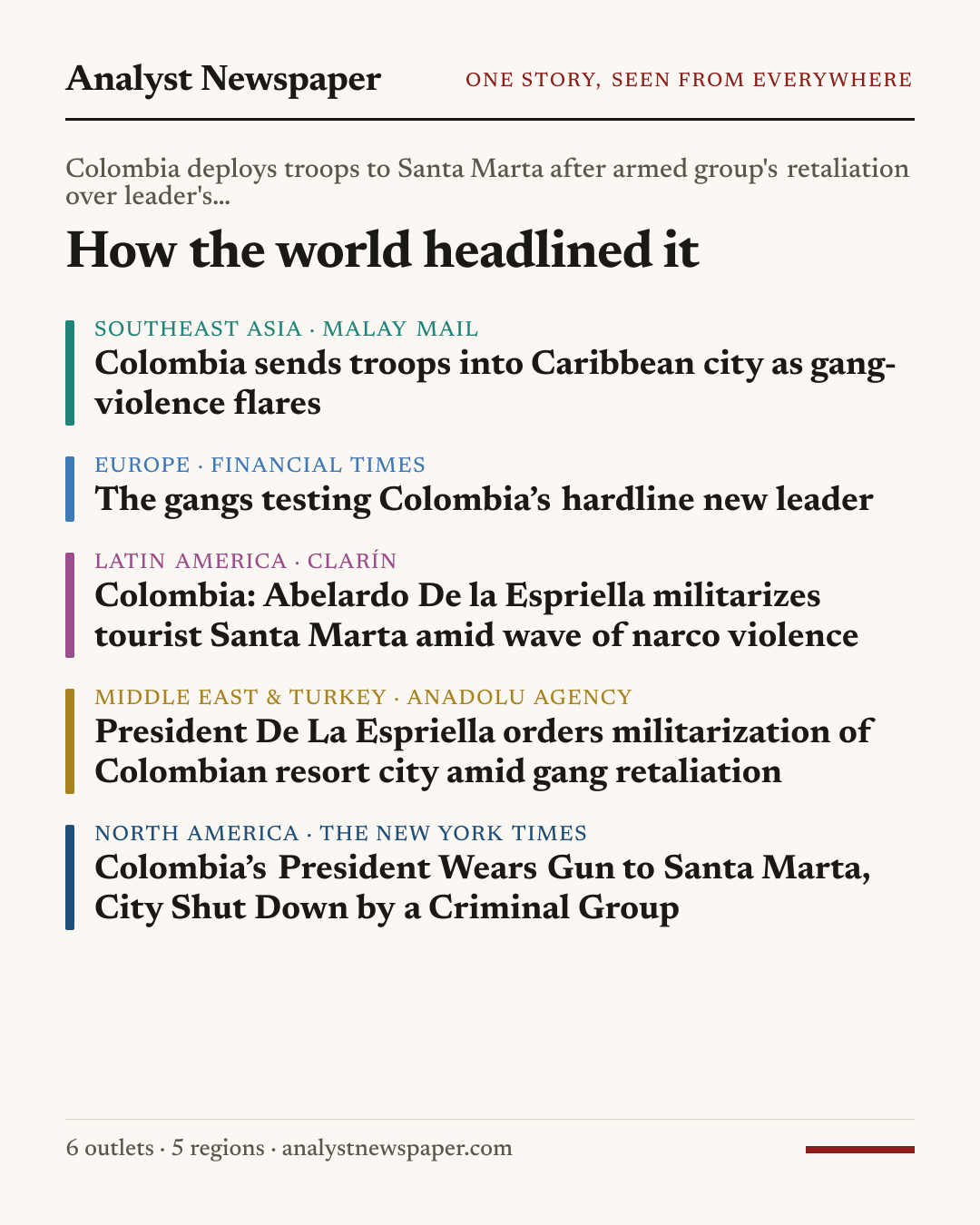
What happened
Colombian President Abelardo De La Espriella ordered troops into Santa Marta, a Caribbean tourist city, after an armed group carried out retaliatory threats and attacks following the killing of one of its leaders.23456
According to the New York Times, state forces killed the leader; other outlets reported the killing as the trigger for retaliation without specifying who was responsible.46
The retaliation, described by some outlets as an 'armed strike', shut down businesses and transportation and left the city at a standstill, with some reports calling it a 'ghost town'.136
The New York Times reported that the president visited the city armed, while the Financial Times linked the unrest to his broader departure from his predecessor's 'total peace' policy toward armed groups.14
What's agreed
Reported consistently by outlets in more than one region.
- President Abelardo De La Espriella ordered troops or army deployment into Santa Marta, a Caribbean tourist city.2345
- An armed group carried out retaliatory action, including threats against businesses and transportation, after one of its leaders was killed.346
- The retaliation brought Santa Marta to a standstill, with deserted or shut-down streets and businesses.136
Where accounts differ
Each account is attributed to who makes it. We do not judge between them.
Characterization of the perpetrating group
Anadolu Agency
Described as a 'criminal gang' whose commander was killed, prompting a 'gang retaliation'.3
The New York Times and The Straits Times
Described as an 'armed group' or 'illegal armed group' rather than framed primarily as a gang.46
Clarín
Described the situation as 'narco violence' tied to attacks on businesses.2
Cause of the violence
Financial Times
Frames the violence as testing the new president's hardline approach after he abandoned the 'total peace' strategy of his predecessor, adding broader policy context alongside the immediate trigger.1
How it's framed
What each perspective puts first, based on headlines and summaries.
| Perspective | How it reads | What it puts first |
|---|---|---|
| European financial pressEurope | Situates the crisis within a broader narrative about the new Colombian president's hardline security policy and departure from his predecessor's peace strategy, describing gangs as testing the new leader.1 | hardline leadership, abandoned total peace, testing the new leader |
| Latin American pressLatin America | Emphasizes the militarization order and its direct link to attacks on businesses causing terror among residents and tourists.2 | militarization, narco violence, terror among residents and tourists |
| Middle East state mediaMiddle East & Turkey | State-controlled outlet frames the story around gang retaliation and militarization, emphasizing the killing of a top commander as the trigger.3 | gang retaliation, militarization, armed strike |
| North American pressNorth America | Focuses on the president's personal, armed presence in the city and framing the situation as a criminal group's control over urban space.4 | president wore gun, city shut down, criminal group control |
| Southeast Asian pressSoutheast Asia | Reports the troop deployment and standstill in largely neutral, factual terms, citing gang violence or armed group threats without strong framing toward policy or symbolism.56 | troop deployment, standstill, threats to businesses |
What the coverage leaves out
- None of the outlets reviewed reported the name of the armed group or gang involved.
- None of the outlets reviewed detailed the government's broader security policy beyond references to abandoning 'total peace'.
- None of the outlets reviewed reported casualty figures beyond the killing of the group's leader.
- None of the outlets reviewed reported reactions from residents, business owners, or tourists directly.
Why it matters
Sources (6)
Every outlet we drew on, grouped by where it is based. Read the originals for the full reporting.
North America
- 4The New York TimesUSPrivate
Colombia’s President Wears Gun to Santa Marta, City Shut Down by a Criminal Group
Latin America
- 2ClarínARPrivate
Colombia: Abelardo De la Espriella militarizes tourist Santa Marta amid wave of narco violence
Translated from Spanish: Colombia: Abelardo De la Espriella militariza la turística Santa Marta ante la ola de violencia narco
Europe
- 1Financial TimesGBPrivate
Middle East & Turkey
- 3Anadolu AgencyTRState-controlled
President De La Espriella orders militarization of Colombian resort city amid gang retaliation
Southeast Asia
- 5Malay MailMYPrivate
Colombia sends troops into Caribbean city as gang-violence flares
- 6The Straits TimesSGPrivate
Threats from armed group bring Colombia's Santa Marta to standstill