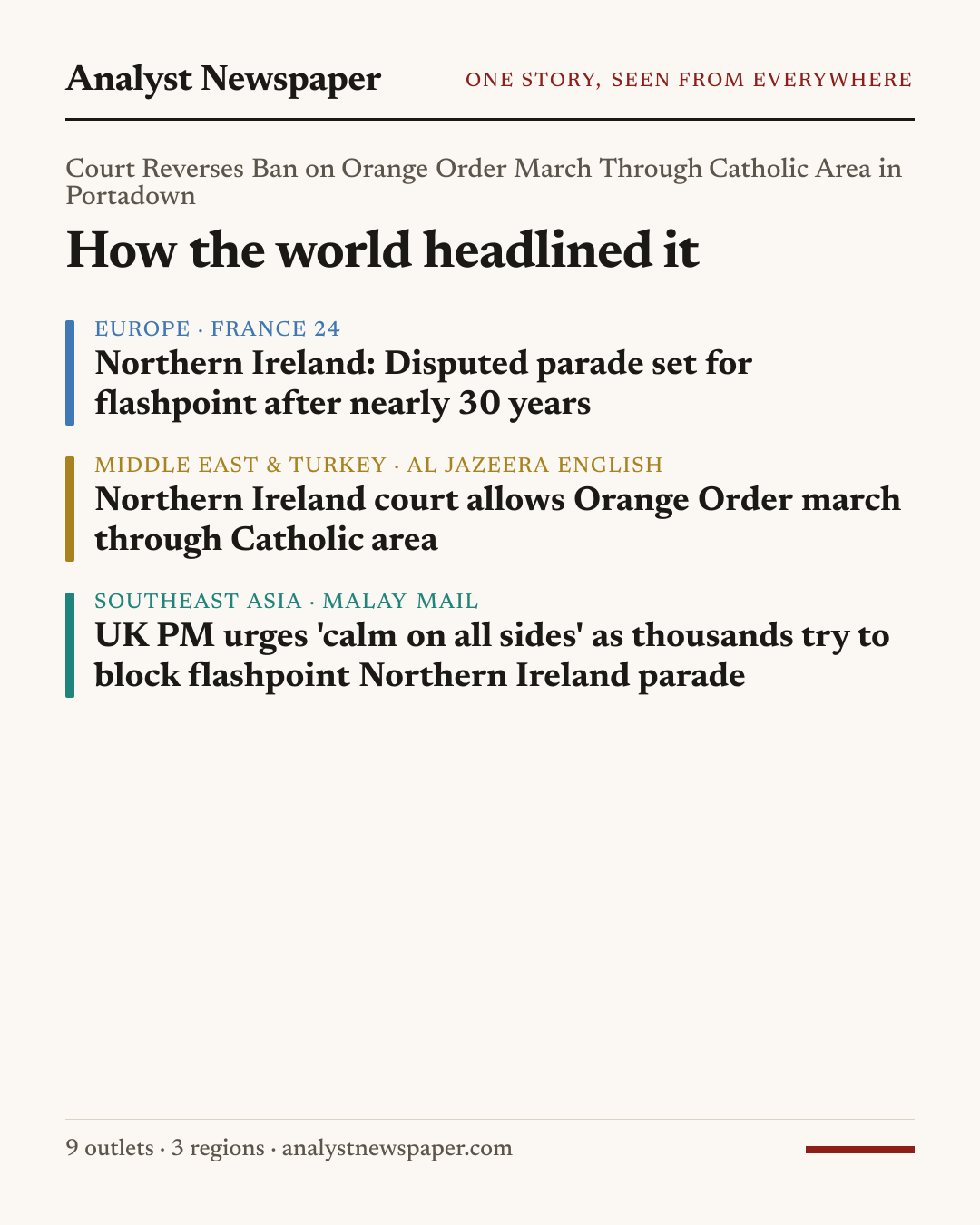
Court Reverses Ban on Orange Order March Through Catholic Area in Portadown
A last-minute legal battle over an Orange Order march through a Catholic area of Portadown ended with an appeals court overturning a ban, reviving a decades-old sectarian flashpoint.
What happened
Northern Ireland's courts allowed an Orange Order parade to proceed through the Garvaghy Road area of Portadown, a mainly Catholic neighborhood, after an appeals court overturned a temporary injunction against it.4567
The ruling came after a high court judge had initially blocked the march, warning of the risk of sectarian violence, before the Lady Chief Justice found that decision had erred in law.87
The parade marked the first time in almost 30 years that marchers were permitted along this contested route, linked to the long-running Drumcree dispute of the 1990s.1
UK Prime Minister Andy Burnham urged calm as thousands of people gathered to protest the ruling, with police working to separate marchers and counterprotesters.3812
What's agreed
Reported consistently by outlets in more than one region.
- Northern Ireland's courts ultimately allowed a Protestant/Orange Order parade to proceed through the Garvaghy Road area of Portadown, a mainly Catholic/nationalist area, reversing an earlier injunction against it.1245679
- The route has historically been a flashpoint for sectarian tension, linked to the Drumcree parade disputes dating back to the mid-1990s that led to unrest.16
- A high court judge had initially granted a temporary injunction blocking the march, citing fears of sectarian violence.847
- An appeal court later overturned that injunction, with the Lady Chief Justice saying the original judge had erred in law.47
- UK Prime Minister Andy Burnham called for calm as the situation developed.38
- Crowds gathered on Garvaghy Road, including counterprotesters, as police worked to manage the situation around the march.123
Where accounts differ
Each account is attributed to who makes it. We do not judge between them.
Sequence and legal basis of the court rulings
The Guardian
A high court judge temporarily injuncted the march, urging all sides to step back from the abyss amid fears of sectarian violence.8
Financial Times and RTÉ News
An appeals court subsequently overturned that ban, with the Lady Chief Justice ruling the original judge had erred in law.47
The Jerusalem Post
The High Court dismissed a new application to stop the march after the Court of Appeal vacated the Saturday injunction.5
How it's framed
What each perspective puts first, based on headlines and summaries.
| Perspective | How it reads | What it puts first |
|---|---|---|
| UK and Irish outletsEurope | British and Irish coverage foregrounds the legal mechanics of the overturned injunction, judicial language about the decision, and political calls for calm, reflecting close domestic stakes in Northern Ireland's peace process.478 | judicial reasoning, political reaction, sectarian violence fears |
| International wire and broadcast coverageMiddle East & Turkey | Al Jazeera and Jerusalem Post coverage presents the court ruling and immediate protest reaction with minimal added context, framing it primarily as a legal and public order event.25 | court ruling, protest reaction |
| Southeast Asian wire coverageSoutheast Asia | Straits Times and Malay Mail coverage emphasizes the scale of public mobilization against the parade and the historical sectarian character of the area, alongside political appeals for calm.36 | thousands gathering, flashpoint history, calls for calm |
| French and German public broadcastersEurope | France 24 and Deutsche Welle frame the event with historical context about the decades-long dispute and use concise descriptive framing of the march's political character.19 | historical dispute, first in decades, pro-UK identity of marchers |
What the coverage leaves out
- None of the outlets reviewed reported on the reaction of the Orange Order itself beyond the fact of the march proceeding.
- None of the outlets reviewed detailed the reasoning behind the original injunction beyond brief judicial statements.
- None of the outlets reviewed reported whether any violence or arrests occurred once the march took place.
- None of the outlets reviewed gave a specific figure for the number of counterprotesters beyond general terms like 'thousands' or 'crowd'.
Why it matters
The Drumcree parade dispute has been a longstanding flashpoint in Northern Ireland's sectarian divisions since the mid-1990s, with past tensions over the route linked to riots, roadblocks and deaths that threatened the peace process.1
The ruling marked the first time in nearly three decades that the parade was permitted along this contested route.1
What to watch
- Whether the march proceeds without incident or triggers renewed unrest, as feared by the courts and political leaders.
- Any further legal challenges or political responses from unionist and nationalist communities.
Sources (9)
Every outlet we drew on, grouped by where it is based. Read the originals for the full reporting.
Europe
- 1France 24FRPublic broadcaster
Northern Ireland: Disputed parade set for flashpoint after nearly 30 years
- 4Financial TimesGBPrivate
Appeals court overturns ban on contentious Northern Ireland parade
- 7RTÉ NewsIEPublic broadcaster
- 8The GuardianGBPrivate
Belfast court injuncts decision to allow Orange Order march down Garvaghy Road
- 9Deutsche WelleDEPublic broadcaster
Middle East & Turkey
- 2Al Jazeera EnglishQAState-controlled
Northern Ireland court allows Orange Order march through Catholic area
- 5The Jerusalem PostILPrivate
Northern Ireland's High Court reverses ban on Protestant Orange Order march through Catholic area
Southeast Asia
- 3Malay MailMYPrivate
UK PM urges 'calm on all sides' as thousands try to block flashpoint Northern Ireland parade
- 6The Straits TimesSGPrivate
Northern Ireland court allows Protestant march in Catholic area