Denmark warns of possible Russian attack on a NATO country within months
Danish intelligence's warning of a possible Russian strike on a NATO country has been reported widely across Western outlets, while Russian state media dispute the premise and Polish officials offer differing assessments of Moscow's intentions and capacity.
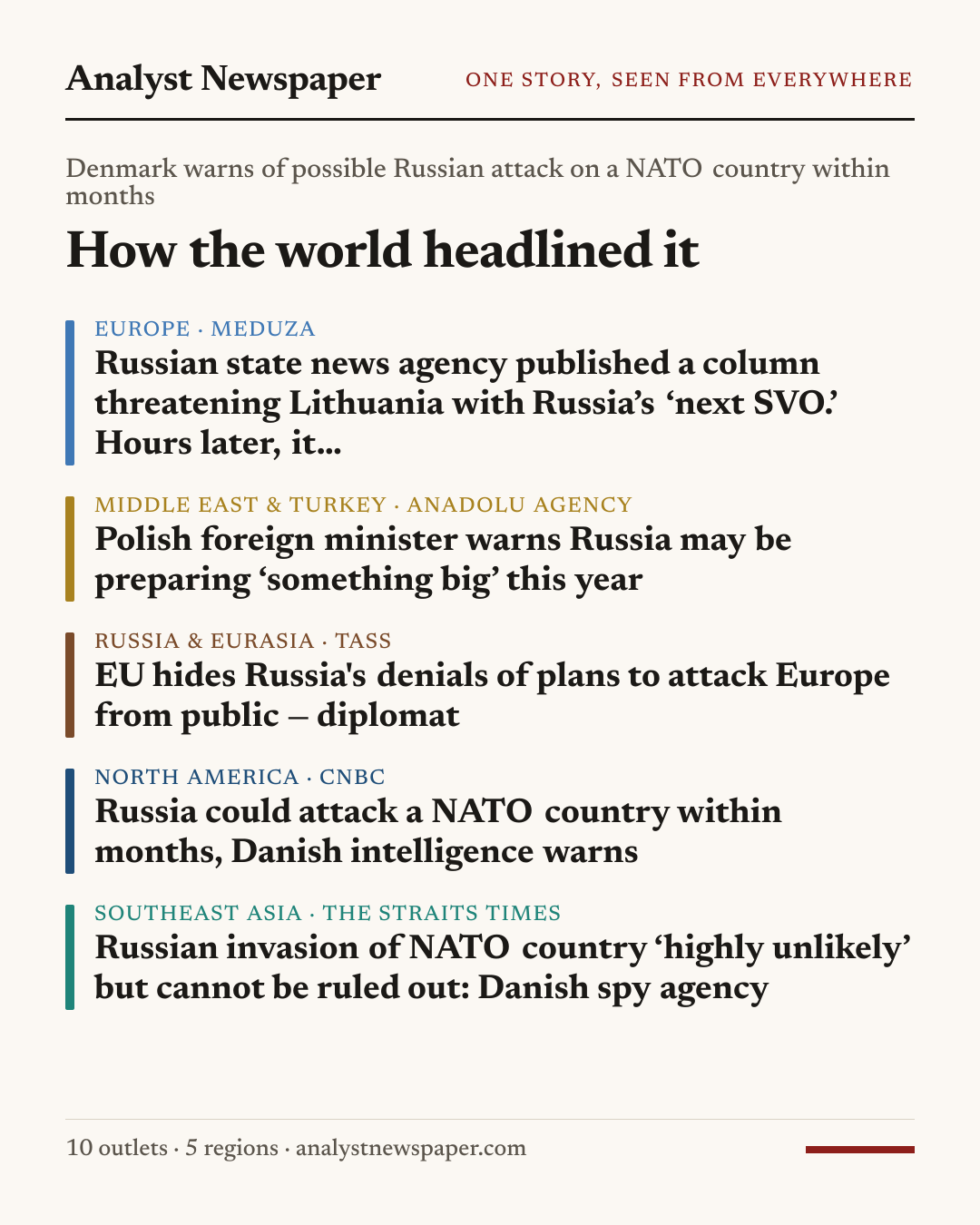
What happened
Danish defence intelligence warned of a 'low but growing risk' that Russia could launch long-range strikes on NATO infrastructure supporting Ukraine, or carry out a limited incursion into a neighbouring NATO country with a small number of troops, within the coming months.8910
The warning was described as coming amid a series of related developments, including Poland's claim that a fire at a Starlink satellite station was an act of sabotage, and a growing number of Russia-related warnings from European officials.48
Separately, Russian state news agency RIA Novosti published, then deleted, a column threatening Lithuania with a nuclear strike, an incident reported by independent outlets in Latvia and Ukraine.26
Polish Foreign Minister Radoslaw Sikorski offered differing public assessments, at one point warning Russia may be preparing 'something big' including a possible false-flag operation, and at another saying Russia lacks the forces to invade NATO.37
What's agreed
Reported consistently by outlets in more than one region.
- Danish defence intelligence warned of a 'low but growing risk' that Russia could launch long-range strikes on NATO infrastructure supporting Ukraine, or a limited incursion into a neighbouring NATO country with a small number of troops, within coming months.8910
- Danish intelligence's warning was reported as one of the starkest such assessments yet from a Western security service, arriving amid a series of related Russia warnings from other European officials.48
- Russian state news agency RIA Novosti published a column threatening Lithuania with a nuclear strike, framed as another Russian 'special military operation,' and the column was later deleted.26
- Polish Foreign Minister Radoslaw Sikorski made public statements about Russia's posture toward NATO, including that Russia may be preparing 'something big' and, separately, that Russia lacks the forces to invade NATO.37
Where accounts differ
Each account is attributed to who makes it. We do not judge between them.
Whether Russia intends or is capable of attacking a NATO country
Danish defence intelligence service, as reported by Western outlets
There is a low but growing risk Russia could strike NATO infrastructure or make a limited incursion into a neighbouring country within months.8910
Polish Foreign Minister Radoslaw Sikorski, in one statement
Russia may be preparing 'something big' this year, possibly including a false-flag attack to justify further mobilization.3
Polish Foreign Minister Radoslaw Sikorski, in a separate interview
Russia does not have the forces to invade NATO.7
Danish spy agency, per Straits Times reporting
A Russian invasion of a NATO country is highly unlikely, though it cannot be ruled out.5
Russian Permanent Representative to OSCE Dmitry Polyansky
The EU conceals Russia's denials of any plan to attack Europe, and Russian media has long been blocked in EU countries.1
Nature and severity of the RIA Novosti column on Lithuania
Meduza, Latvia-based independent outlet
RIA Novosti published a column headlined about a new 'SVO,' threatening Lithuania with a nuclear strike, which was later deleted.2
Ukrainska Pravda
A Kremlin-aligned outlet published and then deleted an opinion piece threatening Lithuania with invasion and nuclear strike.6
How it's framed
What each perspective puts first, based on headlines and summaries.
| Perspective | How it reads | What it puts first |
|---|---|---|
| Western mainstream and European outletsEurope | Emphasize the Danish intelligence warning as a stark, credible alert about growing risk of Russian attack on NATO infrastructure or territory, often linking it to other recent incidents such as the Polish Starlink sabotage claim.8910 | starkest warnings yet, low but growing risk, infrastructure attack, troop incursion |
| US outlet syndicating European coverageNorth America | Frames the Danish warning as part of a broader, escalating pattern of Russia warnings from multiple European security officials and lawmakers.4 | growing chorus of warnings, within months |
| Russian state mediaRussia & Eurasia | Frames the warnings as part of an EU effort to suppress Russian denials and restrict Russian media, casting the West as concealing Moscow's position rather than accurately representing Russian intentions.1 | EU hides denials, media blocked, diplomat's rebuttal |
| Turkish and Qatari state-controlled outletsMiddle East & Turkey | Present competing statements from the same Polish official, including a warning of a possible major Russian move and, separately, an assessment that Russia lacks the military strength to invade NATO.37 | false-flag attack, preparing something big, Russia doesn't have the force |
| Southeast Asian outlet relaying Danish assessmentSoutheast Asia | Reports the Danish spy agency's assessment with emphasis on the low probability of invasion alongside continued European vigilance over interference.5 | highly unlikely, cannot be ruled out, high alert |
| Ukrainian and Latvia-based independent outletsEurope | Highlight the RIA Novosti column threatening Lithuania with nuclear strike as evidence of Kremlin-aligned rhetoric, noting its swift deletion.26 | Kremlin-aligned, nuclear strike threat, deleted |
What the coverage leaves out
- None of the outlets reviewed reported the full text or specific reasoning behind the Danish intelligence service's threat assessment beyond the 'low but growing risk' characterization.
- None of the outlets reviewed detailed which specific NATO country or countries the Danish warning identified as most at risk.
- None of the outlets reviewed reported an official Russian government response to the Danish intelligence warning itself, as opposed to broader Russian statements about EU media policy.
- None of the outlets reviewed explained why RIA Novosti deleted the column threatening Lithuania or offered an official Russian explanation for its removal.
- None of the outlets reviewed reported NATO's official collective response or statement to the Danish assessment.
Why it matters
The Danish assessment follows a period of heightened Western concern about Russian sabotage and hybrid threats, including a fire at a Starlink satellite station in Poland that Warsaw described as an act of sabotage.8
The warning comes as European officials debate how much military capacity Russia retains after its war in Ukraine, with assessments ranging from concern about infrastructure strikes to skepticism that Russia could mount a full invasion of NATO territory.78
What to watch
- Whether Danish or other NATO intelligence services issue further updates on the assessed risk level in coming months.
- Any official Russian government response to the Danish intelligence assessment specifically.
- Further developments regarding the Starlink station fire in Poland described as sabotage.
Sources (10)
Every outlet we drew on, grouped by where it is based. Read the originals for the full reporting.
North America
Europe
- 2MeduzaLVIndependent
- 6Ukrainska PravdaUAPrivate
- 8The GuardianGBPrivate
Russia could attack a Nato country within months, Danish intelligence says
- 9El PaísESPrivate
Denmark alerts to possible Russian attack against a NATO country in coming months
Translated from Spanish: Dinamarca alerta de un posible ataque ruso contra un país de la OTAN en los próximos meses
- 10Financial TimesGBPrivate
Russia could attack Nato country within months, Denmark warns
Russia & Eurasia
- 1TASSRUState-controlled
EU hides Russia's denials of plans to attack Europe from public — diplomat
Middle East & Turkey
- 3Anadolu AgencyTRState-controlled
Polish foreign minister warns Russia may be preparing ‘something big’ this year
- 7Al Jazeera EnglishQAState-controlled
Southeast Asia
- 5The Straits TimesSGPrivate
Russian invasion of NATO country ‘highly unlikely’ but cannot be ruled out: Danish spy agency