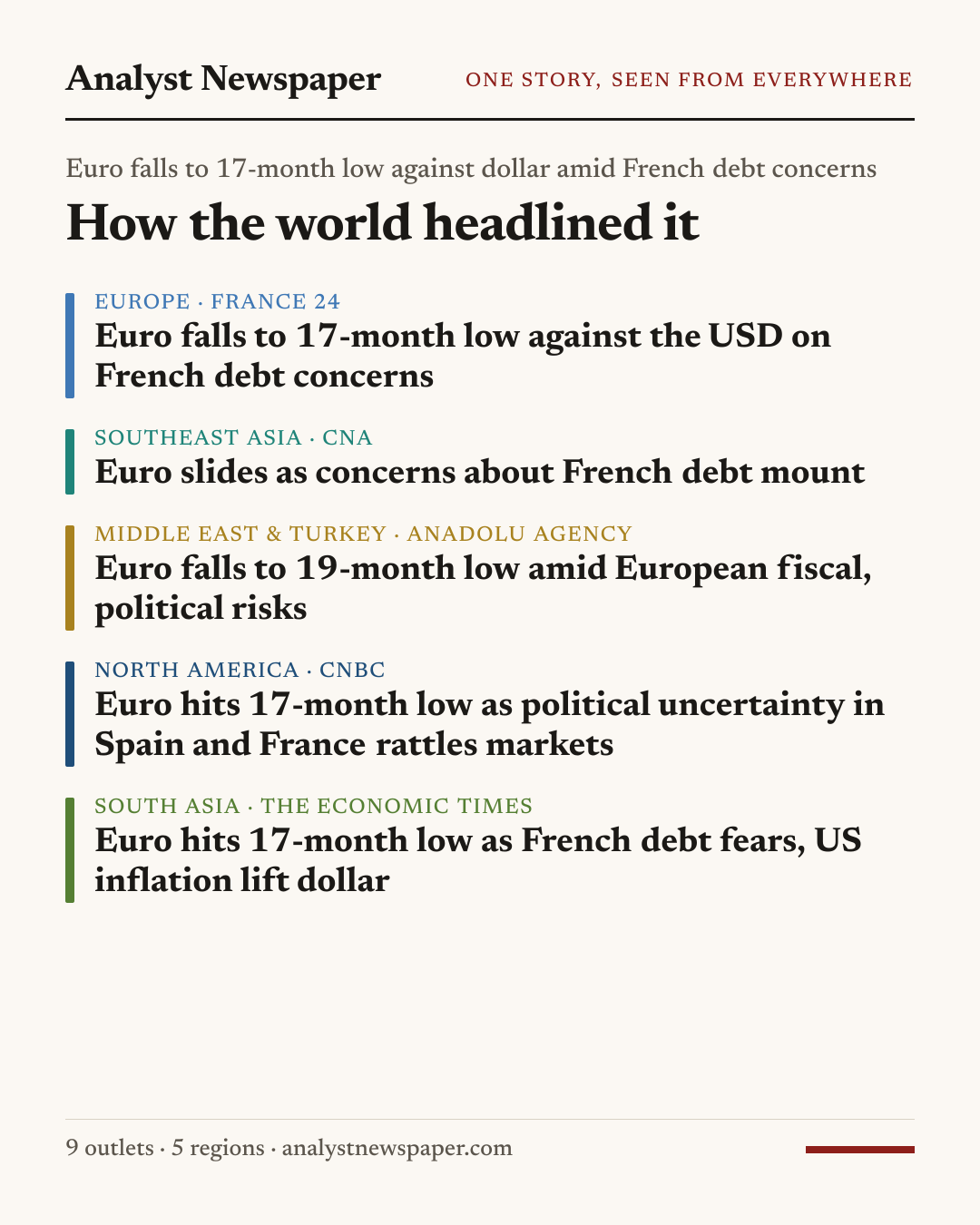
Euro falls to 17-month low against dollar amid French debt concerns
Outlets agree the euro has slumped on worries over France's public finances, but differ on how many other factors, from Spanish politics to US inflation to energy prices, they fold into the story.
What happened
The euro fell to a 17-month low against the US dollar, with concern over France's ability to manage its public finances cited as the main driver.13456789
The single currency fell as much as 0.8% in early Monday trading to below $1.12, its weakest level since May.8
Anadolu Agency reported the euro dropping 0.6% to $1.1164, describing the move as a 19-month low.2
The Guardian reported the euro has slumped about 1.2% this month and roughly 8 cents from its peak, while France 24 put the decline from the late-January peak at nearly 7%.81
What's agreed
Reported consistently by outlets in more than one region.
Where accounts differ
Each account is attributed to who makes it. We do not judge between them.
Exact size and framing of the euro's decline
Anadolu Agency
Described the move as a 19-month low, with the euro down 0.6% to $1.1164.2
France 24, CNBC, The Economic Times, Deutsche Welle, The Guardian, Financial Times
France 24
Said the euro has fallen nearly 7% from its late-January peak.1
The Guardian
Said the euro has slumped about 1.2% this month and around 8 cents from its peak, falling as much as 0.8% in early Monday trading to below $1.12.8
What else, beyond French debt, is driving the euro's fall
CNBC
Framed the move as being driven jointly by political uncertainty in both Spain and France.3
The Guardian
Cited the announcement of a snap election in Spain, alongside French debt fears, as fuelling eurozone uncertainty.8
The Economic Times, citing Reuters
Attributed part of the dollar's strength, and hence the euro's weakness, to persistent US inflation pressures.4
Financial Times
Cited high energy prices, alongside French indebtedness concerns, as adding pressure on the euro.9
How it's framed
What each perspective puts first, based on headlines and summaries.
| Perspective | How it reads | What it puts first |
|---|---|---|
| European public broadcasters and UK pressEurope | Framed the euro's fall in starker terms, with Deutsche Welle raising the question of a wider fiscal crisis and the Guardian linking French debt fears to the stability of the whole currency bloc.6819 | fiscal crisis language, threat to eurozone stability, Spanish political uncertainty |
| Middle East & Turkey state-controlled outletMiddle East & Turkey | Anadolu Agency's state-controlled report emphasized both fiscal and political risk factors in Europe, citing a slightly different timeframe (19-month low) and a specific exchange rate figure.2 | precise exchange rate figures, fiscal and political risk framing |
| South Asian business pressSouth Asia | The Economic Times, citing Reuters, broadened the story to include US inflation data and France's 2027 election timeline as factors behind dollar strength and euro weakness.4 | US inflation data, 2027 French election, debt crisis fears |
| Southeast Asian outletsSoutheast Asia | CNA and Malay Mail used near-identical, brief wording focused narrowly on French debt concerns without additional context.57 | brief factual framing, French debt as sole cause cited |
| North American financial pressNorth America | CNBC emphasized political uncertainty in two countries, Spain and France, using language describing markets as being rattled.3 | political uncertainty, market reaction, two-country framing |
What the coverage leaves out
- None of the outlets reviewed reported detailed comment from the French or Spanish governments on the currency or bond market moves.
- None of the outlets reviewed reported the European Central Bank's response or any statement on the euro's decline.
- None of the outlets reviewed detailed how the G7 strategic oil reserve release or energy prices specifically connect to the euro's movement, beyond brief mentions.
Why it matters
French government bonds have come under pressure amid expectations of higher interest rates and political uncertainty ahead of the country's 2027 election, raising doubts about the stability of the eurozone's second-largest economy's public finances.4
Deutsche Welle noted the euro's decline could worsen inflation within the EU.6
Sources (9)
Every outlet we drew on, grouped by where it is based. Read the originals for the full reporting.
North America
Europe
- 1France 24FRPublic broadcaster
Euro falls to 17-month low against the USD on French debt concerns
- 6Deutsche WelleDEPublic broadcaster
- 8The GuardianGBPrivate
Euro falls to 17-month low against dollar amid French debt fears
- 9Financial TimesGBPrivate
Middle East & Turkey
- 2Anadolu AgencyTRState-controlled
Euro falls to 19-month low amid European fiscal, political risks
South Asia
- 4The Economic TimesINPrivate
Euro hits 17-month low as French debt fears, US inflation lift dollar
Southeast Asia
- 5CNASGState-controlled
- 7Malay MailMYPrivate