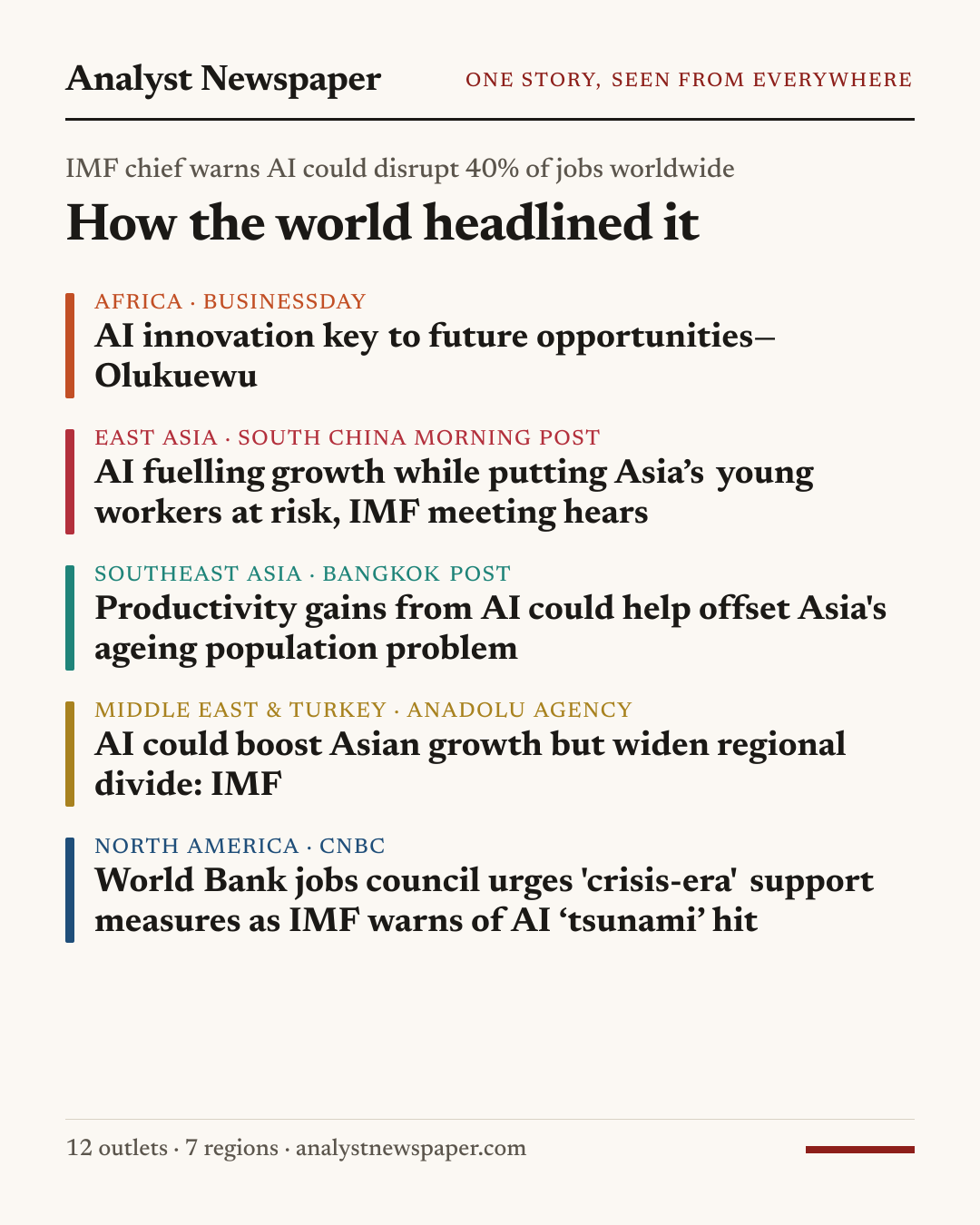
IMF chief warns AI could disrupt 40% of jobs worldwide
At the IMF-World Bank annual meetings in Bangkok, officials warned that artificial intelligence threatens jobs globally, though coverage differs on whether the emphasis should be on crisis, inequality, or growth opportunity.
What happened
IMF Managing Director Kristalina Georgieva said AI is hitting the global labor market like a 'slow-moving tsunami,' with young workers entering the job market most exposed.4910
Georgieva said AI could affect 40% of global jobs, describing it as something that could augment, downgrade or eliminate jobs.8
The warnings came at the IMF-World Bank annual meetings in Bangkok, where delegates were also told AI could help offset Asia's shrinking workforce if adoption is scaled evenly across the region.27
The IMF and World Bank also warned that AI could worsen existing jobs crises in developing economies, including Nigeria, unless governments and businesses act to prepare workers.11
What's agreed
Reported consistently by outlets in more than one region.
- Kristalina Georgieva described AI's impact on the labour market as a 'slow-moving tsunami.'48910
- AI is already taking over routine, repetitive tasks and reducing demand for some human workers.910
- AI risks widening inequality alongside any productivity or growth gains it produces.56
- Uneven adoption of AI between advanced and emerging economies could deepen existing disparities.37
Where accounts differ
Each account is attributed to who makes it. We do not judge between them.
Scale and framing of AI's job impact
Premium Times, citing IMF boss
AI could affect 40% of global jobs, which could be augmented, downgraded or eliminated.8
CNBC, citing World Bank jobs council and IMF
The threat is severe enough to require 'crisis-era' support measures for workers.4
Bangkok Post, citing IMF
AI's effect could be positive for Asia if it offsets a shrinking, ageing workforce, provided adoption is scaled evenly.7
Net economic effect of AI
South China Morning Post
AI investment is helping prop up a global economy battered by energy supply shocks, even as it risks job losses for Asia's youth.2
Mint, citing Bloomberg Economics
AI could lift India's annual GDP growth by 0.4 to 0.9 percentage points, but automation without new job creation could widen unemployment and inequality.6
Vanguard, citing IMF and World Bank
AI could worsen the jobs crisis in Nigeria and other developing economies absent urgent action.11
How it's framed
What each perspective puts first, based on headlines and summaries.
| Perspective | How it reads | What it puts first |
|---|---|---|
| US and English-language financial mediaNorth America | Emphasize the urgency and scale of the warning, framing it in crisis terms and highlighting calls for 'crisis-era' policy responses.4 | tsunami, crisis-era support, young workers most exposed |
| East Asian outletsEast Asia | Focus on the tension between AI's economic benefits and its disruptive effect on jobs, often citing the Bangkok IMF-World Bank meetings directly.2912 | growth vs job losses, hollowing out demand for workers, regional divide |
| Southeast Asian outletsSoutheast Asia | Emphasize the possibility that AI could help the region, particularly by offsetting an ageing workforce, provided adoption is spread evenly, alongside alarm at the 'tsunami' framing.710 | ageing population, even adoption, slow-moving tsunami |
| Nigerian outletsAfrica | Frame AI coverage around both opportunity (student readiness) and crisis (worsening existing jobs problems in developing economies), with emphasis on the 40% global jobs figure.1811 | jobs crisis, urgent government action, future-ready |
| South Asian outletsSouth Asia | Emphasize AI's potential economic upside for India's GDP growth, while noting warnings about unemployment and inequality if job creation lags automation.6 | GDP growth potential, higher-value services, automation risk |
| Middle East and Turkey state-controlled outletMiddle East & Turkey | Anadolu Agency, a state-controlled outlet, frames the IMF warning around the growth-versus-divide tension, emphasizing the gap in adoption timelines between advanced and emerging economies.3 | regional divide, adoption delay for emerging markets |
| Oceania public broadcasterOceania | Reports a domestic political angle, citing a Labor MP's warning that AI could worsen income inequality even as it narrows the wage gap.5 | income inequality, wage gap |
What the coverage leaves out
- None of the outlets reviewed detailed the methodology behind the IMF's 40% global jobs figure or how it was calculated.
- None of the outlets reviewed reported specific policy measures proposed by the IMF or World Bank beyond general calls for governments and businesses to act.
- None of the outlets reviewed included responses from labour groups, employers, or workers themselves to the IMF's warnings.
- The full snippet and claims from Taipei Times (S12) were unavailable, limiting assessment of that outlet's framing.
Why it matters
The warnings were delivered at the IMF-World Bank annual meetings in Bangkok, which opened against a backdrop of soaring energy prices, persistent inflation and mounting debt.2
The World Bank's jobs council called for 'crisis-era' support measures in response to the IMF's warning, suggesting policymakers view the AI labour disruption as comparable in urgency to past economic crises.4
What to watch
- Whether the IMF or World Bank follow up with specific policy recommendations for governments and businesses.
- How emerging economies, cited as facing 1-2 decade adoption delays, respond to calls for more even AI adoption.
- Further data on AI's effect on youth employment in Asia and developing economies.
Sources (12)
Every outlet we drew on, grouped by where it is based. Read the originals for the full reporting.
North America
Middle East & Turkey
- 3Anadolu AgencyTRState-controlled
Africa
- 1BusinessDayNGPrivate
- 8Premium TimesNGIndependent
- 11VanguardNGPrivate
South Asia
East Asia
- 2South China Morning PostHKPrivate
AI fuelling growth while putting Asia’s young workers at risk, IMF meeting hears
- 9The Japan TimesJPPrivate
- 12Taipei TimesTWPrivate
Southeast Asia
- 7Bangkok PostTHPrivate
Productivity gains from AI could help offset Asia's ageing population problem
- 10The Straits TimesSGPrivate
IMF chief alarmed at ‘slow-moving tsunami’ of AI for jobs, taxes
Oceania
- 5ABC News (Australia)AUPublic broadcaster