IMF-World Bank Bangkok meetings dominated by war, energy shocks and debt
The IMF's annual meetings in Bangkok are set against warnings of Middle East conflict spillover and mounting debt pressures, with outlets differing on whether to frame the crisis around war, energy costs, AI, or developing-nation austerity.
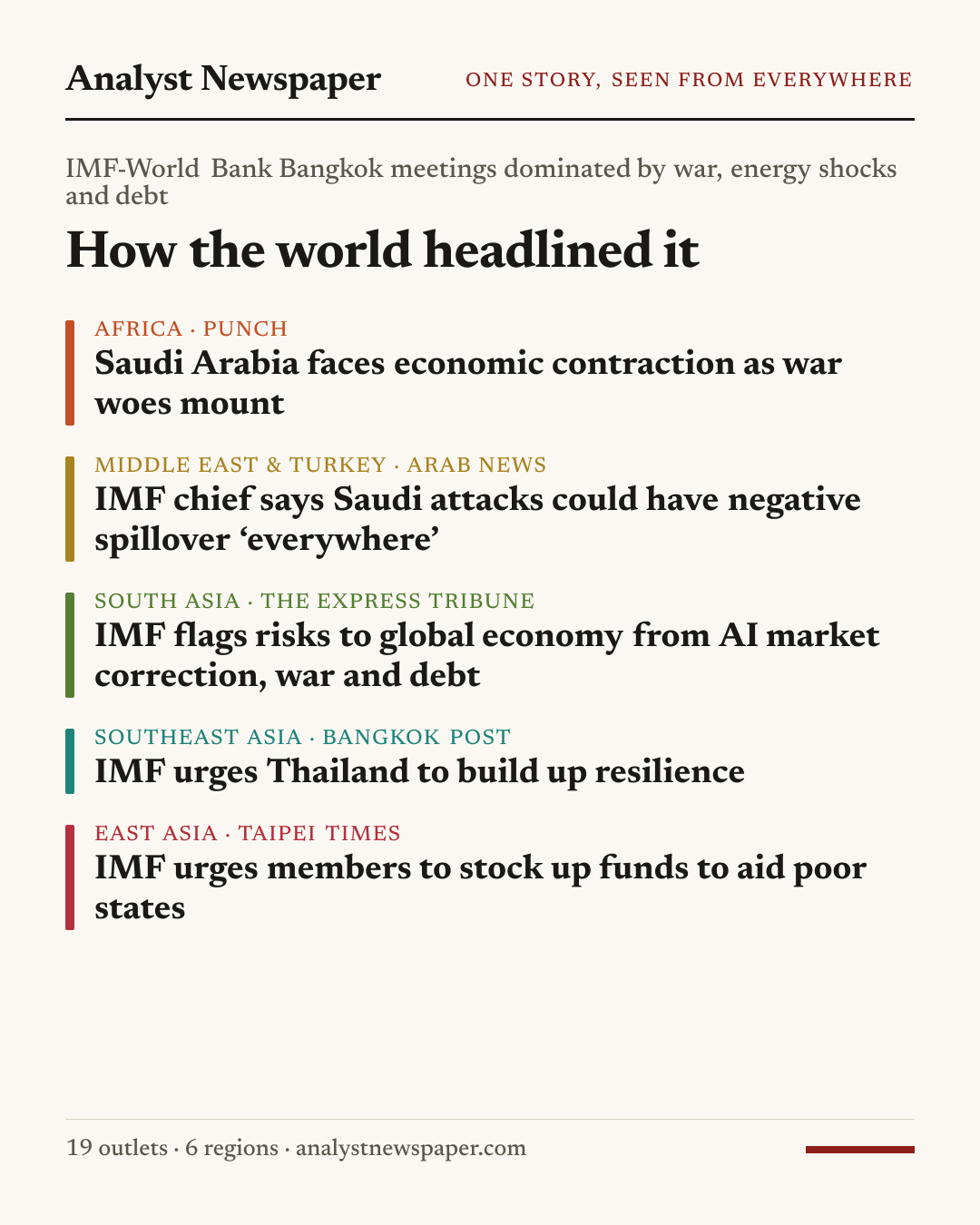
What happened
The IMF-World Bank Annual Meetings are being held in Bangkok, running through October 18, amid what is described as widening Mideast conflict.13
IMF Managing Director Kristalina Georgieva warned that attacks on Saudi Arabia could have negative economic spillover 'everywhere' and that global resilience is 'reaching its limits'.41119
The IMF said low-income and heavily indebted developing countries hit by an energy shock linked to the Iran war may have 'no choice' but to cut spending or restructure debt.101418
The IMF projected Saudi Arabia's economy will shrink by 3.3% this year, and separately forecast the Middle East and Central Asia region's economy will shrink in 2026, with Iraq, Bahrain, Kuwait and Qatar facing double-digit GDP declines.19
The IMF also cut growth forecasts for Latin America and the Caribbean, citing the energy shock and limited economic boost from AI.15
What's agreed
Reported consistently by outlets in more than one region.
- Attacks on Saudi Arabia and the broader Middle East conflict are a major focus of the Bangkok meetings, with the IMF chief warning of global spillover risk.411193
- The IMF has warned that developing and heavily indebted countries face pressure to cut spending or restructure debt because of an energy shock tied to the Iran war.101418
- Energy shocks, war, and rising/record debt are identified as dominant themes of the meetings' agenda.7121617
- AI's economic impact, alongside war and debt, is being discussed as a topic at the meetings.5716
Where accounts differ
Each account is attributed to who makes it. We do not judge between them.
Characterization of the conflict driving the economic shock
The Jerusalem Post
Describes an eighth-month 'US-Israeli-led war with Iran' as the cause of inflation and hardship dominating the meetings.17
NDTV
Describes a 'US war on Iran' that plunged the Middle East into conflict, with Iran's 'retaliatory action' targeting US Gulf allies.18
Al Jazeera English
Refers to fallout from the 'US-Israel war on Iran' as driving regional GDP declines.9
Anadolu Agency
Refers more generally to a 'widening Mideast conflict' without specifying parties' roles in the same terms.13
Saudi Arabia 2025 growth figure
Punch, citing the IMF
Reports the IMF projects Saudi Arabia's economy will shrink by 3.3% this year.1
How it's framed
What each perspective puts first, based on headlines and summaries.
| Perspective | How it reads | What it puts first |
|---|---|---|
| Middle East outletsMiddle East & Turkey | Emphasize the IMF chief's direct warnings about Saudi attacks and global spillover risk, and frame the region's economic contraction explicitly around the US-Israel war on Iran.491713 | Saudi attacks, global spillover, war with Iran, regional GDP decline |
| South Asian outletsSouth Asia | Focus on the IMF's message to developing countries that they have 'no choice' but to cut spending, quoting IMF officials on accumulated debt and inflation, and describe the Iran conflict as a driver of a broader energy shock affecting poorer nations.1014185 | no choice, spending cuts, debt levels, inflation, war shock |
| African private and independent press (Nigeria)Africa | Frame the meetings around a trio of agenda items, AI, energy shocks and record/mounting debt, with a more neutral tone and some attention to national investment opportunities (Nigeria) alongside the economic contraction facing Saudi Arabia.712161 | AI, energy shock, record debt, investment opportunities |
| Southeast Asian outletsSoutheast Asia | Blend coverage of the IMF chief's spillover warnings with region-specific IMF advice, such as urging Thailand to build economic resilience, and report on IMF forecast cuts for Latin America tied to energy shocks and limited AI gains.1119615 | global resilience, economic fundamentals, forecast cuts, energy shock |
| European outlet (Financial Times)Europe | Highlights IMF alarm over 'dire' public finances generally, linking Houthi attacks to broader concerns about public debt sustainability rather than focusing narrowly on one region's conflict.3 | dire public finances, alarm, Houthi attacks |
What the coverage leaves out
- None of the outlets reviewed reported detailed responses from Saudi Arabia, Iran, the United States or Israel to the IMF's specific warnings and growth forecasts.
- None of the outlets reviewed provided a detailed breakdown of what spending cuts or debt restructuring measures specific developing countries are considering.
- None of the outlets reviewed explained in detail how AI is expected to affect economic growth, beyond brief mentions of a market correction risk or limited boost.
- Full outcomes, agreements or formal communiques from the Bangkok meetings were not covered in the material reviewed.
Why it matters
The meetings take place as the IMF links an energy price shock to the US-Israel conflict with Iran, which it says is worsening conditions for heavily indebted, oil-importing developing countries.10189
The IMF's warning that attacks on Saudi Arabia could have global spillover effects reflects concern that regional conflict could raise energy costs worldwide.411
What to watch
- The IMF-World Bank Annual Meetings continue in Bangkok through October 18, with further policy announcements expected.
- Further IMF guidance on debt restructuring options for heavily indebted oil-importing countries.
Sources (19)
Every outlet we drew on, grouped by where it is based. Read the originals for the full reporting.
Europe
- 3Financial TimesGBPrivate
Middle East & Turkey
- 4Arab NewsSAPrivate
IMF chief says Saudi attacks could have negative spillover ‘everywhere’
- 9Al Jazeera EnglishQAState-controlled
Middle East and Central Asia’s economy to shrink in 2026 amid war, IMF says
- 13Anadolu AgencyTRState-controlled
IMF-World Bank Annual Meetings open in Bangkok amid widening Mideast conflict
- 17The Jerusalem PostILPrivate
Middle East conflicts, energy supplies, to dominate IMF-World Bank meetings in Thailand
Africa
- 1PunchNGPrivate
- 7Premium TimesNGIndependent
AI, energy supply shock, mounting debts headline IMF/World Bank meetings in Bangkok
- 12Channels TelevisionNGPrivate
Policymakers Take On Energy Shock, Rising Debt At IMF-World Bank Meetings
- 16BusinessDayNGPrivate
AI, energy shock, record debt to dominate IMF-World Bank meetings in Bangkok
South Asia
- 5The Express TribunePKPrivate
IMF flags risks to global economy from AI market correction, war and debt
- 10DawnPKPrivate
'No choice': IMF says developing countries must cut spending despite Iran war shock
- 14The HinduINPrivate
No choice: IMF says developing countries must cut spending despite war shock
- 18NDTVINPrivate
"No Other Choice": IMF Warns Developing Nations May Need Spending Cuts
East Asia
- 2Taipei TimesTWPrivate
- 8Nikkei AsiaJPPrivate
IMF chief calls for urgent fiscal repairs in advanced economies
Southeast Asia
- 6Bangkok PostTHPrivate
- 11Malay MailMYPrivate
- 15CNASGState-controlled
IMF cuts Latin America, Caribbean growth forecasts on energy shock, little AI boost
- 19The Straits TimesSGPrivate
IMF chief says Saudi attacks could have negative spillover ‘everywhere’