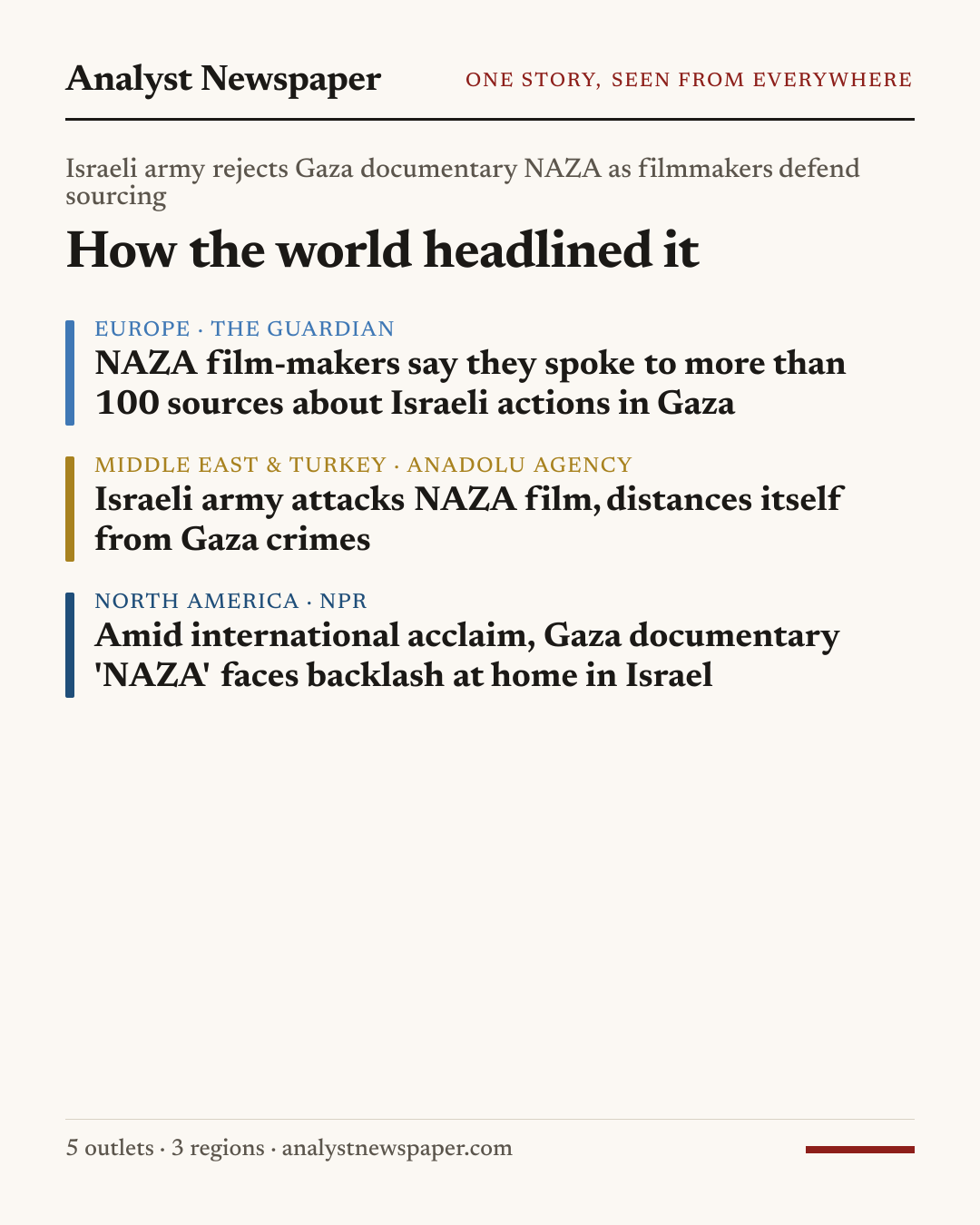
Israeli army rejects Gaza documentary NAZA as filmmakers defend sourcing
A documentary about Israeli military conduct in Gaza has drawn international acclaim and domestic controversy, with the Israeli army rejecting its claims as the filmmakers defend their reporting.
What happened
NAZA, a documentary by Israeli filmmakers examining the Israeli military's targeting policies and alleged acceptance of civilian deaths in Gaza, has won international acclaim but sparked controversy in Israel.134
The Israeli military (IDF) issued a statement rejecting the film's claims as baseless and describing it as an inversion of reality and a distorted picture of its operations.25
The IDF said its delayed response was because the filmmakers did not give it advance notice of the claims or let it view the film until recently.5
The filmmakers responded that they had spoken to more than 100 sources with knowledge of the military systems used in the war, and the film includes testimony from three Israeli soldiers about civilian casualties.14
What's agreed
Reported consistently by outlets in more than one region.
- NAZA is a documentary made by Israeli filmmakers about the Israeli military's actions in Gaza, including its targeting policies and civilian casualties.134
- The film has received international acclaim, including awards at foreign festivals, while provoking significant criticism and controversy within Israel.34
- The Israeli military (IDF) publicly rejected the film's claims.125
- The documentary includes testimony reinforcing allegations about civilian deaths in the Gaza war.14
Where accounts differ
Each account is attributed to who makes it. We do not judge between them.
Accuracy and fairness of the NAZA film's portrayal of Israeli military operations in Gaza
NAZA film team, via The Guardian
The filmmakers say they spoke to more than 100 sources with knowledge of the military systems used in the war, backing their account of targeting policies and civilian deaths.1
Israeli soldiers interviewed, via El País
Three Israeli soldiers gave testimony reinforcing the documentary's account of collateral damage in Gaza, with one soldier stating that at some point killing dozens of people no longer seemed so serious.4
Reason for the IDF's delayed response to the film
IDF, via The Jerusalem Post
The IDF said its delayed response was because the filmmakers did not give advance notice of the claims or allow it to see the film until recently.5
How it's framed
What each perspective puts first, based on headlines and summaries.
| Perspective | How it reads | What it puts first |
|---|---|---|
| Turkish state-controlled mediaMiddle East & Turkey | Anadolu Agency frames the story around the Israeli army's attack on the film and its effort to distance itself from Gaza crimes, foregrounding the military's denial as evasive.2 | Israeli army distancing itself, Gaza crimes, distorted picture |
| Israeli domestic pressMiddle East & Turkey | The Jerusalem Post centers the IDF's rejection of the film, emphasizing the military's characterization of the claims as baseless and procedural concerns about lack of advance notice.5 | IDF rejection, baseless claims, inversion of reality, lack of advance notice |
| European outletsEurope | The Guardian and El País emphasize the filmmakers' sourcing and soldier testimonies supporting the documentary's claims, framing the IDF's response as an attempt to discredit the work.14 | extensive sourcing, soldier testimony, collateral damage, pushback against discrediting |
| US public broadcasterNorth America | NPR frames the story around the contrast between the film's international acclaim and its domestic backlash in Israel, without taking a position on the substance of the claims.3 | international acclaim, domestic backlash, premiere in the US |
What the coverage leaves out
- None of the outlets reviewed detailed the specific content of the more than 100 sources cited by the filmmakers.
- None of the outlets reviewed provided the full text or details of the IDF's rejection statement beyond characterizing it as baseless and an inversion of reality.
- None of the outlets reviewed reported on reactions from Israeli government officials beyond the military.
- None of the outlets reviewed specified which festivals awarded the film or gave details of its reception at them.
Why it matters
The dispute centers on a documentary's portrayal of Israeli military conduct in Gaza, touching on broader debates about accountability for civilian casualties in the war.145
What to watch
- Further IDF or Israeli government response to the documentary.
- Reception of the film at its U.S. premiere.
- Whether additional soldier testimonies or sources become public.
Sources (5)
Every outlet we drew on, grouped by where it is based. Read the originals for the full reporting.
North America
- 3NPRUSPublic broadcaster
Amid international acclaim, Gaza documentary 'NAZA' faces backlash at home in Israel
Europe
- 1The GuardianGBPrivate
NAZA film-makers say they spoke to more than 100 sources about Israeli actions in Gaza
- 4El PaísESPrivate
Translated from Spanish: Tres soldados israelíes sobre Gaza: “Llegó un momento en que ya no parecía tan grave matar a decenas de personas”
Middle East & Turkey
- 2Anadolu AgencyTRState-controlled
Israeli army attacks NAZA film, distances itself from Gaza crimes
- 5The Jerusalem PostILPrivate
'Inversion of reality': IDF issues rejection of 'baseless' claims made in 'NAZA' film