Ivory Coast, top cocoa grower, faces climate strain as region seeks resilient beans
Ivory Coast, which produces nearly 40 percent of the world's cocoa, is grappling with increasingly unpredictable rainfall, while coverage across West Africa and beyond highlights different facets of the region's cocoa challenges, from climate resilience to processing capacity.
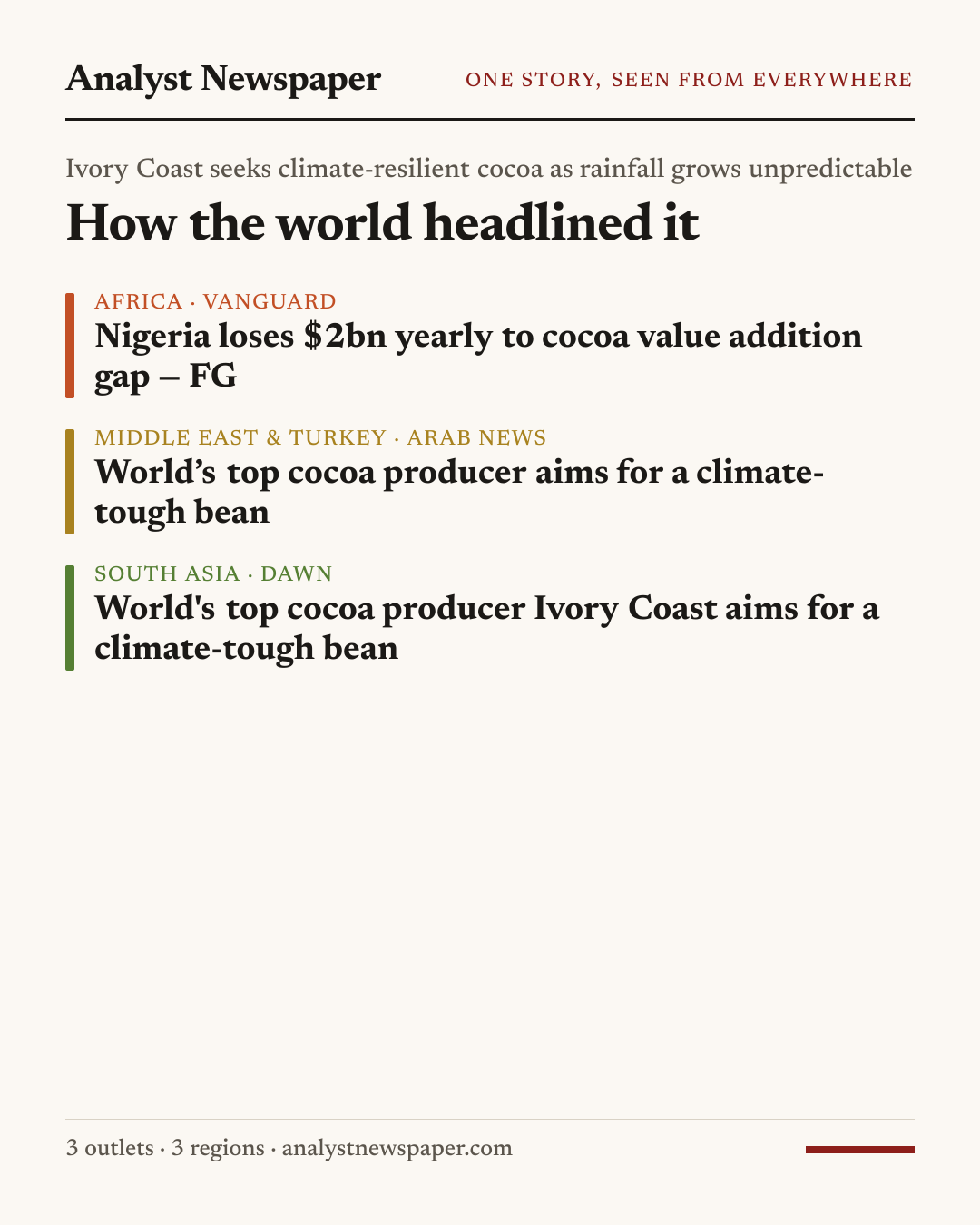
What happened
Ivory Coast, which produces nearly 40 percent of the world's cocoa and relies on the crop for about 15 percent of its GDP, is experiencing increasingly unpredictable and reduced rainfall that is damaging cocoa plantations.23
Ivorian cocoa farmers, exemplified by grower Kofi Alexis Amani, have described watching trees wilt and wither, and some are changing planting practices while awaiting more climate-tolerant cocoa varieties.35
In neighboring Nigeria, the federal government says the country loses about $2 billion annually due to underused cocoa processing capacity, and the International Institute of Tropical Agriculture has called for climate-resilient cocoa varieties for the region.4
Separately, Nigerian agribusiness Johnvents, led by founder John Alamu, has described its own efforts to address cocoa sector challenges through processing, farmer support and international expansion.1
What's agreed
Reported consistently by outlets in more than one region.
- Ivory Coast is the world's top cocoa producer, with the crop central to its national economy.23
- Ivory Coast's cocoa plantations face challenges from unpredictable rainfall linked to climate change.23
- West African cocoa farmers and researchers are responding to climate pressures, including efforts to develop more climate-resilient cocoa and changes to planting practices.345
How it's framed
What each perspective puts first, based on headlines and summaries.
| Perspective | How it reads | What it puts first |
|---|---|---|
| Middle East and South Asian outlets covering Ivory Coast's climate challengeMiddle East & Turkey | Arab News and Dawn (via South Asia) both focus on Ivory Coast's climate vulnerability as the top cocoa producer, framing the story around unpredictable rainfall threatening a nationally vital crop.23 | climate change impact, national economic dependence, global cocoa supply |
| South Asian coverage with farmer-level detailSouth Asia | Dawn's account centers on an individual Ivorian farmer, Kofi Alexis Amani, using his described experience of wilting trees to illustrate broader climate and economic stakes, citing specific production and GDP figures.3 | farmer testimony, GDP and production statistics, population dependent on cocoa |
| Nigerian private press on domestic agribusiness and policyAfrica | Nigerian outlets Premium Times and Vanguard focus on domestic cocoa industry issues distinct from Ivory Coast's climate story: one profiles a Nigerian agribusiness executive's efforts in processing and sustainability, the other reports a government claim about lost economic value from underutilized processing capacity and a call from an agricultural research institute for climate-resilient cocoa varieties.14 | value addition and processing capacity, government economic figures, agribusiness expansion |
| Nigerian broadcast coverage of the Ivory Coast climate storyAfrica | Channels Television's brief syndicated item echoes the Ivory Coast climate-resilience angle, noting farmers altering planting methods while awaiting scientific development of a more climate-tolerant cocoa bean.5 | farmer adaptation, awaiting scientific solutions |
What the coverage leaves out
- None of the outlets reviewed detailed what specific scientific research or breeding programs are underway to develop a climate-resilient cocoa bean, beyond IITA's general call for high-yielding varieties.
- None of the outlets reviewed reported on the Ivorian government's official response or policy measures addressing the rainfall and climate challenges described.
- None of the outlets reviewed provided data on how climate impacts in Ivory Coast compare with or affect global cocoa prices or supply chains.
Why it matters
Cocoa is a major economic pillar in West Africa: it accounts for about 15 percent of Ivory Coast's GDP and supports roughly five million people there, while Nigeria's government says it loses about $2 billion a year from underused processing capacity.34
What to watch
- Development of climate-resilient cocoa varieties by agricultural researchers such as IITA
- Ivorian farmers' continued adaptation of planting practices in response to rainfall changes
Sources (5)
Every outlet we drew on, grouped by where it is based. Read the originals for the full reporting.
Middle East & Turkey
- 2Arab NewsSAPrivate
Africa
- 1Premium TimesNGIndependent
INTERVIEW: How Johnvents is turning Nigeria’s cocoa challenges into a global agribusiness
- 4VanguardNGPrivate
- 5Channels TelevisionNGPrivate