Japan's cabinet approves bill to cut food consumption tax
Japan's cabinet has approved a plan to cut consumption tax on food and drinks, with coverage varying in which details and figures are emphasized.
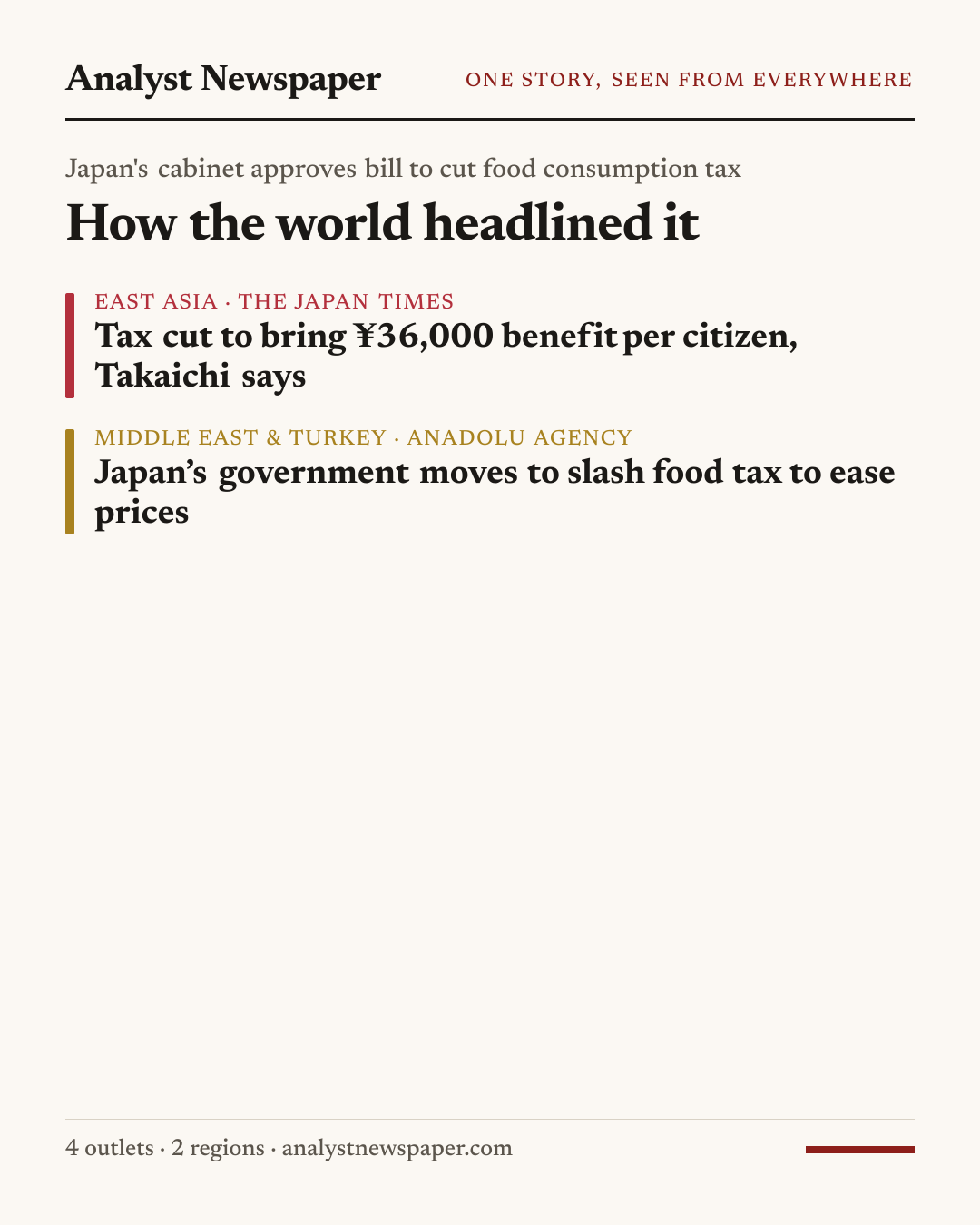
What happened
Japan's cabinet approved a bill to temporarily cut the consumption tax on food and beverages and introduce an income-based benefit program, according to CGTN.3
Nikkei Asia's headline notes the cabinet approval came with key questions about the policy still unanswered.4
The proposed cut would lower the tax rate on food and drinks from 8% to 1%, according to Anadolu Agency.2
Prime Minister Takaichi said the tax cut would bring a ¥36,000 benefit per citizen, based on dividing total tax revenue loss by population, according to The Japan Times.1
The tax cut is expected to reduce government revenue by around $63 billion over two years, according to Anadolu Agency.2
Where accounts differ
Each account is attributed to who makes it. We do not judge between them.
Financial impact of the tax cut
Japan Times, citing Prime Minister Takaichi
The tax cut will bring a ¥36,000 benefit per citizen, calculated by dividing total tax revenue loss across central and local governments by population.1
Anadolu Agency
The tax cut is expected to reduce government revenue by around $63 billion over two years.2
Whether the plan is fully settled
Whether the cabinet's approval of the bill constitutes a shared fact across regions
How it's framed
What each perspective puts first, based on headlines and summaries.
| Perspective | How it reads | What it puts first |
|---|---|---|
| Japanese domestic pressEast Asia | Japanese outlets report specific figures and open questions: The Japan Times cites a per-citizen benefit figure from the prime minister, while Nikkei Asia's headline flags that key questions about the policy remain unanswered.14 | per-citizen benefit figure, unanswered questions |
| Chinese state mediaEast Asia | CGTN foregrounds the formal cabinet approval process and the inclusion of an income-based benefit program, emphasizing procedural progress toward passage.3 | cabinet approval, legislative process, benefit program |
| Turkish state mediaMiddle East & Turkey | Anadolu Agency emphasizes the scale of the tax cut and its cost to government revenue, framing it as a move to ease consumer prices.2 | price relief, revenue cost, specific tax rate change |
What the coverage leaves out
- None of the outlets reviewed detailed what specific key questions remain unanswered about the policy.
- None of the outlets reviewed reported public or opposition reaction to the proposed tax cut.
- None of the outlets reviewed specified the timeline for when the tax cut would take effect if passed.
- None of the outlets reviewed detailed the structure or eligibility criteria for the income-based benefit program.
Why it matters
The tax cut is framed by Anadolu Agency as a measure to ease consumer prices amid cost-of-living pressures.2
CGTN describes the bill's cabinet approval as a major step toward passage during the current Diet session.3
What to watch
- Passage of the bill during the current Diet session, as cabinet approval is described by CGTN as a step toward securing passage.
- Clarification of unanswered questions about the policy noted by Nikkei Asia.
Sources (4)
Every outlet we drew on, grouped by where it is based. Read the originals for the full reporting.
Middle East & Turkey
- 2Anadolu AgencyTRState-controlled
East Asia
- 1The Japan TimesJPPrivate
- 3CGTNCNState-controlled
Japan's cabinet approves bill for 1st food consumption tax cut
- 4Nikkei AsiaJPPrivate
Japan food tax cut gets cabinet approval with key questions unanswered