A month after Nepal floods, thousands remain missing as recovery continues
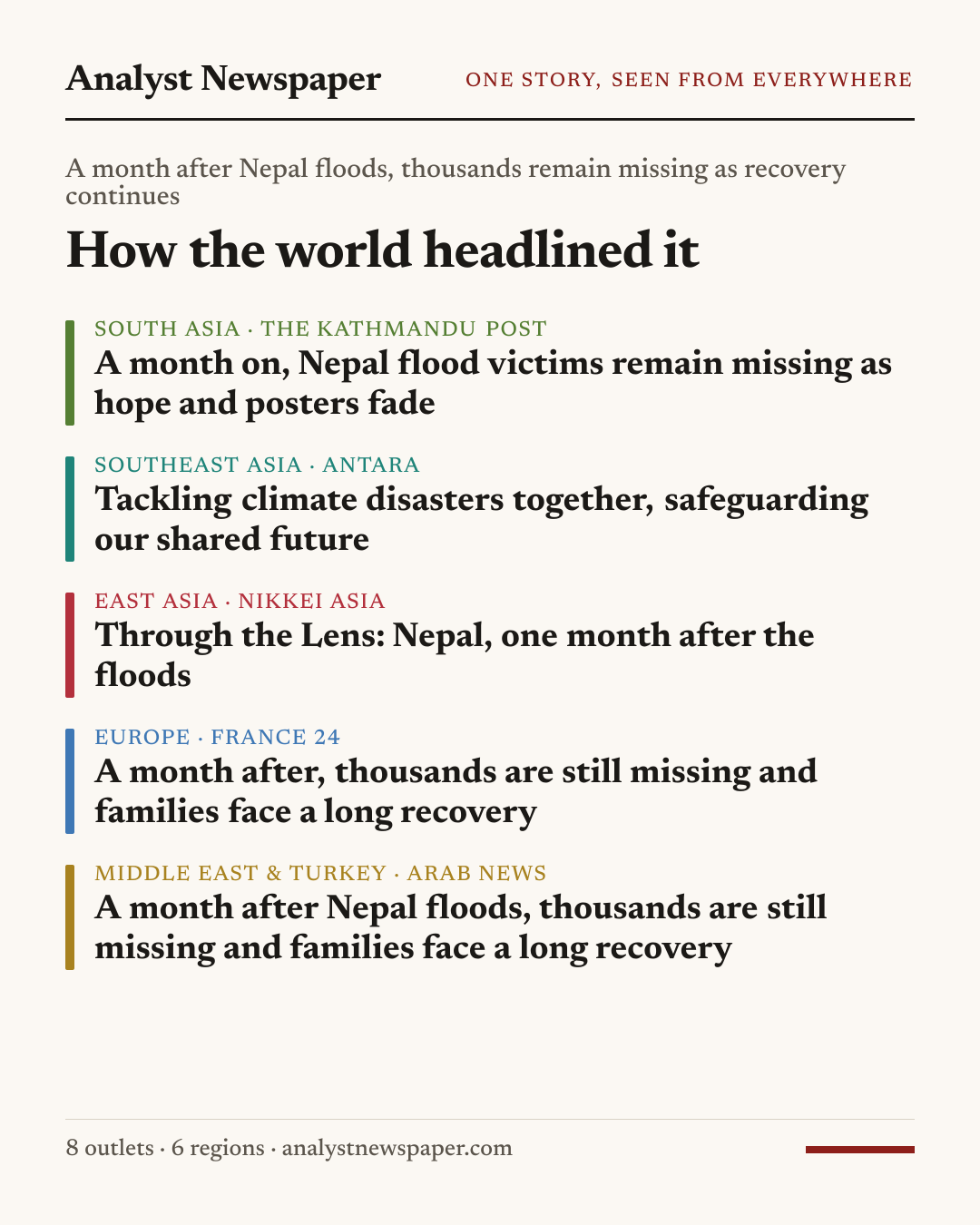
One month after a glacial collapse triggered devastating floods in Nepal, outlets across regions agree thousands remain missing, but coverage differs in whether it foregrounds human loss, climate causes, or broader disaster-response themes.
What happened
One month after floods and a glacial mountain collapse struck Nepal on August 26, thousands of people remain missing and families face a long recovery.23578
The disaster was triggered when a mass of ice and rock broke away from the north face of Langtang Lirung mountain at about 5,200 metres altitude, on the China-Nepal border, sending debris racing down the valley.7
Families in Kathmandu and in Nuwakot district are still searching for missing loved ones, with some turning to symbolic last rites, while the Nepal government appeals for international aid for reconstruction and climate resilience.345
What's agreed
Reported consistently by outlets in more than one region.
- One month after floods struck Nepal on August 26, thousands of people remain missing.23578
- Nepal faces a long and difficult recovery, with reconstruction and aid needs mounting.2378
- The disaster was triggered by a high-altitude glacial mountain collapse on the China-Nepal border, sending a mass of ice, rock and debris down the valley from Langtang Lirung mountain.67
- Families in affected areas, including Kathmandu and Nuwakot district, are searching for missing loved ones and turning to symbolic last rites in the absence of recovered bodies.45
Where accounts differ
Each account is attributed to who makes it. We do not judge between them.
Scale and nature of the immediate trigger
How it's framed
What each perspective puts first, based on headlines and summaries.
| Perspective | How it reads | What it puts first |
|---|---|---|
| South Asian outletsSouth Asia | Nepal's own press and Pakistani outlet Dawn foreground the human toll, technical detail of the glacial collapse, and the scientific climate link, giving the most granular account of the disaster's mechanics and its emotional aftermath for families.57 | symbolic last rites, hospital notices for missing, glacial collapse detail, climate change link |
| Southeast Asian outletsSoutheast Asia | Malay Mail runs the same AFP wire report as Dawn, emphasizing the disaster's scale and mounting aid needs, while Indonesia's state-controlled Antara frames the event through a Chinese state media report emphasizing collective climate action rather than Nepal-specific detail.68 | aid needs, shared climate future, collective disaster response |
| Western public broadcasters and Middle East outletEurope | France 24 and Arab News both use near-identical headlines and language emphasizing missing persons and long recovery, with Arab News additionally highlighting the Nepal government's international aid appeal for reconstruction and climate resilience.23 | thousands missing, long recovery, government aid appeal |
| Oceania public broadcasterOceania | ABC News centers on a specific location, Nuwakot district, using vivid sensory description of the aftermath to convey ongoing hardship for survivors beyond the immediate disaster.4 | local survivor experience, lingering physical aftermath, what comes next for survivors |
| East Asian outletEast Asia | Nikkei Asia presents the story primarily through photographic documentation rather than narrative reporting, based on the available headline and description.1 | visual documentation, one month retrospective |
What the coverage leaves out
- None of the outlets reviewed reported a specific official death toll or missing-persons count.
- None of the outlets reviewed detailed the scale or timeline of international aid pledged or delivered.
- None of the outlets reviewed reported on the Nepal government's specific reconstruction plans or budget.
- None of the outlets reviewed addressed longer-term climate policy responses beyond a general appeal for aid.
Why it matters
Scientists cited by AFP have linked the disaster to climate change, and the Nepal government is appealing for international aid for reconstruction and to address future climate risks.37
What to watch
- Whether international aid pledges are confirmed or delivered to support Nepal's reconstruction.
- Whether authorities release updated or final figures on missing and deceased persons.
Sources (8)
Every outlet we drew on, grouped by where it is based. Read the originals for the full reporting.
Europe
- 2France 24FRPublic broadcaster
A month after, thousands are still missing and families face a long recovery
Middle East & Turkey
South Asia
- 5The Kathmandu PostNPPrivate
A month on, Nepal flood victims remain missing as hope and posters fade
- 7DawnPKPrivate
Thousands missing, aid needs mount one month after Nepal's deadly floods
East Asia
- 1Nikkei AsiaJPPrivate
Southeast Asia
- 6AntaraIDState-controlled
Tackling climate disasters together, safeguarding our shared future
- 8Malay MailMYPrivate
Thousands still missing, aid needs mount one month after Nepal’s deadly floods
Oceania
- 4ABC News (Australia)AUPublic broadcaster
Nepal's flood survivors still waiting to find out what comes next