New crocodile species identified from fossil in rock used to build Great Sphinx
Researchers have identified a 45-million-year-old crocodile species from fossils found in the same Egyptian limestone used to build the Great Sphinx, with outlets converging on the discovery but varying in how much detail and context they provide.
What happened
Researchers have identified a new, 45-million-year-old crocodile species from a fossil skull recovered nearly a century ago in Egypt's Mokattam Formation, the same limestone later used to build the Great Sphinx.12345
The species has been named Herugavialis cairensis, after the Egyptian god Heru, who researchers say may have inspired the Sphinx monument.25
The fossil skull is missing the tip of its snout, a detail outlets note as a striking parallel to the Sphinx's own famously damaged nose.145
Professor Philip Mannion of University College London, who co-led the study, said the coincidence with the Sphinx's missing nose motivated the species' name.5
What's agreed
Reported consistently by outlets in more than one region.
- A fossil skull found roughly a century ago in Egypt's Mokattam Formation has been identified as a new crocodile species.1345
- The rock formation containing the fossil is the same limestone that was used to build Egypt's Great Sphinx.12345
- The species has been named Herugavialis cairensis, after the Egyptian god Heru, who is linked to the Sphinx monument.25
- The crocodile's skull is missing its snout tip, echoing the Sphinx's own missing nose.145
- The fossil and rock formation date to about 45 million years ago.235
How it's framed
What each perspective puts first, based on headlines and summaries.
| Perspective | How it reads | What it puts first |
|---|---|---|
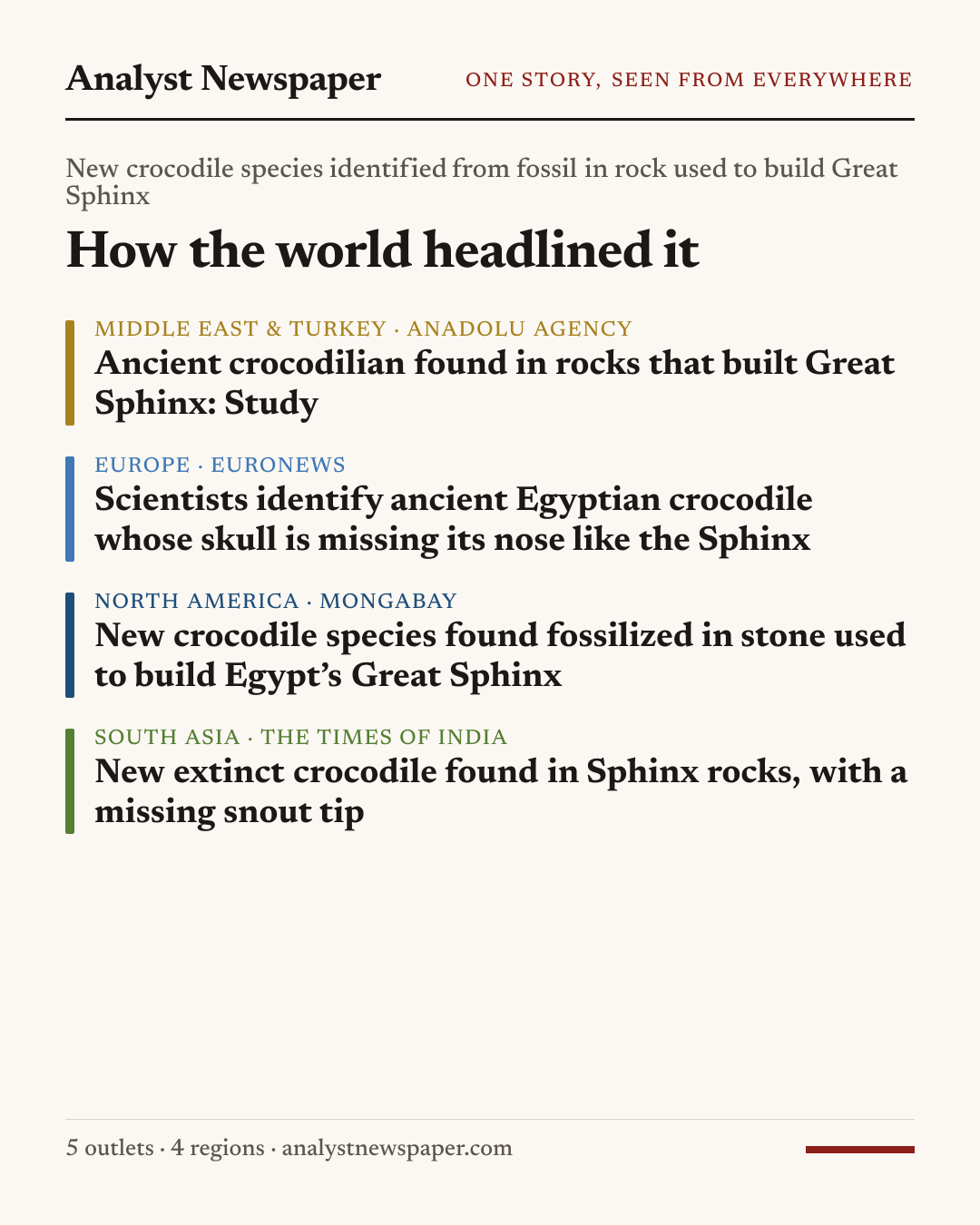
| European outletEurope | Euronews frames the story around the scientific revision of the crocodile family tree and the coincidental link to the Sphinx's damaged nose.1 | family tree revision, missing nose parallel |
| Middle East and Turkey outletsMiddle East & Turkey | Anadolu Agency and The National both emphasize the naming of the species after the Egyptian god Heru and its mythological connection to the Sphinx, with The National including direct detail from the lead researcher.25 | naming after Egyptian god Heru, mythological connection, researcher quote |
| North American outletNorth America | Mongabay provides a narrative, descriptive account of the crocodile's ancient habitat and the century-long path from excavation to species identification.3 | prehistoric habitat narrative, century-long research timeline |
| South Asian outletSouth Asia | The Times of India offers a brief, fact-focused headline centered on the new species and its missing snout tip, without extended detail.4 | brief factual framing, missing snout tip |
What the coverage leaves out
- None of the outlets reviewed detailed the full physical characteristics of Herugavialis cairensis beyond the missing snout tip.
- None of the outlets reviewed specified where the study was published beyond a partial reference in The National's snippet.
- None of the outlets reviewed explained in detail how the species differs taxonomically from other known crocodilians.
- None of the outlets reviewed addressed the condition or location of the original 1920s excavation beyond general timing.
Why it matters
Sources (5)
Every outlet we drew on, grouped by where it is based. Read the originals for the full reporting.
North America
- 3MongabayUSIndependent
New crocodile species found fossilized in stone used to build Egypt’s Great Sphinx
Europe
Middle East & Turkey
- 2Anadolu AgencyTRState-controlled
Ancient crocodilian found in rocks that built Great Sphinx: Study
- 5The NationalAEPrivate
South Asia
- 4The Times of IndiaINPrivate
New extinct crocodile found in Sphinx rocks, with a missing snout tip