Hormuz tanker attacks hit wartime high even as oil exports near pre-war levels
Shipping data shows record attacks on tankers in the Strait of Hormuz alongside a recovery in Middle East crude exports, with outlets differing on how sustainable that recovery is and who bears responsibility for the disruption.
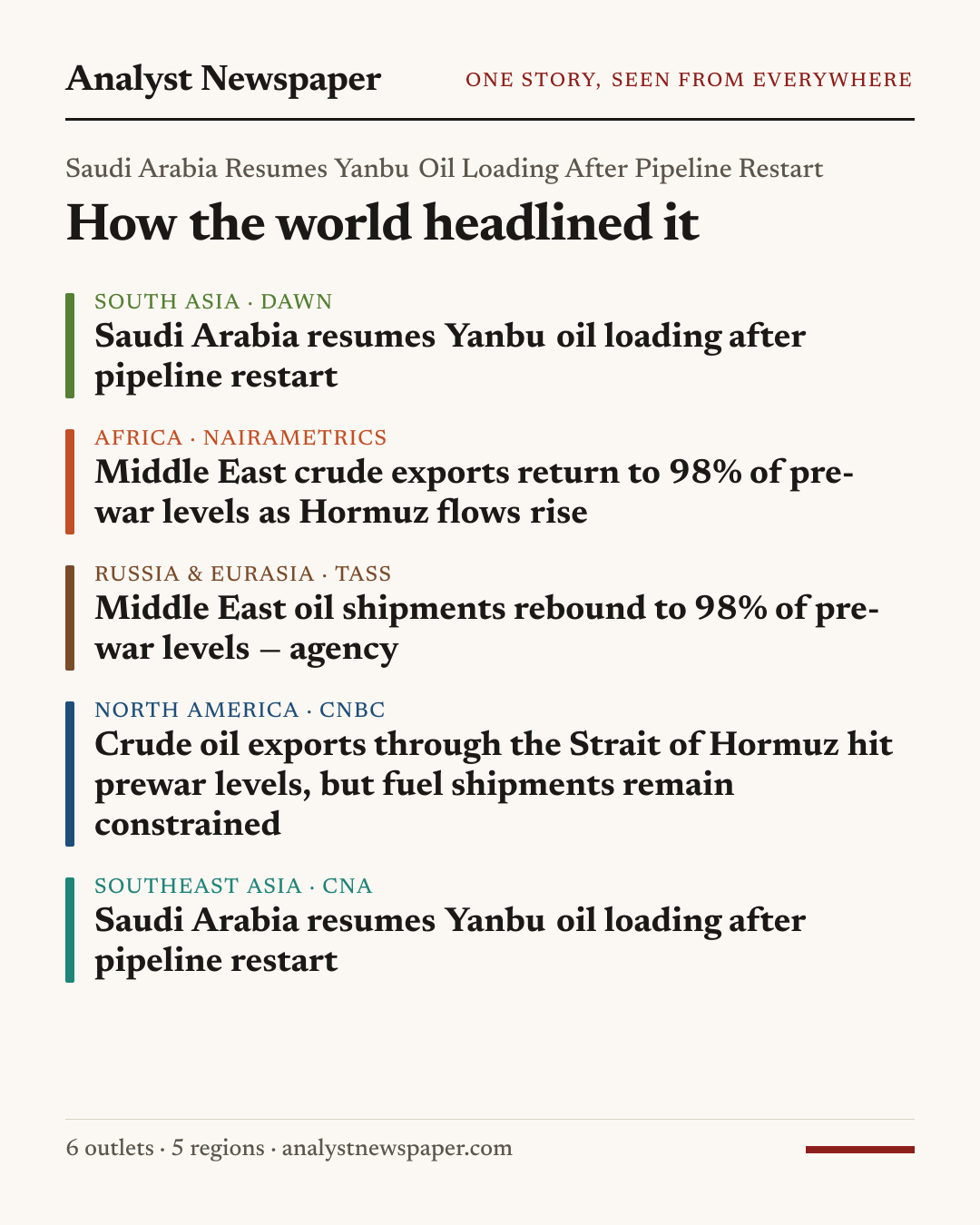
What happened
Attacks on tankers transiting the Strait of Hormuz reached their highest weekly level since the US-Israeli war with Iran began, even as the overall number of vessels transiting fell to a more than two-month low.110111216
Despite this, multiple outlets report that Middle East and Gulf crude oil exports have recovered to near or above pre-war levels, aided by alternative routes and pipelines that bypass Hormuz, though US officials and other outlets differ on exact figures and how secure that recovery is.618192215
The disruption has driven up shipping costs and diesel prices and led to shipping companies offering large financial incentives to crews willing to navigate the strait.9278
Iran has been reported as both expanding attacks beyond Hormuz and, through an official, accusing the US of running smuggling operations in the strait, while CENTCOM has stated it helped transport over 1.25 billion barrels of oil through the waterway.4143
What's agreed
Reported consistently by outlets in more than one region.
- Tanker attacks in the Strait of Hormuz surged to their highest weekly level since the US-Israeli war with Iran began, even as shipping data showed overall transits falling to multi-month lows.11011121516
- Despite the attacks, Gulf and Middle East crude oil exports have recovered to around or above pre-war levels, with producers also using alternative routes and pipelines bypassing Hormuz.613181922
- Shipping companies and maritime unions report that tanker crews and captains are being paid unusually large sums, described by some as up to $100,000 a month, to make the crossing.78
Where accounts differ
Each account is attributed to who makes it. We do not judge between them.
Current state of oil and gas flows through Hormuz
US Energy Secretary Chris Wright, via The National
Up to 14 million barrels of oil a day are moving through Hormuz, with Gulf crude flows recovered to 80-90% of prewar levels and the crude problem mostly handled.6
Number of recent tanker attacks or incidents
The Japan Times, citing UK Maritime Trade Operations
Nine attacks reported already this month, half the total reported for all of September.12
The Times of India, citing reports and the International Maritime Organisation
At least twelve incidents involving various vessels last week, with the IMO separately reporting nine incidents in the same timeframe.16
Responsibility for and nature of oil-related operations in the strait
Iranian official Mohsen Rezaei, via Anadolu Agency
Accuses the US CENTCOM commander of running oil smuggling operations in the Strait of Hormuz using UAE military, and threatens US assets if Iran is attacked again.14
TASS, citing CENTCOM
CENTCOM states it helped transport over 1.25 billion barrels of oil via the Strait of Hormuz, framing the US role as facilitating rather than smuggling.3
How it's framed
What each perspective puts first, based on headlines and summaries.
| Perspective | How it reads | What it puts first |
|---|---|---|
| US and Western outletsNorth America | Emphasize the political and security stakes of the attacks, including pressure on the Trump administration and doubts about the sustainability of export recovery.15217 | wartime high, choke off oil exports, pressure on Trump, midterms |
| Gulf and Middle East outletsMiddle East & Turkey | Highlight recovery and resilience of exports and operations, including US officials' optimistic assessments and individual country achievements like Iraq's tanker milestone, alongside Iranian accusations against the US.6241420 | recovery, pipeline alternatives, Iraq's first operation in decades, smuggling accusations |
| State-controlled Russian mediaRussia & Eurasia | Frames the conflict as a US-Israeli war against Iran and foregrounds CENTCOM's account of US logistical support for oil transport through the strait.3 | US-Israeli war, CENTCOM figures |
| African private pressAfrica | Reports shipping data on declining transits and rising exports in relatively neutral terms, citing attack statistics alongside recovery figures.11118 | shipping data, export recovery, attack spike |
| South Asian outletsSouth Asia | Focus on quantifying the economic fallout, including shipping cost increases and detailed incident counts, framing the situation as a maritime security and cost crisis.91622 | shipping cost surge, incident counts, doubts about stability |
| European outletsEurope | Emphasize structural bottlenecks such as tanker shortages and diesel shortfalls, and the broader fragility of global trade routes exposed by the strait's disruption.13223 | tanker shortage, diesel shortage, trade route fragility |
| East Asian and Southeast Asian outletsEast Asia | Track the pace of attacks and their effect on oil and gas flows and prices, often noting the juxtaposition of rising exports with rising danger.12217 | attacks ramping up, oil price rises, supply concerns |
What the coverage leaves out
- None of the outlets reviewed reported the Iranian government's official response to the specific US and allied figures on export recovery.
- None of the outlets reviewed detailed casualty figures or damage assessments from the individual tanker attacks.
- None of the outlets reviewed explained how the ship-to-ship transfers or alternative pipeline routes operate in technical detail.
- None of the outlets reviewed reported on insurance market responses or premium changes tied to the rising attack risk, beyond the hazard pay for crews.
Why it matters
The Strait of Hormuz is a key passage for global energy supplies, with one report citing that roughly 20% of hydrocarbons transited it before the war, and fossil fuels making up 81% of global energy.520
Disruption to the route has fed into a broader shipping and diesel crisis, with the IEA reporting Gulf diesel exports averaging about a quarter of pre-war levels in August and one outlet reporting oil shipping costs rising 8-10 times since the war began.29
Sources (24)
Every outlet we drew on, grouped by where it is based. Read the originals for the full reporting.
North America
- 7NPRUSPublic broadcaster
Seafarer's union official says crews offered big money to transit Strait of Hormuz
- 15CNBCUSPrivate
Tanker attacks in Strait of Hormuz surge to wartime high as Iran tries to choke off oil exports
- 21The Washington PostUSPrivate
Iran scales up Hormuz attacks, raising pressure on Trump as midterms near
Latin America
- 5ClarínARPrivate
Oil returned to US$105 following the attack on a ship near Hormuz
Translated from Spanish: El petróleo volvió a US$ 105 tras el ataque contra un buque cerca de Ormuz
Europe
- 4Financial TimesGBPrivate
- 13Le MondeFRPrivate
Gulf oil exports rebound beyond pre-war levels
Translated from French: Les exportations de pétrole du Golfe rebondissent au-delà de leurs niveaux d’avant-guerre
- 19Deutsche WelleDEPublic broadcaster
Middle East oil exports recover to pre-Iran war levels despite Hormuz attacks
- 23Politico EuropeBEPrivate
Russia & Eurasia
- 3TASSRUState-controlled
US helped transport over 1.25 billion barrels of oil via Strait of Hormuz — CENTCOM
Middle East & Turkey
- 6The NationalAEPrivate
US says Hormuz oil flows recover to 14 million bpd despite Saudi attacks
- 14Anadolu AgencyTRState-controlled
Iran accuses CENTCOM chief of running oil smuggling operations in Strait of Hormuz
- 20Al Jazeera EnglishQAState-controlled
What the Iran war has done to the world’s energy supply, in charts
- 24Arab NewsSAPrivate
Iraq says it transported 2 million barrels of crude through Strait of Hormuz
Africa
- 1MyJoyOnlineGHPrivate
Hormuz transits at lowest in over two months after attacks, data shows
- 11PunchNGPrivate
- 18NairametricsNGPrivate
Middle East crude exports return to 98% of pre-war levels as Hormuz flows rise
South Asia
- 9MintINPrivate
How the oil crisis is morphing into a shipping crisis, in 5 charts
- 16The Times of IndiaINPrivate
Tanker attacks in Strait of Hormuz highest in a week since Iran war began: Report
- 22The HinduINPrivate
West Asian crude oil exports exceed pre-war levels but tanker attacks increase
East Asia
- 2South China Morning PostHKPrivate
Global diesel shortage: why Gulf refined fuel exports lag crude oil shipments
- 12The Japan TimesJPPrivate
Iran ramps up ship attacks in Hormuz just as oil and gas flows climb
Southeast Asia
- 10The Straits TimesSGPrivate
Attack risks rise for tankers as Iran vows to block more Hormuz routes
- 17CNASGState-controlled
Oil rises as Middle East supply concerns persist amid shipping attacks
Oceania
- 8ABC News (Australia)AUPublic broadcaster
Shipping companies offering sailors 'crazy money' to transit Strait of Hormuz