Swiss glaciers suffer another year of record ice loss
Outlets agree Swiss glaciers lost more than 5% of their ice this year amid a record heatwave, but differ on whether to frame the loss as a single dramatic year or part of a longer five-year collapse.
What happened
Swiss glaciers lost more than 5% of their ice this year, a loss widely described as record-breaking.345
The melt coincided with a record-breaking European heatwave.45
Arab News additionally reported that Swiss glaciers have lost nearly 20% of their mass over the past five years.2
The BBC and NPR linked the ice loss to threats against water supplies, ecosystems and communities.13
What's agreed
Reported consistently by outlets in more than one region.
- Swiss glaciers experienced significant ice loss this year, in a pace described by multiple outlets as record or near-record.134
- More than 5% of Swiss glacier ice vanished this year alone.345
- A record-breaking European heatwave contributed to the melt.45
- The ice loss threatens water supplies in the region.13
Where accounts differ
Each account is attributed to who makes it. We do not judge between them.
Scale and framing of the loss (single-year percentage vs multi-year cumulative loss)
How it's framed
What each perspective puts first, based on headlines and summaries.
| Perspective | How it reads | What it puts first |
|---|---|---|
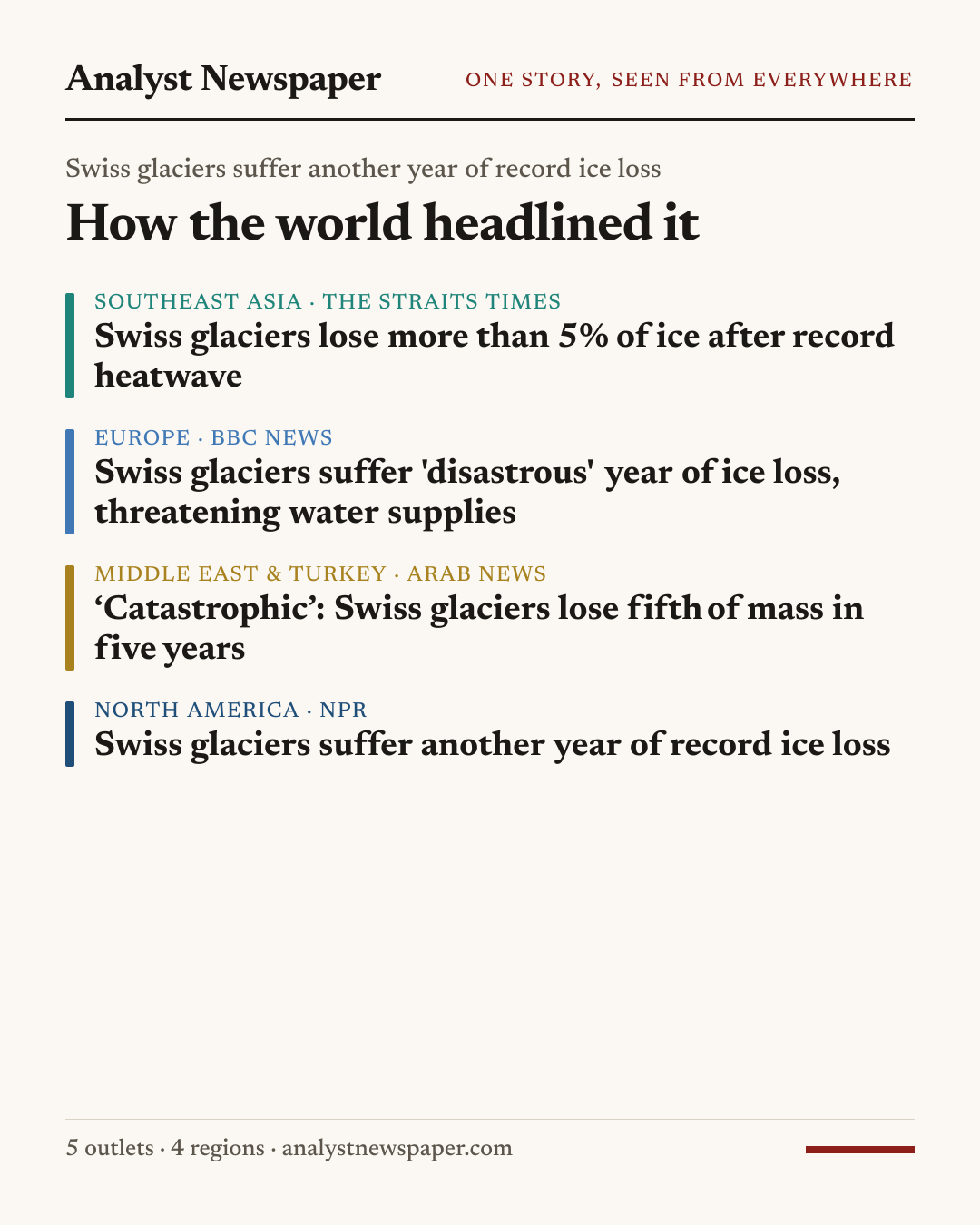
| European public broadcasterEurope | The BBC foregrounds the human and resource impact, emphasizing threats to water supplies and framing the event with the term 'disastrous' attributed to the severity of the melt.1 | water supply threat, climate change context, scientific commentary |
| US public broadcasterNorth America | NPR emphasizes precise quantification of the loss and its cascading downstream effects on ecosystems and communities across Europe.3 | record pace, specific percentage figure, ecosystem and community impact |
| Middle East outletMiddle East & Turkey | Arab News emphasizes the longer-term, cumulative scale of glacier loss over five years, using the term 'Catastrophic' to describe the overall trend rather than focusing on a single year.2 | five-year cumulative loss, catastrophic framing, long-term trend |
| Southeast Asian outletsSoutheast Asia | The Straits Times and CNA (the latter via syndicated copy) emphasize the immediate meteorological cause, linking the ice loss directly to a record-breaking European heatwave.45 | heatwave as direct cause, rapid shrinkage, specific percentage figure |
What the coverage leaves out
- None of the outlets reviewed reported specific policy responses from the Swiss government or international bodies.
- None of the outlets reviewed detailed the methodology used to calculate the percentage ice loss figures.
- None of the outlets reviewed included on-the-record comment from Swiss glaciologists beyond general attribution to 'scientists'.
Why it matters
Sources (5)
Every outlet we drew on, grouped by where it is based. Read the originals for the full reporting.
North America
- 3NPRUSPublic broadcaster
Europe
- 1BBC NewsGBPublic broadcaster
Swiss glaciers suffer 'disastrous' year of ice loss, threatening water supplies
Middle East & Turkey
- 2Arab NewsSAPrivate
‘Catastrophic’: Swiss glaciers lose fifth of mass in five years
Southeast Asia
- 4The Straits TimesSGPrivate
Swiss glaciers lose more than 5% of ice after record heatwave
- 5CNASGState-controlled
Swiss glaciers lose more than 5% of ice after record heatwave