Asian Games close in Japan amid records and organizational complaints
The Aichi-Nagoya Games ended with standout athletic performances, but multiple national teams and outlets reported logistical failures including transport mix-ups and accommodation problems.
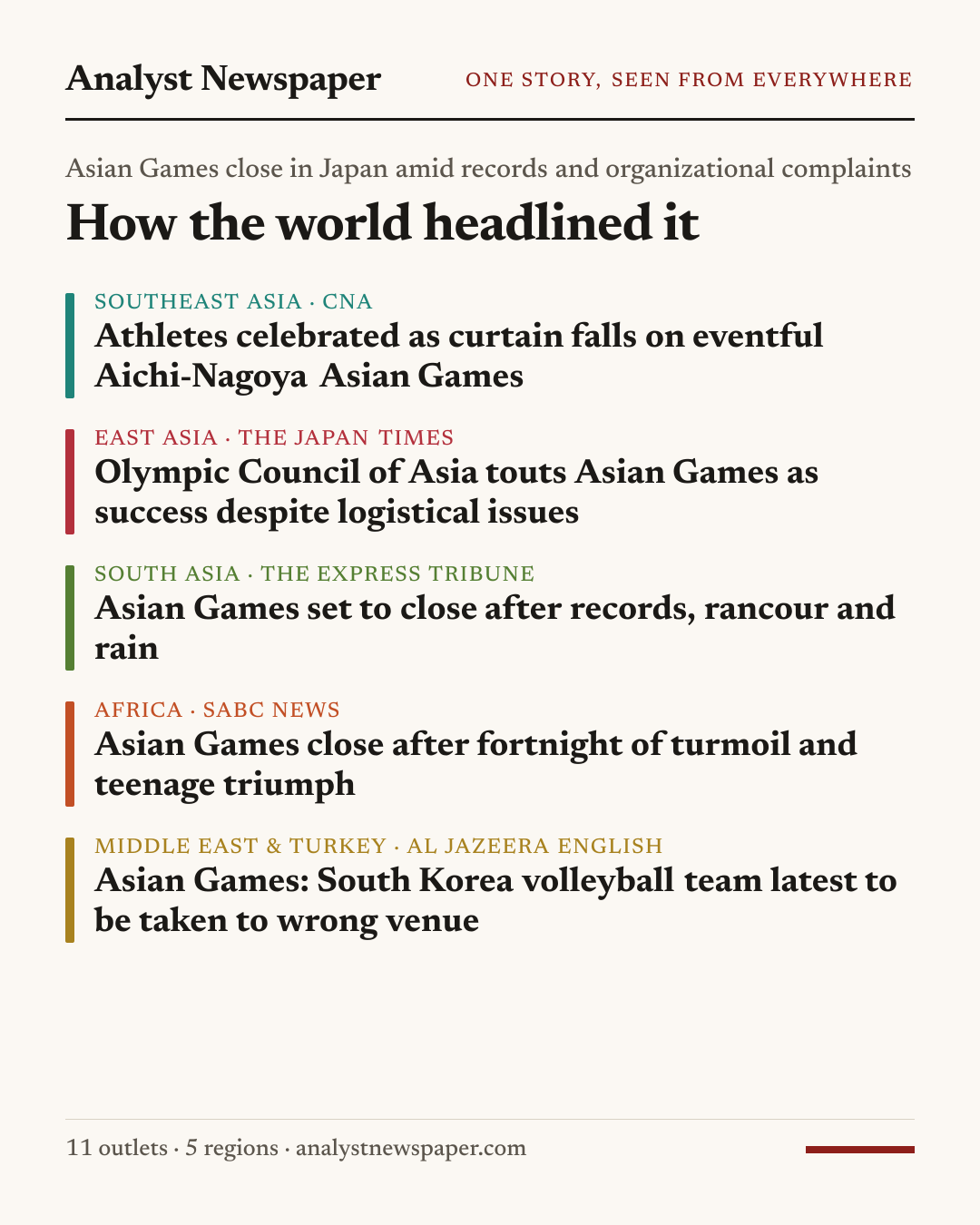
What happened
The Asian Games in Japan closed after a fortnight of competition, with OCA President Sheikh Al Thani declaring the Games closed at Mizuho Park Athletic Stadium.18
China topped the medal table with 169 gold medals, with hosts Japan finishing second with 83.4
The Games saw more than 50 world records set.5
Multiple outlets reported organizational problems, including a South Korea volleyball team being transported to the wrong venue, and Thailand describing the organisation as a chaotic game of musical chairs.3911
Organizers apologized for logistical issues, which Rappler reported were linked to an unexpected surge of late entries that strained accommodation and transport networks, with athletes and officials complaining of cramped rooms, small beds, and travel delays.10
OCA Director General Husain Al-Musallam said the Aichi-Nagoya model for organizing the Games was worth copying, framing the Games as sustainable and financially viable despite the issues.2
Key points
- The Asian Games in Japan concluded after two weeks of competition.1458
- A South Korean team was transported to the wrong venue during the Games, part of a pattern of transport issues raised by multiple teams.3911
- The Games were marked by both notable athletic achievements and organizational complaints, described variously as turmoil, rancour, or chaos alongside record-setting performances.1478
How it's framed
What each perspective puts first, based on headlines and summaries.
| Perspective | How it reads | What it puts first |
|---|---|---|
| OCA leadership statementsMiddle East & Turkey | Coverage citing OCA officials frames the Games as a successful, sustainable model worth replicating, acknowledging logistical issues but emphasizing overall success.2 | success, sustainability, financial viability |
| Southeast Asian outletsSoutheast Asia | Outlets from Southeast Asia, including state-controlled CNA and independent Rappler and Bangkok Post, give significant attention to athlete and team complaints, organizer apologies, and specific national grievances such as Thailand's criticism.51011 | chaos, organizer apology, athlete complaints, logistical strain |
| South Asian and African outletsSouth Asia | Outlets use paired framing of achievement and dysfunction in headlines, juxtaposing records and medal performances with organizational rancour or turmoil.471 | records, rancour, turmoil, triumph |
| East Asian outletsEast Asia | Coverage from Japan and Taiwan focuses on specific logistical failures such as transport mix-ups, while Japanese coverage also includes OCA leadership's framing of the Games as a success.29 | logistical issues, transport failures, OCA success narrative |
What the coverage leaves out
- None of the outlets reviewed reported a detailed response or corrective measures from Japanese Games organizers beyond a general apology.
- None of the outlets reviewed specified how many teams or athletes were affected by transport or accommodation problems in total.
- None of the outlets reviewed provided details on the content of CGTN's esports or sporting powers coverage, limiting assessment of that outlet's framing.
Why it matters
The complaints over transport and accommodation came amid an unexpected surge of late entries to the Games, which organizers said strained logistics networks.10
Sources (11)
Every outlet we drew on, grouped by where it is based. Read the originals for the full reporting.
Middle East & Turkey
- 3Al Jazeera EnglishQAState-controlled
Asian Games: South Korea volleyball team latest to be taken to wrong venue
Africa
- 1SABC NewsZAPublic broadcaster
Asian Games close after fortnight of turmoil and teenage triumph
South Asia
- 4The Express TribunePKPrivate
- 7The Economic TimesINPrivate
East Asia
- 2The Japan TimesJPPrivate
Olympic Council of Asia touts Asian Games as success despite logistical issues
- 6CGTNCNState-controlled
Beyond the Medal Table: Asian Games, Esports, Asia's sporting powers
- 9Taipei TimesTWPrivate
Southeast Asia
- 5CNASGState-controlled
Athletes celebrated as curtain falls on eventful Aichi-Nagoya Asian Games
- 8Malay MailMYPrivate
Records and rancour: Asian Games close amid flag gaffe, mismanagement claims and standout feats
- 10RapplerPHIndependent
- 11Bangkok PostTHPrivate