Two authors deny AI wrote their acclaimed books amid separate scandals
Two unrelated literary controversies broke in the same period, with authors on different continents denying their acclaimed work was AI-generated, though coverage diverges on what each writer actually admitted.
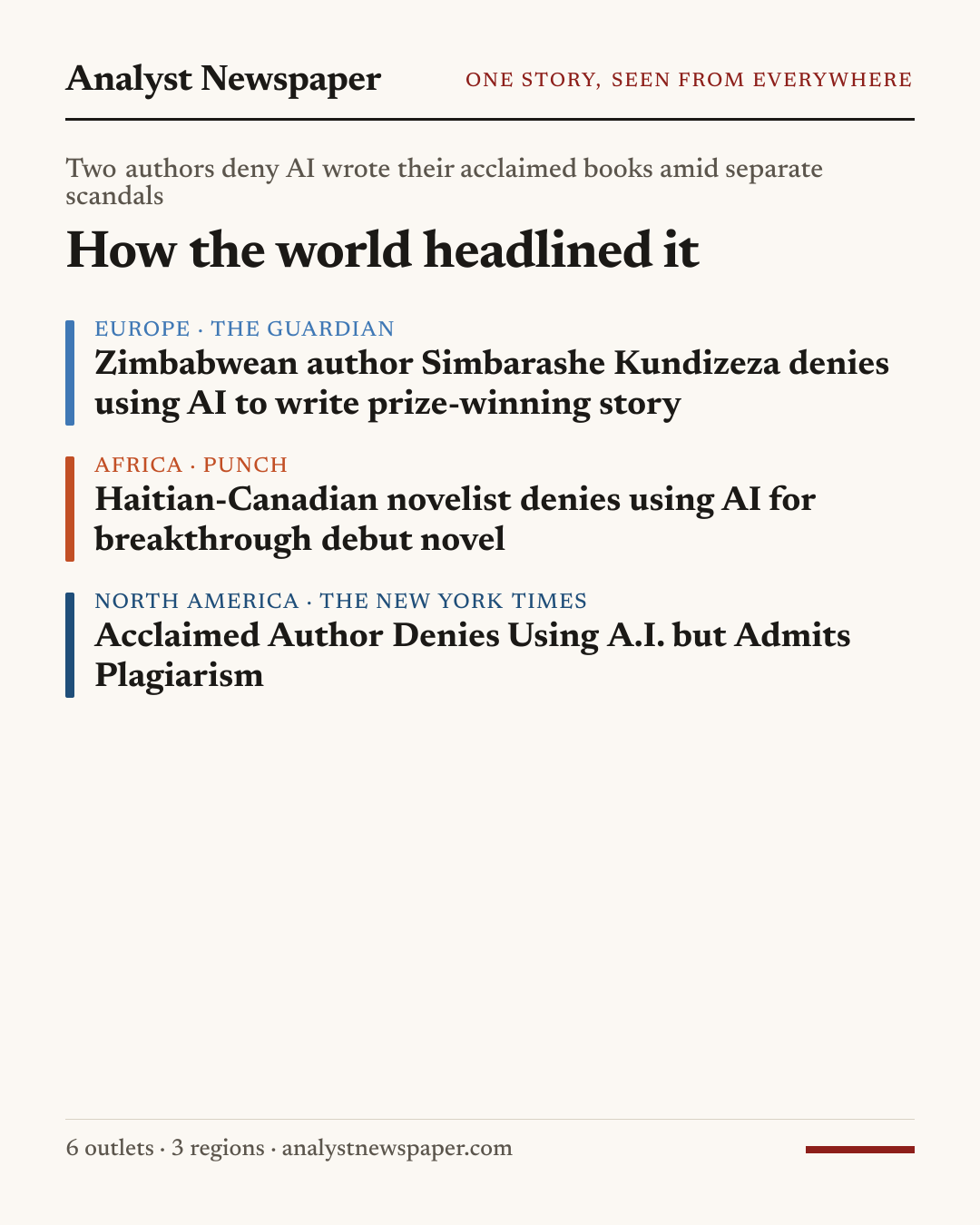
What happened
Haitian-Canadian writer Thelyson Orelien has denied allegations that artificial intelligence was used to write his breakthrough debut novel, 'It Was Either That or Die,' while acknowledging past plagiarism issues.136
Separately, Zimbabwean author Simbarashe Kundizeza has denied using AI to write his short story 'The Blue Fighter,' which won the Caine Prize for African Writing on 6 October.245
The allegation against Kundizeza followed an Atlantic magazine article reporting that software flagged his story as almost completely AI-generated, sparking controversy on social media.25
What's agreed
Reported consistently by outlets in more than one region.
- Thelyson Orelien, a Haitian-Canadian writer, denied allegations that he used artificial intelligence to write his breakthrough debut novel.136
- Orelien acknowledged past plagiarism mistakes in connection with the novel.36
- Zimbabwean writer Simbarashe Kundizeza denied using AI to write his short story 'The Blue Fighter,' which won the Caine Prize for African Writing.245
Where accounts differ
Each account is attributed to who makes it. We do not judge between them.
What Thelyson Orelien admitted regarding his novel
The New York Times
Reports that Orelien denied AI use but admits plagiarism, framing this as a clear admission of wrongdoing alongside the denial.3
France 24
Reports Orelien denied AI use while acknowledging past plagiarism 'mistakes,' a softer characterization than an outright admission of plagiarism.6
Punch
Reports only the denial of AI allegations without mentioning plagiarism.1
How it's framed
What each perspective puts first, based on headlines and summaries.
| Perspective | How it reads | What it puts first |
|---|---|---|
| African private press syndication of Caine Prize storyAfrica | Punch and MyJoyOnline carry brief, largely factual summaries of the two AI-authorship controversies, with Punch focusing on Orelien and MyJoyOnline on Kundizeza, both with minimal elaboration.14 | denial of AI use, brief factual framing |
| US and European outlets on OrelienNorth America | The New York Times gives the most detailed account of the Orelien case, explicitly pairing his AI denial with a plagiarism admission and noting a weekslong silence before his response.3 | weekslong silence, plagiarism admission, detailed scandal timeline |
| European outlets on KundizezaEurope | The Guardian and BBC News, both UK-based, detail the origin of the allegation in an Atlantic article and note the social media uproar, giving more context on how the accusation arose than the African outlets.25 | Atlantic article as source of allegation, software flagging, social media uproar |
| French public broadcaster on OrelienEurope | France 24 frames Orelien's statement as his first detailed response to the scandal, emphasizing the admission of plagiarism 'mistakes' in quotation marks.6 | first detailed response, plagiarism 'mistakes' |
What the coverage leaves out
- None of the outlets reviewed reported how either novel or short story's prize or publication status is being affected going forward.
- None of the outlets reviewed detailed the specific evidence or methodology behind the AI-detection software used to flag Kundizeza's story.
- None of the outlets reviewed reported statements from publishers, the Caine Prize organizers, or literary institutions on either controversy.
- None of the outlets reviewed specified what the plagiarism in Orelien's case involved or from which work material may have been taken.
Why it matters
The allegations against Kundizeza followed an Atlantic article by Vauhini Vara stating that software flagged his prize-winning story as almost completely AI-generated, published days after it won the Caine Prize.2
Orelien's denial came after weeks of silence and amid a scandal over his debut novel 'It Was Either That or Die.'36
The accusation against Kundizeza caused an uproar on social media.5
Sources (6)
Every outlet we drew on, grouped by where it is based. Read the originals for the full reporting.
North America
- 3The New York TimesUSPrivate
Europe
- 2The GuardianGBPrivate
Zimbabwean author Simbarashe Kundizeza denies using AI to write prize-winning story
- 5BBC NewsGBPublic broadcaster
Zimbabwean author denies using AI to write award-winning story
- 6France 24FRPublic broadcaster
Novelist Thelyson Orelien denies AI use, admits plagiarism 'mistakes'
Africa
- 1PunchNGPrivate
Haitian-Canadian novelist denies using AI for breakthrough debut novel
- 4MyJoyOnlineGHPrivate
Zimbabwean author denies using AI to write award-winning story