UN: El Niño to intensify further before peaking in December
The World Meteorological Organization says this year's El Niño will strengthen before its December peak and could rank among the strongest since 1950, with outlets worldwide emphasizing different aspects of the forecast's impact.
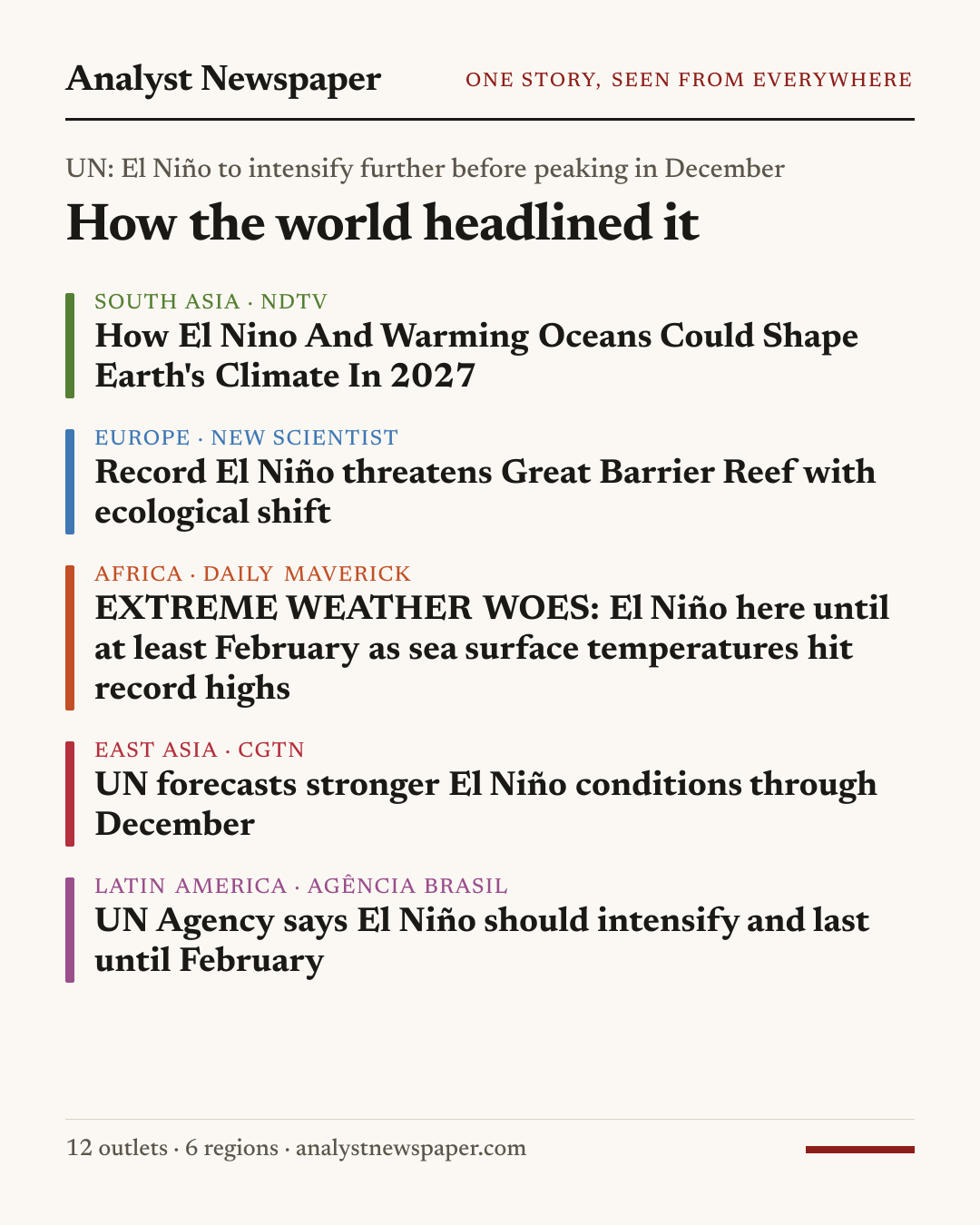
What happened
The World Meteorological Organization (WMO) said El Niño will continue to intensify before peaking in December.24678101112
The WMO said the event could be among the strongest since at least 1950.48101112
WMO Secretary-General Celeste Saulo said there is almost 100% probability El Niño will persist until February 2027.4
The UN's weather agency said El Niño, a naturally occurring phenomenon, will bring higher temperatures to much of the planet and shift rainfall patterns, compounding man-made climate change.781112
What's agreed
Reported consistently by outlets in more than one region.
Where accounts differ
Each account is attributed to who makes it. We do not judge between them.
How it's framed
What each perspective puts first, based on headlines and summaries.
| Perspective | How it reads | What it puts first |
|---|---|---|
| Western public broadcasters and wire-fed outletsEurope | France 24 and RTÉ News, both public broadcasters, lead with the UN warning and the comparison to the strongest El Niño since 1950, framing the story primarily around the WMO's own statements.810 | UN warning, strongest since 1950, man-made climate change compounding |
| South Asian privately owned outletsSouth Asia | Indian and Pakistani privately owned outlets cover the same WMO forecast and strength comparison; The Economic Times' headline uses the phrase 'turns fierce,' while Dawn and The Express Tribune use more measured, UN-attributed wording.91112 | record strength, strongest since 1950, global heat risks |
| African independent and private pressAfrica | Daily Maverick uses the phrase 'flashing red light' to describe sea surface temperatures and extends its outlook to February, while Channels Television reports the UN warning and its link to man-made climate change in more measured terms.17 | extreme weather, record sea surface temperatures, flashing red light |
| Chinese state mediaEast Asia | CGTN, a state-controlled outlet, presents the WMO forecast in measured, non-alarmist wording focused on temperature and rainfall pattern changes.2 | above-average temperatures, rainfall pattern changes, drought and flood risk |
| European science pressEurope | New Scientist, privately owned, shifts focus away from the global forecast to a specific ecological consequence, highlighting researcher concern about the Great Barrier Reef and raising the question of whether damage can be averted.3 | Great Barrier Reef, ecological shift, researcher concern |
| Latin American public broadcasterLatin America | Agência Brasil, a public broadcaster, provides the most detailed direct attribution to WMO Secretary-General Celeste Saulo, including a specific near-100% probability figure and a 2027 persistence date.4 | direct WMO quote, specific probability figure, long-range persistence to 2027 |
What the coverage leaves out
- None of the outlets reviewed reported specific regional damage figures, death tolls, or economic cost estimates linked to the forecast El Niño.
- None of the outlets reviewed reported detailed government or disaster-preparedness responses to the WMO forecast.
- Only Agência Brasil included the specific near-100% probability figure and the February 2027 persistence date; other outlets did not include this detail or cited the forecast differently.
Why it matters
El Niño is triggered by warming of surface sea temperatures in the central and eastern tropical Pacific beyond certain thresholds, and current temperatures were described as off the charts by Daily Maverick's reporting.1
The WMO's forecast comes via its monthly climate bulletin, with the agency warning that El Niño's impact compounds man-made climate change effects already driving extreme weather.47811
What to watch
- Whether El Niño peaks in December as forecast and whether it reaches the strength levels described by the WMO.
- Further WMO updates on the probability and duration of the event through February 2027.
- Reported impacts on specific ecosystems such as the Great Barrier Reef as the event intensifies.
Sources (12)
Every outlet we drew on, grouped by where it is based. Read the originals for the full reporting.
Latin America
- 4Agência BrasilBRPublic broadcaster
UN Agency says El Niño should intensify and last until February
Translated from Portuguese: Agência da ONU diz que El Niño deve se intensificar e ir até fevereiro
Europe
- 3New ScientistGBPrivate
Record El Niño threatens Great Barrier Reef with ecological shift
- 8France 24FRPublic broadcaster
- 10RTÉ NewsIEPublic broadcaster
Africa
- 1Daily MaverickZAIndependent
- 7Channels TelevisionNGPrivate
South Asia
- 5NDTVINPrivate
How El Nino And Warming Oceans Could Shape Earth's Climate In 2027
- 9The Economic TimesINPrivate
- 11DawnPKPrivate
- 12The Express TribunePKPrivate
El Nino forecast to reach record strength as global heat, weather risks rise: WMO
East Asia
- 2CGTNCNState-controlled