Yemen government forces and Houthis clash over control of Bab el-Mandeb Strait
Yemeni government forces backed by Saudi air power say they have retaken ground near a key Red Sea chokepoint, while Houthi forces deny losing territory and claim new strikes on Saudi Arabia. Accounts of who controls the strait, and of casualties, diverge sharply along the lines of the conflict.
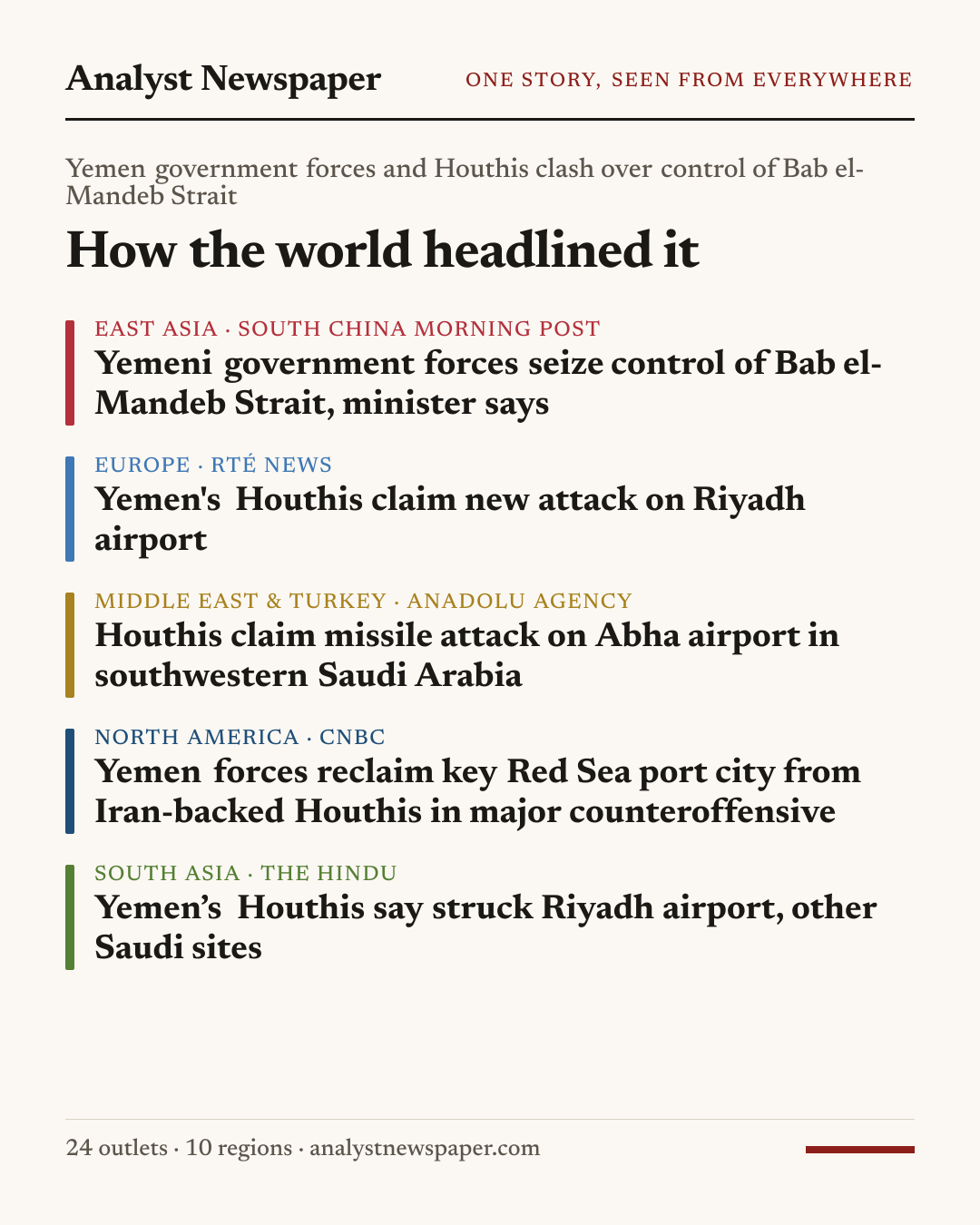
What happened
Yemeni government forces, backed by Saudi air power, launched a counteroffensive and claimed to have retaken strategic positions near the Bab el-Mandeb Strait, including the town of Dhubab, after Houthi forces had seized areas of the Red Sea coast in preceding weeks.1257141524
Houthi officials denied losing territory and said government claims of an advance were fabricated, while also claiming new missile and drone strikes on Riyadh's international airport, an Aramco refinery, Abha airport and military sites in Jazan.3469101318
Saudi Arabia said three people were wounded in Houthi strikes on airports and warned the public against filming or sharing images of missile and drone interceptions.2122
A Saudi airstrike on a marketplace in Taiz reportedly killed seven people and wounded 40 more, according to Houthi media reports, as the broader conflict was described as intertwined with wider Iran-US regional tensions and as having displaced more than 184,000 people according to the United Nations.91112
What's agreed
Reported consistently by outlets in more than one region.
- Yemeni government forces, backed by Saudi air power, launched an offensive and advanced on positions near the Bab el-Mandeb Strait, including the town of Dhubab, after Houthi forces had taken control of the Red Sea coast area in preceding weeks.125714151724
- Houthi forces claimed missile and drone strikes on Riyadh's King Khalid International Airport, an Aramco oil refinery, and other sites in southern Saudi Arabia.469101314182122
- The Houthis are widely described as Iran-backed, while the Yemeni government forces are backed by Saudi Arabia.1716171823
- Fighting has intensified and is widely described as escalating, with the conflict linked to broader regional tensions involving Iran.412132223
Where accounts differ
Each account is attributed to who makes it. We do not judge between them.
Control of the Bab el-Mandeb Strait and surrounding coastal area
Yemeni government and Saudi-backed outlets
Yemeni Information Minister Moammar al-Eryani said government forces had secured effective control of the strait, retaking the town of Dhubab with heavy Saudi air support.214
Houthi military spokesman, via TASS
Houthi spokesman Yahya Saria said the group retains control of captured territories and called reports of a government advance fabricated.34
The Express Tribune
Reported that while Yemeni troops retook coastal positions and advanced toward Mocha, rebels were simultaneously making gains around Taiz.24
Casualties from a Saudi strike on Taiz
Houthi media, reported by Punch
A Saudi airstrike on a central marketplace in Taiz killed seven people and wounded 40 more, according to Houthi media reports.11
Scale and effect of Houthi strikes on Saudi Arabia
Houthis
Houthis claimed direct hits on Riyadh's international airport, Abha airport, an Aramco refinery, and military sites in Jazan, saying the Abha strike disrupted air traffic.6910131418
Le Monde, citing Saudi Arabia
Saudi Arabia said three people were wounded in Houthi strikes on airports, a more limited casualty account than the scale implied by Houthi claims.21
How it's framed
What each perspective puts first, based on headlines and summaries.
| Perspective | How it reads | What it puts first |
|---|---|---|
| Saudi-aligned and Western outlets emphasizing government advancesNorth America | Frame the story around a Yemeni government counteroffensive retaking strategic ground, with attention to the economic stakes of oil markets and shipping.71623 | counteroffensive, oil price impact, strategic chokepoint |
| Yemeni and Egyptian outlets reporting government claimsAfrica | Report government and ministerial claims of retaking territory from Houthis near the strait, framed as a rollback of recent Houthi gains.12 | government advance, Saudi air support, trade route security |
| Russian state media reporting Houthi denialsRussia & Eurasia | Centers Houthi statements denying territorial loss and dismissing government claims as fabricated.313 | Houthi denial, disputed narrative, cross-border strikes |
| Gulf and Turkish outlets covering Saudi response and security measuresMiddle East & Turkey | Focus on Saudi Arabia's security measures and claimed Houthi strikes, including restrictions on filming interceptions and regional troop deployments.61522 | Saudi security measures, escalating strikes, coalition response |
| South Asian outlets emphasizing humanitarian and regional scaleSouth Asia | Emphasize the conflict's place within the wider regional war, citing UN displacement figures and describing Yemen as the most active front.91824 | humanitarian toll, regional war context, displacement figures |
| European outlets detailing operational and diplomatic specificsEurope | Provide detailed operational names and numbers, such as the aircraft count in Operation Yemen Dawn and competing claims about victories and casualties.1421 | operation details, competing claims, troop deployments |
| East and Southeast Asian state and private outletsEast Asia | Report government claims of control and Houthi counterclaims with relatively neutral framing, with Chinese state media linking the conflict to wider Iran-US tensions.21220 | ministerial statements, regional tension linkage |
| Oceania public and private outlets highlighting scale and historyOceania | Situate the operation within the Houthis' history of withstanding prior attacks and highlight Iranian weapons support alongside market-related pressures.817 | historical resilience, Iranian support, widening crisis |
| Malaysian commentarySoutheast Asia | An opinion piece frames Houthi attacks as testing the strategic patience of Saudi Arabia, Turkey and Pakistan, suggesting a possible turning point.19 | strategic threshold, regional patience |
What the coverage leaves out
- None of the outlets reviewed provided an independent, verified casualty count for the overall offensive beyond the Taiz marketplace strike and the Saudi-reported airport injuries.
- None of the outlets reviewed detailed the current, independently confirmed military map of who holds which specific territory along the coast.
- None of the outlets reviewed reported a direct Saudi or coalition government response to the Houthi claims of striking Riyadh airport and the Aramco refinery beyond the interior ministry's filming warning.
- None of the outlets reviewed explained the full details or timeline of the Pakistan and Turkey troop deployment referenced in one report.
Why it matters
Houthi control of the Bab el-Mandeb Strait area, a key route for oil and global shipping, had previously sent shock waves through energy markets, and oil prices remain elevated amid fears of further disruption.27
The United Nations says the fighting has become the most active front in the wider West Asia war in recent weeks and has displaced more than 184,000 people.9
Commentary suggests Houthi attacks may be testing the strategic patience of Saudi Arabia, Turkey and Pakistan, with Pakistan and Turkey reported to have agreed to deploy troops to Saudi Arabia.1419
What to watch
- Whether Yemeni government forces consolidate reported control over the Bab el-Mandeb Strait or face further Houthi counterattacks around Taiz.
- Further Houthi strikes on Saudi territory and any expanded Saudi or coalition military response.
- Developments regarding reported Pakistani and Turkish troop deployments to Saudi Arabia.
- Humanitarian conditions and displacement figures as the United Nations continues to track the conflict.
Sources (24)
Every outlet we drew on, grouped by where it is based. Read the originals for the full reporting.
North America
- 7CNBCUSPrivate
Yemen forces reclaim key Red Sea port city from Iran-backed Houthis in major counteroffensive
- 16The New York TimesUSPrivate
- 23The Washington PostUSPrivate
As Houthis capitalize on U.S-led war with Iran, fighting engulfs Yemen
Latin America
- 5Folha de S.PauloBRPrivate
Yemen forces reach disputed strait with the Houthis
Translated from Portuguese: Forças do Iêmen chegam a estreito disputado com os houthis
Europe
- 4RTÉ NewsIEPublic broadcaster
- 14EuronewsFRPrivate
Yemen government forces advance on Bab el-Mandeb in offensive against Houthis
- 21Le MondeFRPrivate
Houthis deny any retreat and claim new strikes in Saudi Arabia
Translated from French: Les houthistes démentent tout recul et revendiquent de nouvelles frappes en Arabie saoudite
Russia & Eurasia
- 3TASSRUState-controlled
Houthis say they retain control over captured territories in western Yemen
- 13RTRUState-controlled
Middle East & Turkey
- 6Anadolu AgencyTRState-controlled
Houthis claim missile attack on Abha airport in southwestern Saudi Arabia
- 15Al Jazeera EnglishQAState-controlled
- 22The NationalAEPrivate
Saudi Arabia warns against filming or sharing missile and drone interceptions
Africa
- 1Egypt IndependentEGPrivate
Saudi-backed Yemeni forces attack Houthis near key global trade route
- 11PunchNGPrivate
South Asia
- 9The HinduINPrivate
Yemen’s Houthis say struck Riyadh airport, other Saudi sites
- 18NDTVINPrivate
Iran-Backed Houthis Say They Attacked Riyadh Airport, Aramco Refinery
- 24The Express TribunePKPrivate
East Asia
- 2South China Morning PostHKPrivate
Yemeni government forces seize control of Bab el-Mandeb Strait, minister says
- 12CGTNCNState-controlled
Houthis report Saudi strikes as Iran urges dialogue to resolve crisis
- 20Taipei TimesTWPrivate
Southeast Asia
- 10CNASGState-controlled
Yemen's Houthis say they struck Riyadh airport, other Saudi sites
- 19Malay MailMYPrivate
Houthis are testing the patience of Saudi Arabia, Türkiye and Pakistan — Phar Kim Beng
Oceania
- 8ABC News (Australia)AUPublic broadcaster
- 17The Sydney Morning HeraldAUPrivate
Saudi-Backed Yemeni Government Declares War Against Houthis, Widening Crisis