US ban on Canadian alcohol and dairy takes effect amid ongoing trade war
The United States banned nearly $1 billion worth of Canadian alcohol, dairy and motorcycles as the trade war between the two countries continues without a resolution in sight, with outlets differing on how they frame the scale and origin of the dispute.
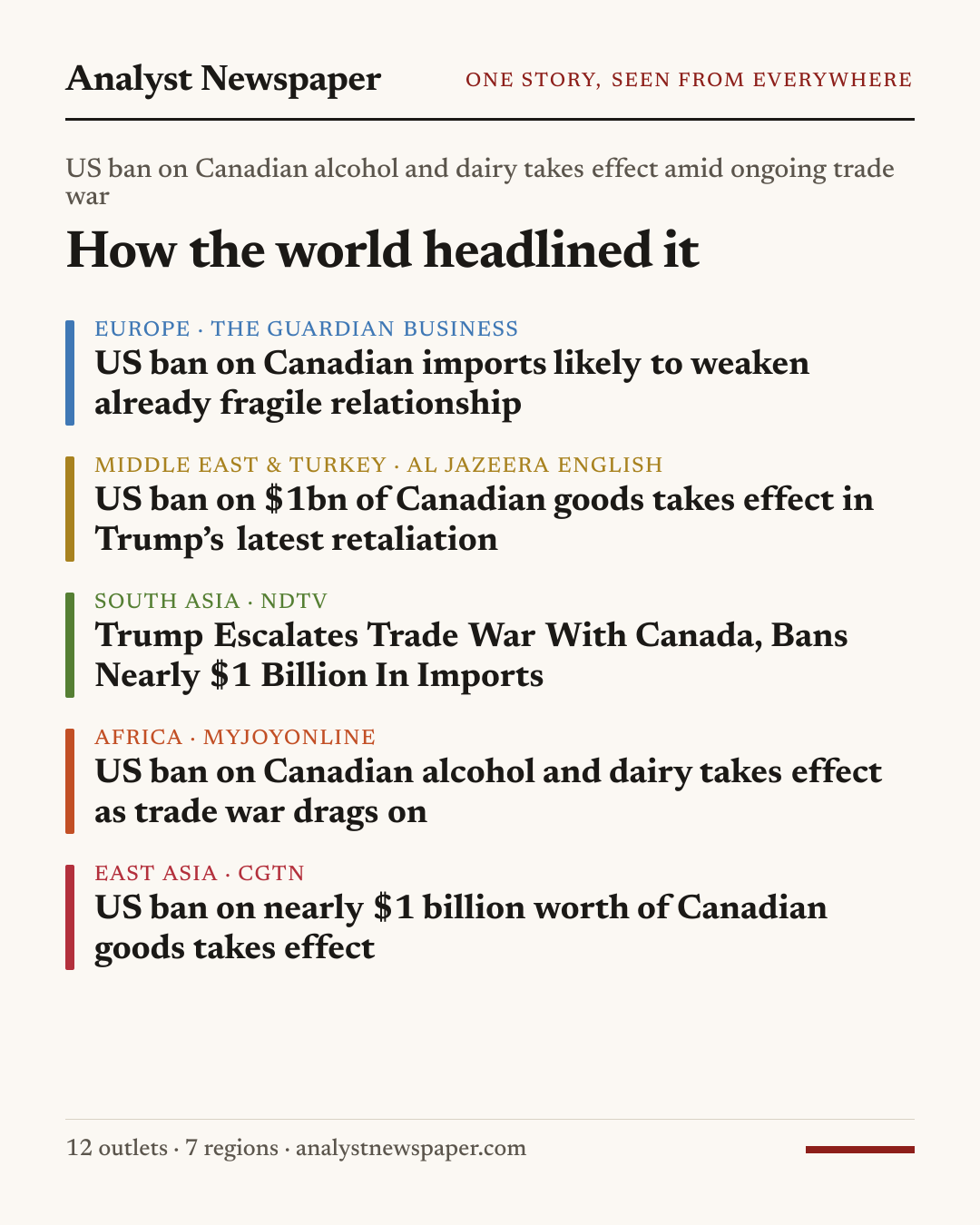
What happened
A US ban on nearly $1 billion worth of Canadian imports, including alcoholic beverages, dairy products and motorcycles, took effect this week.235789
The measure is widely described as the latest escalation in an ongoing trade war between the United States and Canada.37812
Canada has responded, or is responding, with tariffs of its own on US products.9105
According to BBC News Business, the ban follows the collapse of US-Canada trade negotiations in late August, with no indication of when talks might resume.12
What's agreed
Reported consistently by outlets in more than one region.
- A US ban on Canadian imports including alcoholic beverages, dairy products and motorcycles took effect.1234567891012
- The banned goods amount to nearly $1 billion in value.23578910
- The move is described as an escalation of the ongoing US-Canada trade war.37812
- Canada has responded or is responding with its own tariffs on US products.9105
Where accounts differ
Each account is attributed to who makes it. We do not judge between them.
Timeline and origin of the ban
Le Monde
The White House announced the measure on September 8 in response to Canada imposing new tariffs on American products, which itself followed US surcharges on Canadian exports.11
BBC News Business
The ban is the latest escalation after US-Canada trade negotiations collapsed in late August, with no word on when talks might resume.12
How it's framed
What each perspective puts first, based on headlines and summaries.
| Perspective | How it reads | What it puts first |
|---|---|---|
| North American outletNorth America | CNBC frames the story around the competing positions of Trump and Canadian officials on whether a deal will be reached, focusing on negotiating posture rather than the ban's economic scale.6 | Trump's expectation of Canadian concession, Canadian officials' refusal to accept a bad deal, product list details |
| European outletsEurope | European coverage (Guardian, DW, BBC) emphasizes the ban as part of a broader escalating and deteriorating trade war, with the Guardian noting the ban's small size relative to the overall US-Canada trade relationship and BBC highlighting collapsed negotiations with no resumption date.3812 | escalation of trade war, deteriorating relations, collapsed negotiations, small scale relative to total trade |
| French outletEurope | Le Monde presents a more sequential, tit-for-tat account, tracing the ban to a specific announcement date and framing it as a response to Canadian tariffs, which were themselves a response to earlier US surcharges.11 | specific announcement date, action-reaction sequence, reciprocal tariff history |
| State-controlled outlets (China, Qatar, Turkey)East Asia | CGTN, Al Jazeera and Anadolu Agency report the ban with factual emphasis on the dollar figure and reciprocal tariff actions, with Al Jazeera framing it explicitly as Trump's retaliation against Canadian counter-tariffs.259 | dollar value of ban, reciprocal tariff actions, retaliation framing |
| South Asian outletsSouth Asia | NDTV frames the ban as an escalation building on a summer history of US tariffs invoking a Great Depression-era law, while the Express Tribune runs a syndicated brief focused on the ban and Canada's tariff response.710 | historical tariff escalation, use of Great Depression-era law, brief factual summary |
| African and Latin American outletsAfrica | MyJoyOnline and Clarín provide concise factual accounts of the ban and affected products without extensive framing of blame or escalation dynamics.14 | list of banned products, factual, brief reporting |
What the coverage leaves out
- None of the outlets reviewed reported detailed reactions from Canadian alcohol, dairy or motorcycle producers or industry groups affected by the ban.
- None of the outlets reviewed reported specific economic impact estimates or job effects from the ban.
- None of the outlets reviewed detailed the full list or value of products Canada has imposed tariffs on in response.
- None of the outlets reviewed reported on public opinion in either country regarding the trade dispute.
Why it matters
The ban follows a broader pattern of tariff escalation, including a earlier 50% US tariff on about $20 billion of Canadian goods imposed over the summer under a Great Depression-era law, and Canadian counter-tariffs on $20 billion of US imports.75
The Guardian notes the banned goods represent a small fraction of the $880 billion in annual two-way US-Canada trade, even as the broader relationship deteriorates.3
What to watch
- Whether US-Canada trade negotiations resume, as no timeline has been reported.
- Whether Canada's tariff response escalates further or changes in scope.
Sources (12)
Every outlet we drew on, grouped by where it is based. Read the originals for the full reporting.
North America
Latin America
- 4ClarínARPrivate
Translated from Spanish: De motos a bebidas alcohólicas, ya rige el veto de Estados Unidos a las importaciones desde Canadá
Europe
- 3The Guardian BusinessGBPrivate
US ban on Canadian imports likely to weaken already fragile relationship
- 8Deutsche WelleDEPublic broadcaster
US ban on Canadian alcohol, dairy products and motorcycles takes effect as trade dispute escalates
- 11Le MondeFRPrivate
Washington bans imports of certain Canadian products, including alcohols
Translated from French: Washington interdit l’importation de certains produits canadiens, dont des alcools
- 12BBC News BusinessGBPublic broadcaster
US ban on Canadian alcohol and dairy comes into effect as trade war drags on
Middle East & Turkey
- 5Al Jazeera EnglishQAState-controlled
US ban on $1bn of Canadian goods takes effect in Trump’s latest retaliation
- 9Anadolu AgencyTRState-controlled
Africa
- 1MyJoyOnlineGHPrivate
US ban on Canadian alcohol and dairy takes effect as trade war drags on
South Asia
- 7NDTVINPrivate
Trump Escalates Trade War With Canada, Bans Nearly $1 Billion In Imports
- 10The Express TribunePKPrivate
East Asia
- 2CGTNCNState-controlled
US ban on nearly $1 billion worth of Canadian goods takes effect