IMF and World Bank issue upgraded 2026 growth forecasts across regions
The World Bank's upgrade of sub-Saharan Africa's 2026 growth forecast to 4.3% coincides with a round of revised global and national forecasts from the IMF and other bodies, with outlets emphasizing different regions, numbers and caveats.
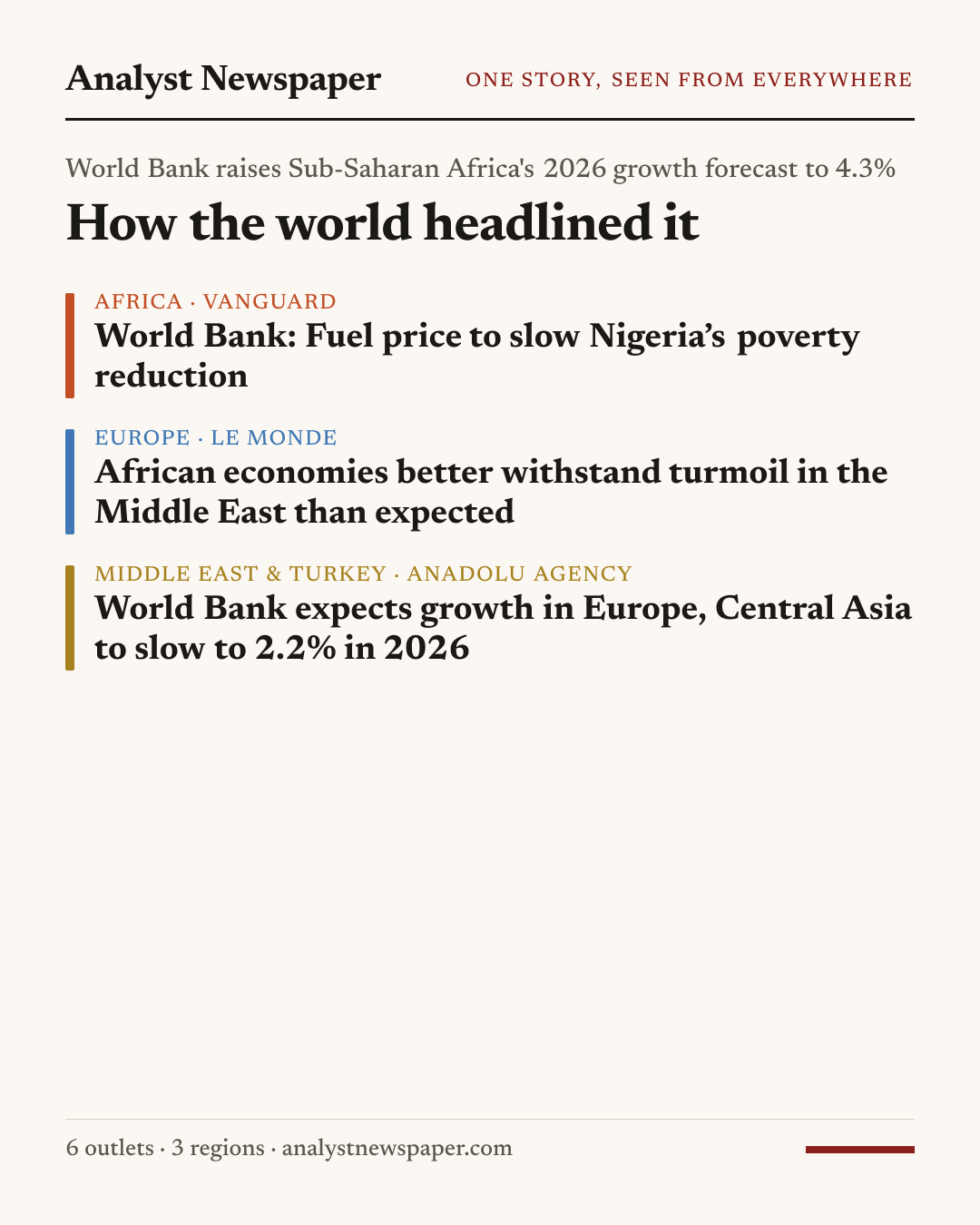
What happened
The World Bank raised its 2026 growth forecast for sub-Saharan Africa from 4.1% to 4.3%, attributing the upgrade to stronger performance among oil and raw materials exporting countries.15
The revision coincides with the IMF's October World Economic Outlook, which projects global growth of around 3% to 3.1% in 2026 and, in the same report, raises forecasts for countries including Nigeria, India, Japan and Saudi Arabia.9121722171626
Within Africa, the IMF also raised Nigeria's 2026 growth forecast to 4.2%, a figure Nigerian outlets reported alongside warnings from the IMF and ActionAid Nigeria about continued economic hardship.1202314
Separately, UNCTAD's Trade and Development Report 2026 projected a slowdown in global and developing-economy growth, a figure that differs from the IMF projections reported elsewhere.21
What's agreed
Reported consistently by outlets in more than one region.
Where accounts differ
Each account is attributed to who makes it. We do not judge between them.
Global growth forecast for 2026
IMF, as reported by Ghanaian, Turkish and Nigerian outlets
IMF, as reported by Channels Television
Global growth projected at 3% in 2026, possibly a rounded version of the same IMF figure reported elsewhere as 3.1%22
UNCTAD, as reported by Dawn
Global economic growth projected to slow to 2.6% in 2026 and 2.7% in 2027, with developing economy growth falling to 4% from 4.7%21
Whether rising African and Nigerian growth figures represent good news
World Bank, as reported by Le Monde
African economies, especially oil and commodity exporters, are withstanding Middle East turmoil better than expected, with upgraded growth forecasts15
ActionAid Nigeria
Nigeria's 4.2% GDP growth is insufficient to reduce poverty; double-digit growth and single-digit inflation are needed14
Nigeria's 2026 growth forecast
How it's framed
What each perspective puts first, based on headlines and summaries.
| Perspective | How it reads | What it puts first |
|---|---|---|
| Nigerian private and independent pressAfrica | Nigerian outlets focus heavily on the IMF's 4.2% growth forecast for Nigeria specifically, often pairing the figure with commentary on continued economic hardship, poverty and the adequacy of the growth rate.11420232217 | domestic growth figure, poverty and suffering, inadequacy of growth, ranking among peers |
| European outletsEurope | European coverage includes a piece examining patterns in the IMF's past forecasts showing growth running higher than predicted, alongside a focus on upgraded African projections linked to commodity exports, and syndicated global coverage of a 'split' outlook.111518 | IMF forecasting patterns, commodity-driven African resilience, global economic divergence |
| South Asian outletsSouth Asia | Indian outlets emphasize India's upgraded growth forecast and its status as the fastest-growing major economy, framing this positively, while a Pakistani outlet instead highlights a separate UNCTAD report warning of a global slowdown.7161921 | India's growth upgrade, fastest-growing major economy, contrasting UNCTAD slowdown warning |
| Middle Eastern and Turkish outletsMiddle East & Turkey | Coverage contrasts a celebratory framing of Saudi Arabia's projected growth outpacing the global average with a more alarmed framing of severe contractions forecast for the wider Middle East and Central Asia region.612 | Saudi outperformance, regional contraction, global growth context |
| East Asian state-controlled and private outletsEast Asia | Coverage is country-specific and largely neutral in tone, reporting Japan's upgraded forecast and Ethiopia's projected double-digit growth without broader comparative framing.210 | country-specific forecasts, neutral tone |
| Russian and Eurasian coverageRussia & Eurasia | State-controlled Russian media attributes a slight growth slowdown to domestic full employment, while an independent Latvian-based outlet reports the IMF's external downward revision for Russia's growth forecast.34 | domestic explanation for slowdown, external forecast cut |
What the coverage leaves out
- None of the outlets reviewed detail the specific methodology or data behind the World Bank's upward revision of sub-Saharan Africa's growth forecast beyond attributing it to oil and raw materials exporters.
- None of the outlets reviewed report reactions from African governments or regional bodies to the World Bank's revised 4.3% forecast specifically.
- Coverage does not clarify why global growth figures differ between IMF reports (3%, 3.1%) and the UNCTAD report (2.6%-2.7%), leaving the relationship between these projections unexplained.
Why it matters
The upward revisions for Africa and other regions come as the IMF describes the global economy as resilient but unevenly so, with low-income and energy-importing economies facing continued pressure from food and energy costs.17202312
What to watch
- Further country-level breakdowns of how African oil and commodity exporters versus importers are affected by global energy and food price trends, as referenced by the IMF and World Bank.
- Whether African governments respond to IMF calls, as reported by Channels Television, to protect vulnerable households amid rising costs.
Sources (23)
Every outlet we drew on, grouped by where it is based. Read the originals for the full reporting.
Latin America
- 5Agência BrasilBRPublic broadcaster
IMF projects 2.2% growth for Brazil's GDP in 2026
Translated from Portuguese: FMI prevê crescimento de 2,2% do PIB do Brasil em 2026
Europe
- 4MeduzaLVIndependent
- 11Financial TimesGBPrivate
- 15Le MondeFRPrivate
African economies better withstand turmoil in the Middle East than expected
Translated from French: Les économies africaines résistent mieux que prévu aux turbulences au Moyen-Orient
- 18France 24FRPublic broadcaster
IMF upgrades 2026 growth forecast but warns of 'split' outlook
Russia & Eurasia
- 3TASSRUState-controlled
Russia’s 2026 GDP growth to slow slightly from last year — Central Bank Deputy Chief
Middle East & Turkey
- 6Arab NewsSAPrivate
Saudi Arabia to outpace global growth with 7.9% expansion in 2027: IMF
- 12Anadolu AgencyTRState-controlled
Global economy to grow 3.1% in 2026 amid severe Middle East contractions, IMF forecasts
Africa
- 1BusinessDayNGPrivate
Nigeria trails African peers as IMF places 2026 growth in the middle of the pack
- 9MyJoyOnlineGHPrivate
Global economy proving resilient, growth projected at 3.1% in 2026 – IMF
- 14PunchNGPrivate
- 17Premium TimesNGIndependent
IMF forecasts 3.1% global growth in 2026, says economic resilience under strain
- 20VanguardNGPrivate
- 22Channels TelevisionNGPrivate
- 23NairametricsNGPrivate
BREAKING: IMF raises Nigeria’s growth forecast to 4.2%, acknowledges Nigerians are suffering
South Asia
- 7MintINPrivate
IMF raises India’s FY27 growth forecast by 60 bps to 7% on strong domestic demand
- 13The HinduINPrivate
IMF upgrades 2026 growth forecast but warns of ‘split’ outlook
- 16NDTVINPrivate
India Remains World's Fastest-Growing Major Economy At 7% For 2026, 2027: IMF
- 19The Economic TimesINPrivate
- 21DawnPKPrivate
East Asia
- 2The Japan TimesJPPrivate
- 10CGTNCNState-controlled
Southeast Asia
- 8AntaraIDState-controlled
Indonesia targets eight percent growth to capture demographic bonus