World Leaders Visit Tuvalu as Pacific Nation Faces Rising Seas
Outlets covered a gathering of world leaders in Tuvalu, with some emphasizing climate justice advocacy and existential risk, and others offering more event-focused accounts.
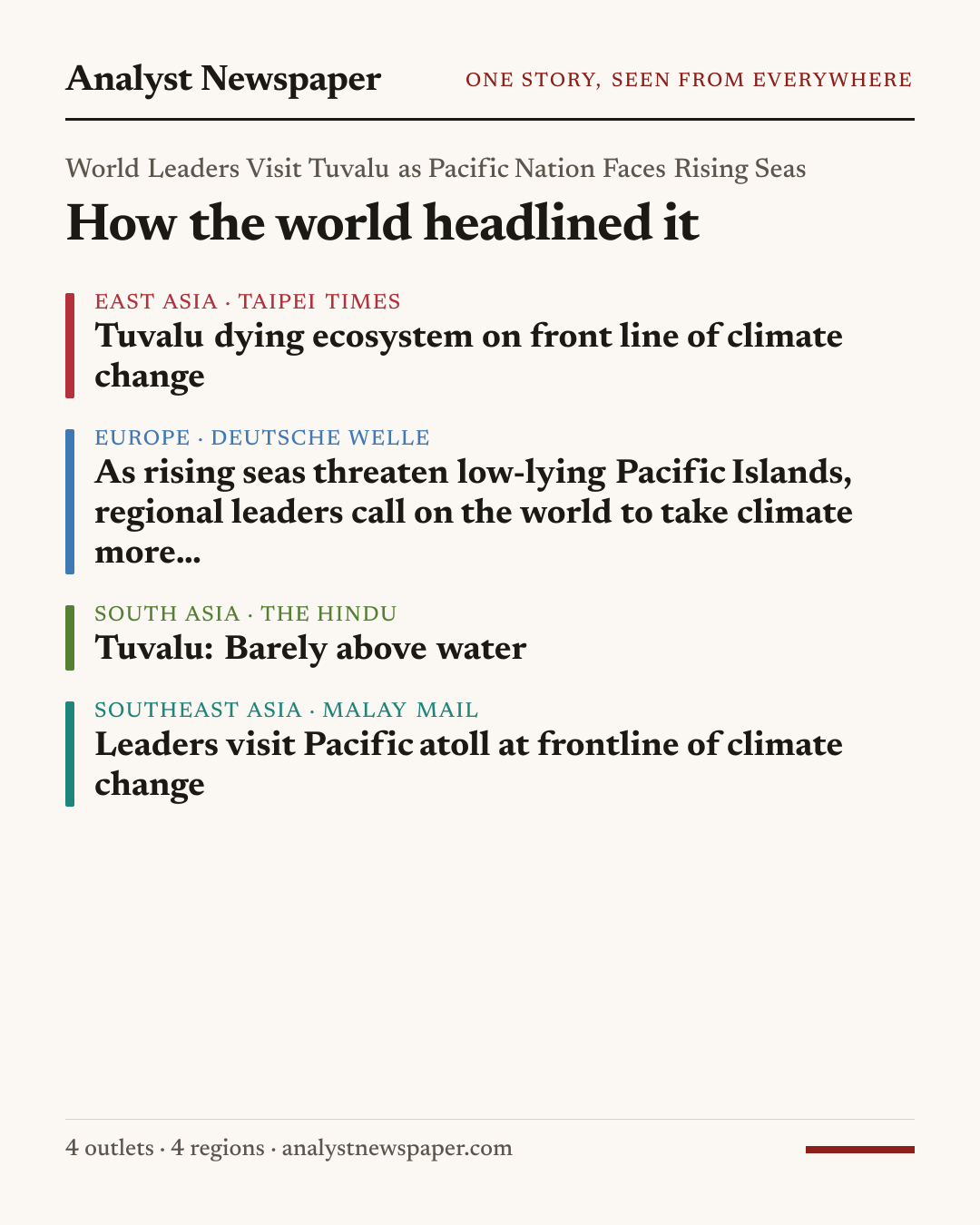
What happened
More than a dozen world leaders traveled to Funafuti, Tuvalu, on October 5, in a visit tied to international climate concerns.4
Pacific island nations, including Tuvalu, have called on global leaders to take stronger action on climate change and fossil fuel emissions.2
Rising sea levels are reported as a significant and worsening threat to Tuvalu's low-lying terrain.23
Some scientists cited in coverage warn that Tuvalu's islands could become unliveable by the end of the century.3
What's agreed
Reported consistently by outlets in more than one region.
How it's framed
What each perspective puts first, based on headlines and summaries.
| Perspective | How it reads | What it puts first |
|---|---|---|
| East Asian privately owned pressEast Asia | Taipei Times' headline describes Tuvalu as a "dying ecosystem" on the "front line of climate change"; only the headline is available for this outlet.1 | dying ecosystem, front line of climate change |
| European public broadcasterEurope | Deutsche Welle emphasizes political advocacy, framing the visit as a call for climate justice and criticism of fossil fuel use.2 | climate justice, burning fossil fuels, invited world leaders |
| South Asian privately owned pressSouth Asia | The Hindu cites scientists' fears that the archipelago could become unliveable by the end of the century.3 | rising sea levels, unliveable by century's end, scientific concern |
| Southeast Asian privately owned pressSoutheast Asia | Malay Mail offers a neutral, event-focused account of the leaders' visit without strong framing language.4 | diplomatic visit, frontline of climate change, factual tone |
What the coverage leaves out
- None of the outlets reviewed specified which world leaders attended or what commitments, if any, emerged from the visit.
- None of the outlets reviewed detailed the scientific basis or data behind projections of Tuvalu's uninhabitability.
- None of the outlets reviewed reported reactions from global fossil fuel-producing nations or international climate bodies.
Why it matters
Sources (4)
Every outlet we drew on, grouped by where it is based. Read the originals for the full reporting.
Europe
- 2Deutsche WelleDEPublic broadcaster
South Asia
- 3The HinduINPrivate
East Asia
- 1Taipei TimesTWPrivate
Southeast Asia
- 4Malay MailMYPrivate