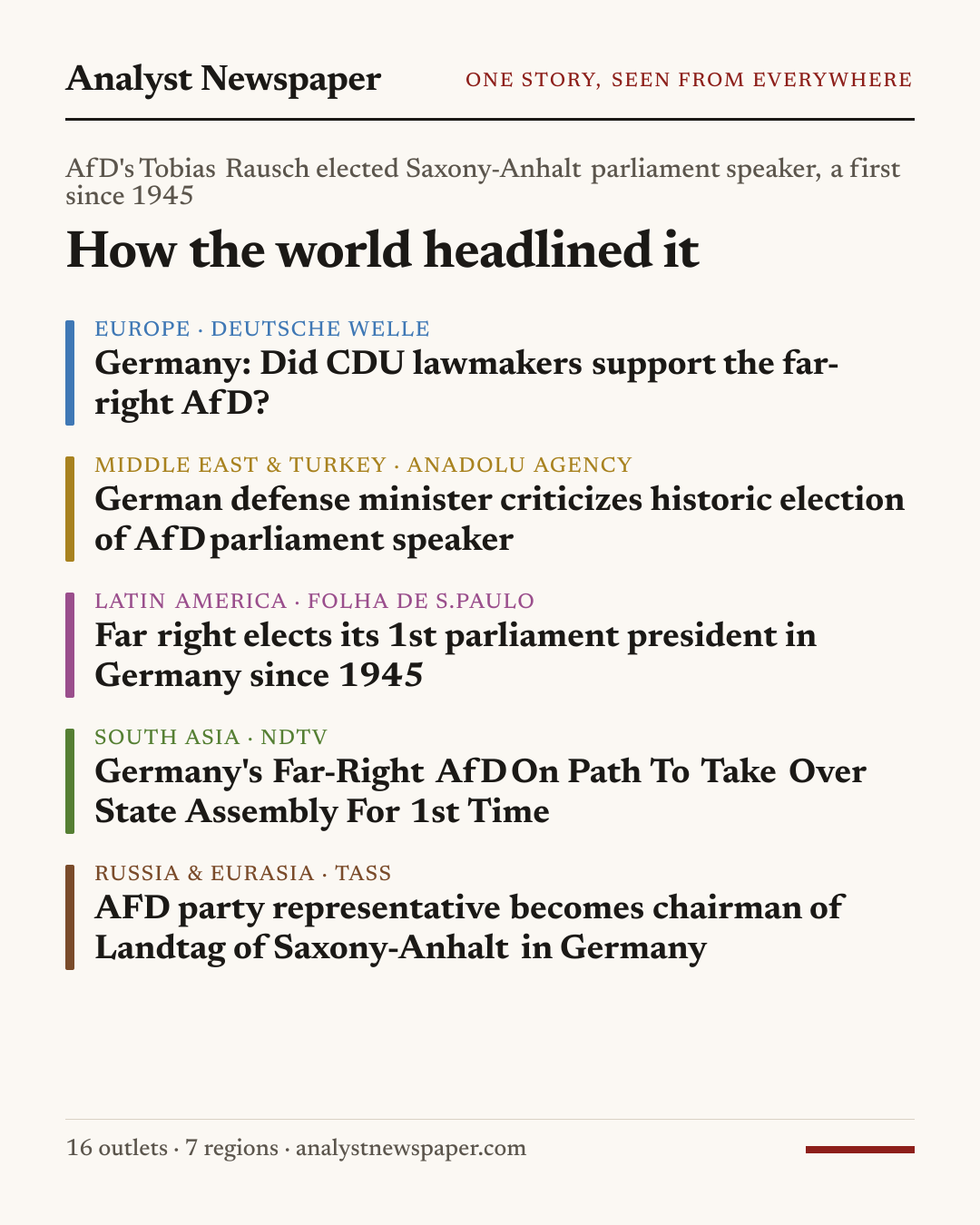
AfD's Tobias Rausch elected Saxony-Anhalt parliament speaker, a first since 1945
The far-right AfD won the presidency of a German state parliament for the first time since the Nazi era, with outlets differing on whether CDU lawmakers crossed party lines to back the AfD candidate and on how the result should be understood historically.
What happened
Tobias Rausch, a 35-year-old AfD politician and former estate agent, was elected president (speaker) of the Saxony-Anhalt state parliament in Magdeburg on Tuesday, October 6, in the first round of voting.13814
The Guardian reported Rausch won 48 of the 82 votes cast; Le Monde reported the total was higher than expected, which it said raises suspicions of defections in conservative ranks, without giving its own vote count.812
This is the first time since 1945, or since the Nazi era, that a far-right party has held the presidency of a German regional parliament.35891516
The election follows the AfD's strong performance in Saxony-Anhalt's state election a month earlier, after which the party has struggled to find a path to forming the state government.671011
What's agreed
Reported consistently by outlets in more than one region.
- Tobias Rausch of the AfD was elected president/speaker of the Saxony-Anhalt state parliament on October 6 in Magdeburg.13814
- This marks the first time a far-right party has held the presidency of a regional German parliament since 1945/the Nazi era.358916
- The AfD had recently won Saxony-Anhalt's state election but, a month on, still lacked a clear path to forming the state government.710
- Migrants in Saxony-Anhalt have expressed fear about deportations and asylum restrictions following the AfD's electoral gains.1113
Where accounts differ
Each account is attributed to who makes it. We do not judge between them.
Whether CDU lawmakers supported the AfD candidate, and what the vote margin implies
Deutsche Welle
Reported that CDU lawmakers may have voted for the AfD candidate, which Germany's Social Democrats called a 'unique breach of taboos.'2
El País
Reported Rausch will lead the chamber with the support of the nationalist left and CDU deputies, and quoted an unspecified supporter saying the 'cordon sanitaire' has ended.15
Le Monde
Reported Rausch was elected with a higher vote total than expected, which it said raises suspicions of defections in conservative ranks, without confirming CDU support or giving a specific count.12
How it's framed
What each perspective puts first, based on headlines and summaries.
| Perspective | How it reads | What it puts first |
|---|---|---|
| Russian state mediaRussia & Eurasia | TASS's report is a brief, headline-only item giving procedural details of Rausch's election; the limited text does not permit a broader characterization of its editorial framing.1 | procedural facts, first round of voting |
| German domestic mediaEurope | Deutsche Welle emphasized the political controversy of possible CDU defection to support the AfD candidate and quoted Social Democrat alarm over a 'taboo' being broken.2 | CDU collusion allegations, taboo breach, Social Democrat warnings |
| Western public broadcasters and major outlets (US, UK)Europe | The Guardian, BBC, and the New York Times (US) framed the event as historically significant, tying it explicitly to the Nazi era and World War II, with the Guardian and NYT using alarmed or critical tones while the BBC noted the role is largely symbolic.5814 | Nazi-era comparison, historic first, symbolic significance |
| Latin American outletsLatin America | Folha de S.Paulo and Clarín both invoked historical or ideological framing; Folha quoted an opposition politician's comparison of Rausch to Hermann Göring, while Clarín described AfD as anti-immigration and pro-Russia.39 | historical parallels, critical quotes from opposition sources, party ideology labels |
| Middle East and Turkish outletsMiddle East & Turkey | Anadolu Agency highlighted criticism from Germany's defense minister accusing Democrats of enabling right-wing extremism, while Arab News and the Jerusalem Post focused on migrant fears and the AfD's struggle to form a government.41013 | government criticism, migrant anxiety, party history |
| South Asian outletsSouth Asia | NDTV and The Hindu emphasized the AfD's strong vote share and the CDU's political weakness, alongside migrant concerns about deportations and asylum restrictions.611 | vote percentages, CDU decline, migrant fears |
| Southeast Asian and European financial pressSoutheast Asia | The Straits Times and Financial Times used comparatively neutral, procedural framing, focusing on the AfD's continued struggle to form a government despite the speaker win.716 | government formation struggle, neutral tone, procedural update |
| Spanish and French pressEurope | El País and Le Monde both highlighted the political mechanics behind Rausch's win, including possible cross-party support and defections, with El País quoting a supporter declaring the end of the 'cordon sanitaire.'1215 | coalition dynamics, defection suspicions, end of political isolation |
What the coverage leaves out
- None of the outlets reviewed detailed how individual CDU lawmakers voted or confirmed the exact number of CDU defections, beyond speculation.
- None of the outlets reviewed reported a response from Tobias Rausch himself regarding his election or his policy plans as speaker.
- None of the outlets reviewed explained in detail what powers or responsibilities the Saxony-Anhalt parliament presidency carries, beyond BBC's note that the role is largely symbolic.
- None of the outlets reviewed reported on reactions from AfD's national leadership regarding the election.
Why it matters
The AfD took nearly 44 percent of the vote in Saxony-Anhalt's state election last month, beating the CDU of Chancellor Friedrich Merz.6
The AfD was founded in 2013 as a eurosceptic movement and has since built support through hardline opposition to immigration, particularly after roughly one million people arrived in Germany in 2015.10
The election of the head of Saxony-Anhalt's regional executive is expected in December.12
What to watch
- The election of the head of Saxony-Anhalt's regional executive, expected in December.
- Whether the AfD can form a state government following its election win.
- Further scrutiny of CDU lawmakers' voting behavior in the speaker election.
Sources (16)
Every outlet we drew on, grouped by where it is based. Read the originals for the full reporting.
North America
- 5The New York TimesUSPrivate
Lawmakers Set to Elect Germany’s 1st Far-Right Statehouse Speaker Since 1945
Latin America
- 3Folha de S.PauloBRPrivate
Far right elects its 1st parliament president in Germany since 1945
Translated from Portuguese: Extrema direita elege seu 1º presidente de Parlamento na Alemanha desde 1945
- 9ClarínARPrivate
German far-right achieves regional parliament presidency for first time since 1945
Translated from Spanish: La ultraderecha alemana logra por primera vez desde 1945 la presidencia de un Parlamento regional
Europe
- 2Deutsche WelleDEPublic broadcaster
- 8The GuardianGBPrivate
State parliament elects Germany’s first far-right speaker since second world war
- 12Le MondeFRPrivate
German far-right secures presidency of a regional parliament, a first since 1945
Translated from French: L’extrême droite allemande décroche la présidence d’un Parlement régional, une première depuis 1945
- 14BBC NewsGBPublic broadcaster
AfD candidate elected speaker of German regional parliament for first time
- 15El PaísESPrivate
Translated from Spanish: La extrema derecha consigue la primera presidencia de un Parlamento en Alemania: “Terminó la idiotez del cordón sanitario”:
- 16Financial TimesGBPrivate
German far-right set to secure its first ever regional parliament president
Russia & Eurasia
- 1TASSRUState-controlled
AFD party representative becomes chairman of Landtag of Saxony-Anhalt in Germany
Middle East & Turkey
- 4Anadolu AgencyTRState-controlled
German defense minister criticizes historic election of AfD parliament speaker
- 10The Jerusalem PostILPrivate
AfD struggles to form government in Germany despite landmark election victory
- 13Arab NewsSAPrivate
Far-right election win leaves migrants questioning their future in eastern Germany
South Asia
Southeast Asia
- 7The Straits TimesSGPrivate
Germany's far-right AfD struggles to form first state government after landmark win