US Treasury yields climb to multi-year highs; outlets differ on benchmarks and causes
Long-term US bond yields have jumped to levels not seen in years, but outlets differ on the exact benchmarks, the Treasury maturities and timeframe of comparison, and what is driving the move.
What happened
US Treasury yields rose sharply, with outlets citing different benchmarks: the 30-year yield reportedly hit its highest level since 2004, the 10-year touched a post-financial-crisis high, and other reports described yields as the highest since 2007 or 2002.12161810
The rise in yields has been linked to US mortgage rates jumping the most in four years, creating difficult conditions for homebuilders and buyers.2
Some coverage reports the bond selloff easing and yields retreating from recent highs as buyers return to the Treasury market, with global shares rising ahead of US jobs data.1113
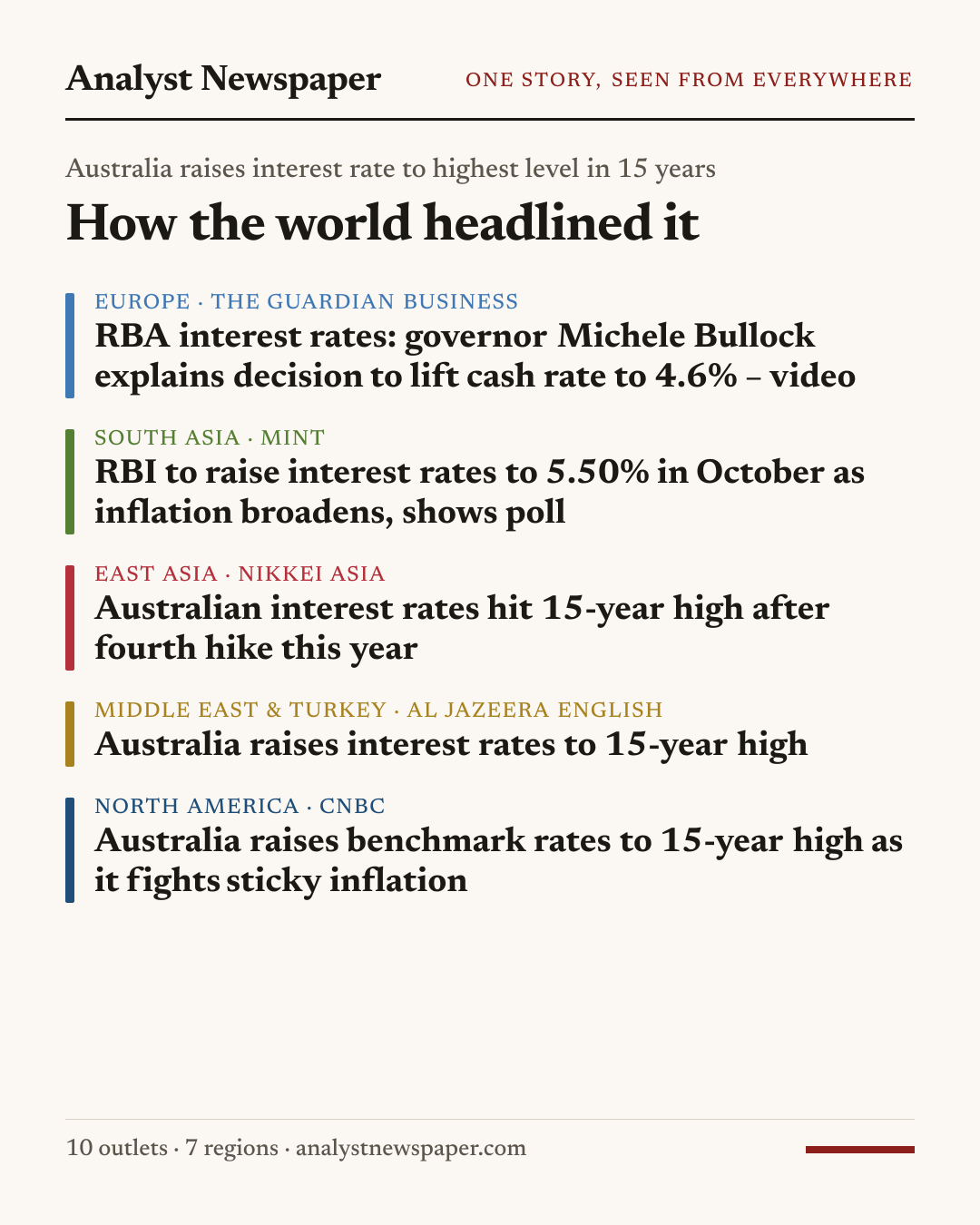
Central banks elsewhere have also raised rates: the Reserve Bank of Australia lifted its cash rate to 4.6%, its highest since 2011. Separately, a Bank of Japan board opinion summary suggests some members are weighing further hikes amid concern about inflation overshoot, though it offers no clear signal on timing.14171518
What's agreed
Reported consistently by outlets in more than one region.
Where accounts differ
Each account is attributed to who makes it. We do not judge between them.
What historical benchmark and which US Treasury maturity are being compared
The Economic Times
The 30-year US Treasury yield rose to its highest level since 2004, reaching 5.444%, while the 10-year yield touched a post-financial-crisis high of 5.145%.12
Le Monde
The ten-year US Treasury yield reached 5.1%, its highest level since July 2007.18
The New York Times
US bond yields hit their highest level since 2002.16
The National
US bond yields have hit an 18-year high.10
What is driving the rise in yields
The New York Times
The war in Iran and high government debt levels are contributing to rising yields, trends described as unlikely to dissipate soon.16
Le Monde
Economic strength, inflation, growth and persistently high oil prices are reinforcing a continued rise in Fed policy rates.18
Bank Indonesia, as reported by Antara
Antara's report, citing Bank Indonesia, states the Federal Reserve is expected to make one further rate hike in the fourth quarter of 2026 amid surging energy prices; the underlying snippet is truncated and the basis for the forecast is not fully clear.7
Direction of recent bond market movement
The Economic Times
The bond selloff intensified, with yields surging to multi-year highs amid strong growth and inflation data, described as a worsening crisis.12
How it's framed
What each perspective puts first, based on headlines and summaries.
| Perspective | How it reads | What it puts first |
|---|---|---|
| US financial mediaNorth America | US outlets frame the yield moves as creating uncertainty and tension for investors, with some noting a tug of war between sellers and buyers in the Treasury market.411 | bond market whiplash, investor uncertainty, buyers stepping back in |
| South Asian financial pressSouth Asia | Indian outlets use dramatic language describing a bond crisis worsening and yields surging, alongside separate coverage of domestic central bank rate forecasts from Nomura.126 | crisis framing, surge, multi-year highs |
| European outletsEurope | European coverage spans critical framing of US mortgage market strain, neutral reporting of French debt levels and economic pessimism, and factual accounts of Australian rate hikes affecting mortgage holders.29171418 | challenging housing conditions, economic pessimism, mortgage holder impact |
| Anadolu Agency (Middle East-based state-controlled outlet)Middle East & Turkey | Anadolu Agency reports sectoral divergence in US markets in neutral, factual terms, distinct from other outlets in the region.3 | sectoral divergence, neutral market reporting |
| Al Jazeera (Middle East-based state-controlled outlet)Middle East & Turkey | Al Jazeera reports Australia's rate rise, describing inflation there as 'stubborn.'15 | stubborn inflation, rate rise |
| The National (Middle East-based private outlet)Middle East & Turkey | The National's available snippet is a show introduction referencing 'tariff turmoil,' 'stock shocks' and global financial 'flux'; this language describes the show's framing rather than detailed analysis of the yield move itself.10 | show introduction, general market flux language |
| East Asian financial pressEast Asia | Japanese outlets focus narrowly and neutrally on the Bank of Japan's internal debate over rate hikes tied to inflation overshoot, without directly linking this to US Treasury movements. One source (Nikkei Asia) is headline-only, so claims from it are limited to the headline's wording.18 | BOJ policy debate, inflation overshoot, accommodative conditions |
| Southeast Asian state-controlled outletsSoutheast Asia | State-controlled outlets report a more measured picture, noting an easing bond selloff and, per one outlet citing Indonesia's central bank, a forecast of a further Fed hike in 2026 tied to energy prices.137 | selloff easing, global shares rising, single-source Fed forecast |
| Oceania outletsOceania | Australian coverage emphasizes the domestic impact of rate rises on regional businesses and mortgage costs, using terms like a snowball effect.51417 | snowball effect, business cost pressure, mortgage repayment costs |
What the coverage leaves out
- None of the outlets reviewed provided a single, consistent explanation reconciling the different reported benchmark comparisons (2002, 2004, 2007, 18-year high) for US Treasury yields, which also reference different maturities (10-year, 30-year, unspecified).
- None of the outlets reviewed detailed how the reported yield retreat and easing selloff (S11, S13) relate in time to the reports of yields hitting multi-year highs (S12, S16, S18).
- None of the outlets reviewed explained in detail how the referenced war in Iran is mechanically linked to US Treasury yield movements.
- None of the outlets reviewed reported reactions from the US Federal Reserve or US Treasury officials to the yield surge.
- Antara's report on Bank Indonesia's Fed rate forecast is based on a truncated snippet, and no other outlet corroborates the specific 2026 timeframe.
Why it matters
Rising long-term yields are linked to higher US mortgage rates, which are described as posing challenges for homebuilders and buyers.2
Central banks in Australia and Japan are separately navigating their own rate decisions amid inflation concerns, occurring alongside the US yield moves. A Bank of Japan board opinion summary indicates the board debated more rate hikes, per Nikkei Asia's headline, though further interpretive detail is not confirmed beyond that headline.141718
A Bank of Japan board opinion summary shows a shift toward curbing inflation overshoot and indicates the board debated more rate hikes, though it offers no clear signal on timing.18
What to watch
- Upcoming US jobs report, which several outlets note investors are awaiting for signals on the Treasury market direction.
- Whether the Bank of Japan proceeds with another rate hike this year, as suggested by its board's opinion summary.
- Whether the Federal Reserve moves forward with a further rate hike; Indonesia's central bank (BI) forecasts one more hike in Q4 2026, per state-run Antara, though this is a single institution's forecast based on a truncated source snippet.
Sources (18)
Every outlet we drew on, grouped by where it is based. Read the originals for the full reporting.
North America
- 4CNBCUSPrivate
- 11MarketWatchUSPrivate
Bond yields suddenly retreat from recent highs as buyers step back into the Treasury market
- 16The New York TimesUSPrivate
Europe
- 2Financial TimesGBPrivate
US mortgage rates jump the most in four years in blow to housing market
- 9Politico EuropeBEPrivate
- 14The Guardian BusinessGBPrivate
RBA interest rates: governor Michele Bullock explains decision to lift cash rate to 4.6% – video
- 17The GuardianGBPrivate
RBA interest rates: Reserve Bank hikes cash rate to 4.6%, the highest level since 2011
- 18Le MondeFRPrivate
In the United States, economic strength and expensive oil trigger a new surge in rates
Translated from French: Aux Etats-Unis, la vigueur de l’économie et le pétrole cher provoquent une nouvelle poussée des taux
Middle East & Turkey
- 3Anadolu AgencyTRState-controlled
US stock markets show mixed results with inflation concerns, bond market pressures in Q3
- 10The NationalAEPrivate
Manus on Markets: US bond yields hit 'juicy' 18-year high - is it time to buy?
- 15Al Jazeera EnglishQAState-controlled
South Asia
East Asia
- 1The Japan TimesJPPrivate
BOJ board opinion summary shows shift in focus to curbing inflation overshoot
- 8Nikkei AsiaJPPrivate
BOJ debated more rate hikes to adjust 'accommodative' conditions: opinion summary
Southeast Asia
- 7AntaraIDState-controlled
- 13CNASGState-controlled
Oceania
- 5ABC News (Australia)AUPublic broadcaster
'Snowball effect' hitting as companies react to rates rise, growing costs