Debt and revenue reports diverge across South Asia, Southeast Asia and Nigeria
Finance ministries and central banks in South Asia and Southeast Asia reported rising public and external debt, while Nigeria posted gains in state revenue and current account surplus alongside a drop in education spending share.
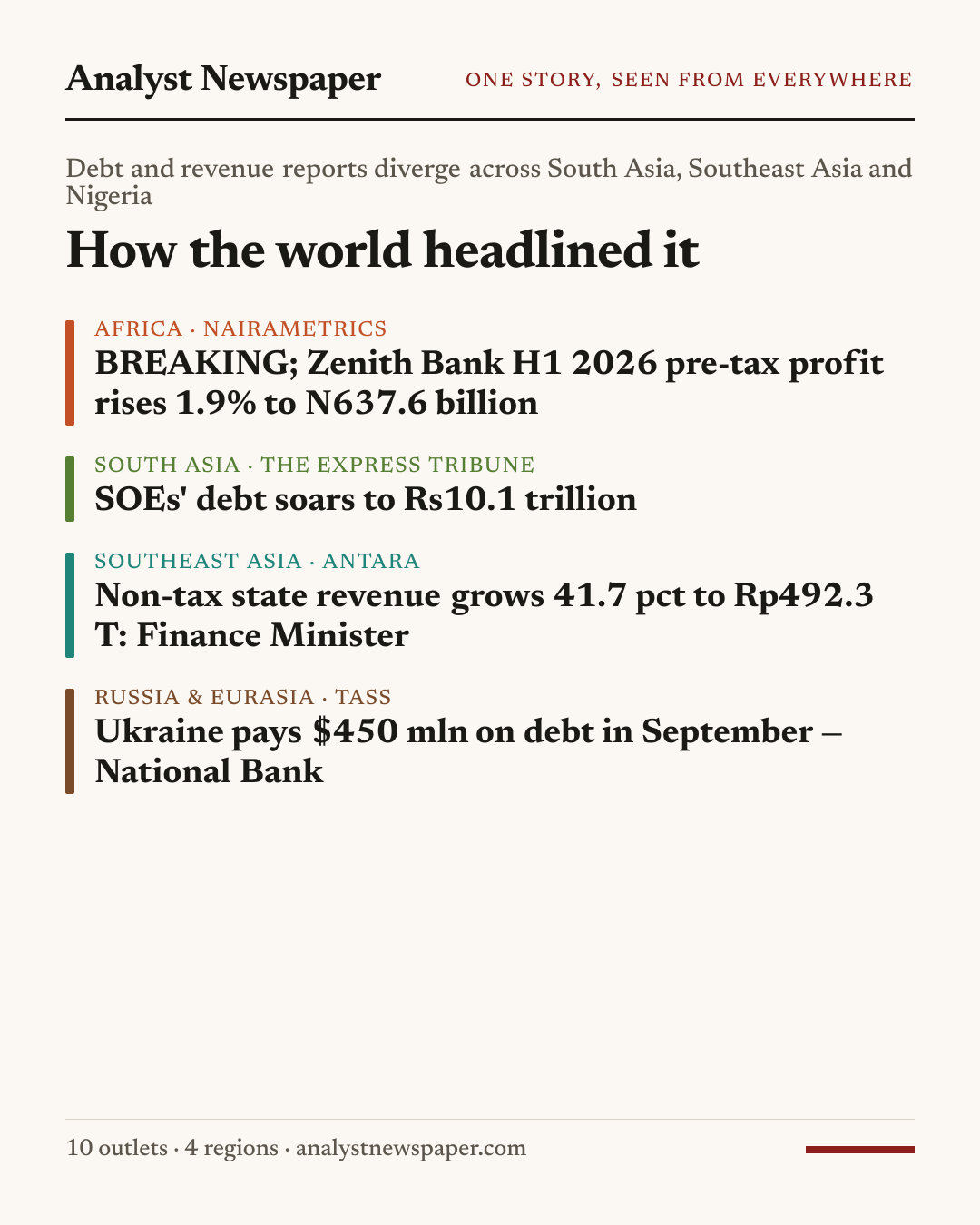
What happened
Pakistan's Ministry of Finance reported total public debt surged 76% over four years to Rs86.7 trillion by June 2026, while a separate finance ministry report put state-owned enterprise debt at Rs10.1 trillion.93
India's external debt rose to $778.2 billion by the end of the June 2026 quarter, according to Reserve Bank of India data, though its debt-to-GDP ratio improved slightly to 20.8%.6
In Southeast Asia, Indonesia reported non-tax state revenue grew 41.7% to Rp492.3 trillion, while Malaysia's government raised RM150.6 billion, or 72.7% of its 2026 gross borrowing target, in the first eight months of the year.47
In Nigeria, the World Bank found state governments' revenue rose 93% between 2023 and 2025 even as education's share of spending declined, while BusinessDay reported the World Bank projects the country's current account surplus will widen to 6% of GDP in 2026.5810
What's agreed
Reported consistently by outlets in more than one region.
Where accounts differ
Each account is attributed to who makes it. We do not judge between them.
Scale and composition of Pakistan's public debt growth
Pakistan's Ministry of Finance, via Dawn
Total public debt rose 76% over four years to Rs86.7 trillion by June 2026, comprising Rs59.4tr domestic and Rs27.3tr external debt, with plans to borrow an additional Rs6.86tr this fiscal year.9
Finance ministry report, via The Express Tribune
State-owned enterprises' debt separately soared to Rs10.1 trillion, a figure Rs7.1tr higher than State Bank figures had shown.3
How it's framed
What each perspective puts first, based on headlines and summaries.
| Perspective | How it reads | What it puts first |
|---|---|---|
| South Asian financial pressSouth Asia | Outlets in Pakistan and India focus on the scale of debt increases and government borrowing plans, citing official ministry and central bank data, with Pakistan's coverage emphasizing a sharp multi-year surge and India's emphasizing a smaller rise alongside an improving debt-to-GDP ratio.369 | debt surge, borrowing plans, fiscal deficit financing |
| Southeast Asian state and private mediaSoutheast Asia | Indonesian and Malaysian outlets report government revenue and borrowing figures in a more neutral, progress-tracking tone, framing the numbers as part of routine fiscal reporting rather than a warning about rising debt.47 | revenue growth, borrowing progress, state finances |
| Nigerian financial pressAfrica | Nigerian outlets cover a mix of corporate earnings, World Bank findings on state revenue and education spending, and current account projections, generally framing Nigeria's fiscal picture as improving in aggregate terms even as spending composition raises questions.15810 | revenue growth, spending priorities, World Bank findings |
What the coverage leaves out
- The sources do not provide a unified comparison methodology across countries, so direct debt-to-GDP comparisons between Pakistan, India, and Nigeria cannot be made from this material.
- No source in this set covers Nigeria's federal public debt figure directly, only state-level revenue, bank earnings, and current account data.
Why it matters
Rising debt burdens have become a focus for finance ministries across South Asia, with Pakistan and India both reporting increases in their respective debt metrics even as other indicators, like India's debt-to-GDP ratio, showed modest improvement.69
Elsewhere, Nigeria's fiscal position shows mixed signals, with state governments seeing revenue growth and the federal current account surplus projected to widen, even as education spending's share of budgets has fallen.5810
What to watch
- Whether Pakistan's planned additional Rs6.86tr borrowing this fiscal year materializes as outlined in its Annual Borrowing Plan 2027.
- Whether Nigeria's current account surplus reaches the World Bank's projected 6% of GDP in 2026.
- Further World Bank or finance ministry reporting on how rising state revenues in Nigeria translate into education and other social spending.
Sources (10)
Every outlet we drew on, grouped by where it is based. Read the originals for the full reporting.
Russia & Eurasia
- 2TASSRUState-controlled
Africa
- 1NairametricsNGPrivate
BREAKING; Zenith Bank H1 2026 pre-tax profit rises 1.9% to N637.6 billion
- 5VanguardNGPrivate
Nigerian states’ revenue rises 93%, education spending falls — World Bank
- 8PunchNGPrivate
Nigerian states’ revenues rise 93%, but education spending drops — World Bank
- 10BusinessDayNGPrivate
Nigeria’s current account surplus to hit 6% of GDP in 2026 – World Bank
South Asia
- 3The Express TribunePKPrivate
- 6The Economic TimesINPrivate
- 9DawnPKPrivate
Southeast Asia
- 4AntaraIDState-controlled
Non-tax state revenue grows 41.7 pct to Rp492.3 T: Finance Minister
- 7Malay MailMYPrivate
Govt raises RM150.6b, 72.7pc of 2026 gross borrowing requirements in first eight months