Countries take varied steps to build food reserves and support farmers
Separate reports from Nigeria, Ghana, Indonesia, Malaysia and Thailand describe different national measures to boost farm financing and food stockpiles, each driven by distinct local pressures.
What happened
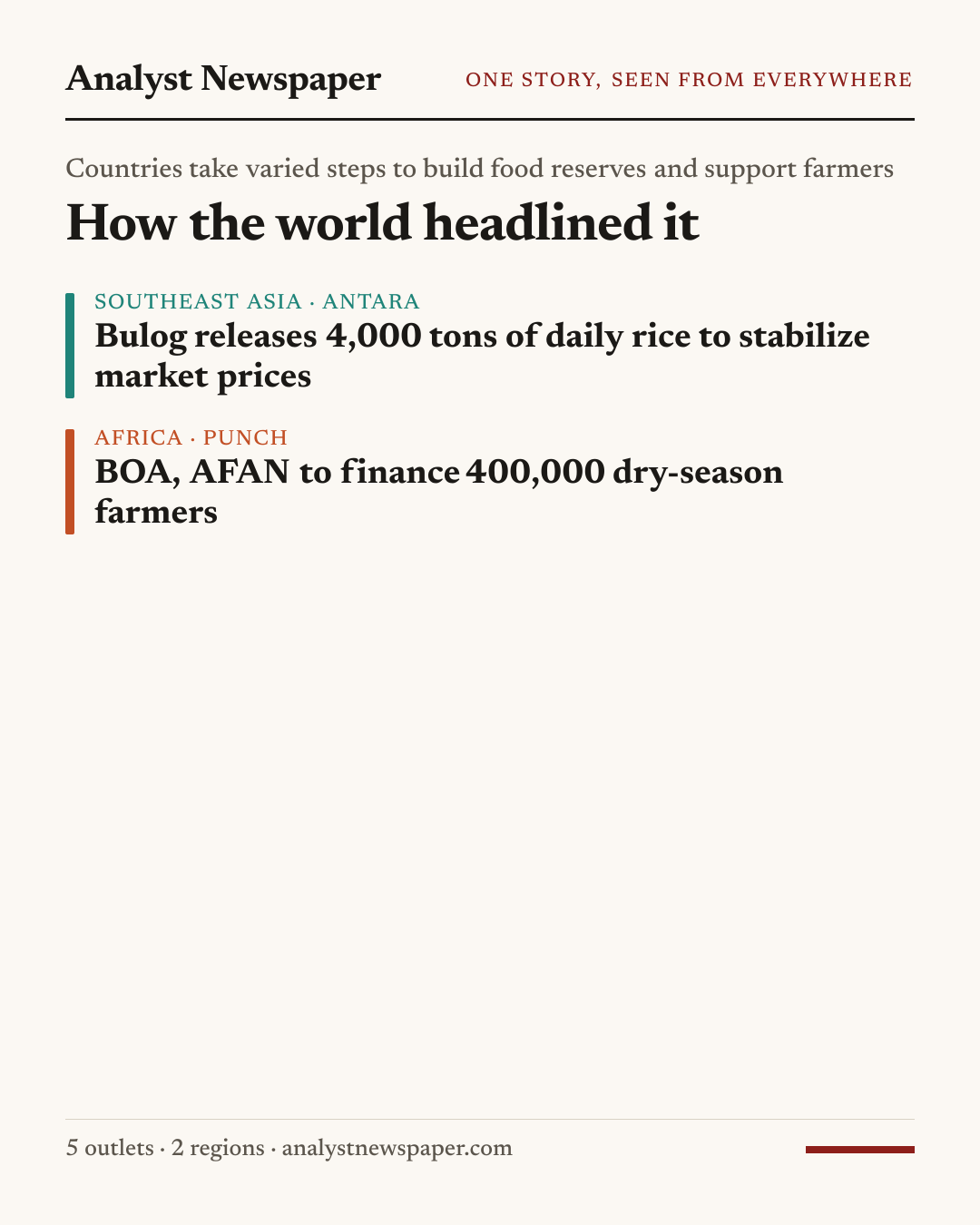
In Nigeria, the Bank of Agriculture has partnered with the All-Farmers Association of Nigeria to finance 400,000 farmers for the 2026 dry-season farming season.1
In Ghana, the government is proposing amendments to public procurement laws that would require state institutions using public funds to buy food from local farmers.3
In Indonesia, state food procurement company Bulog is distributing about 4,000 tons of rice daily nationwide under its Food Supply program to stabilize market prices.2
In Malaysia, the Federal Agricultural Marketing Authority (Fama) is readying warehouses nationwide with buffer stocks in response to a rising El Niño threat, while in Thailand a subcommittee of the National Rice Policy Committee is considering raising the country's rice safety stock by 30% for the same reason.45
What's agreed
Reported consistently by outlets in more than one region.
How it's framed
What each perspective puts first, based on headlines and summaries.
| Perspective | How it reads | What it puts first |
|---|---|---|
| Nigerian private pressAfrica | Focuses on a specific financing partnership between a state agricultural bank and a farmers' association, framed around a concrete beneficiary number and season.1 | farmer financing, specific numeric target, 2026 dry season |
| Ghanaian private pressAfrica | Covers a proposed legal and policy change aimed at reshaping public procurement to favor local farmers, framed as a government initiative still in proposal stage.3 | procurement law reform, local sourcing mandate, public institutions |
| Indonesian state-controlled mediaSoutheast Asia | Emphasizes the scale and routine operation of state rice distribution as a market-stabilization tool, presented as an ongoing program rather than a new response to crisis.2 | state procurement company, daily rice distribution volume, market price stabilization |
| Malaysian and Thai private pressSoutheast Asia | Frame their countries' stockpiling and warehouse measures explicitly as precautionary responses to an anticipated El Niño weather pattern, citing specific preparatory steps and proposed stock increases.45 | El Niño preparedness, buffer stock levels, proactive government response |
What the coverage leaves out
- None of the outlets reviewed reported the total cost or funding source for these various farmer financing, procurement, or stockpiling measures.
- None of the outlets reviewed reported how these measures compare with similar efforts in prior years.
- None of the outlets reviewed reported reactions from farmers, consumers, or opposition groups to these specific policies.
- None of the outlets reviewed reported a timeline for when Ghana's proposed procurement amendments might be enacted.
Why it matters
Malaysia and Thailand's measures are explicitly linked to concerns about the El Niño weather pattern's potential impact on food supply.45
What to watch
- Whether Ghana's proposed procurement law amendments are passed and implemented.
- Whether Thailand's rice policy subcommittee formally approves the proposed 30% increase in safety stock.
- How Nigeria's dry-season farmer financing program performs once the 2026 season begins.
Sources (5)
Every outlet we drew on, grouped by where it is based. Read the originals for the full reporting.
Africa
- 1PunchNGPrivate
- 3MyJoyOnlineGHPrivate
Government moves to compel public institutions to buy food from Ghanaian farmers
Southeast Asia
- 2AntaraIDState-controlled
Bulog releases 4,000 tons of daily rice to stabilize market prices
- 4Malay MailMYPrivate
Fama readies warehouses nationwide with buffer stocks as El Niño threat rises
- 5Bangkok PostTHPrivate