Energy bill changes vary sharply by country as October approaches
Households in the UK and Japan face higher energy costs starting this winter, while Singapore and the Philippines are seeing cuts or partial relief, reflecting different fuel cost pressures and policy responses across regions.
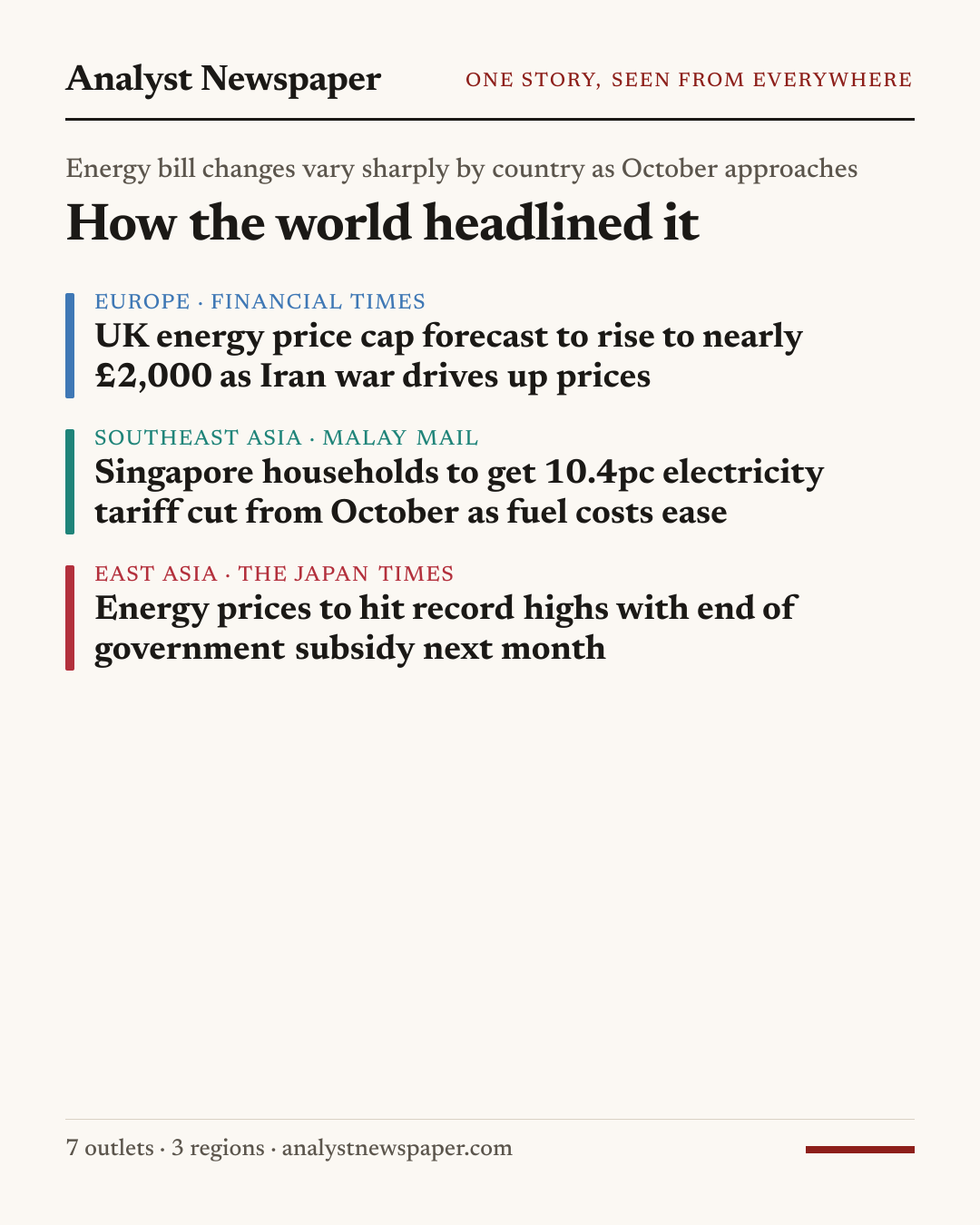
What happened
UK household energy bills are forecast to rise to nearly £2,000 annually from January, a 16% increase described as the biggest rise in four years.246
Japanese utility companies announced October household energy rates will rise by ¥835 to ¥1,578 as a government subsidy ends.1
Singapore households will see electricity tariffs fall 10.4% from October 1 as fuel costs ease, though rising global fuel prices could push tariffs higher next quarter.35
The Philippines has removed VAT on system loss charges in electricity bills starting October, though the underlying system loss charge remains and savings are described as modest.7
What's agreed
Reported consistently by outlets in more than one region.
Where accounts differ
Each account is attributed to who makes it. We do not judge between them.
What is driving the UK energy price rise
Financial Times
Attributes the price cap rise to the Iran war driving up prices.2
The Guardian Business
Attributes the rise to the impact of the Middle East war continuing through winter, citing forecaster Cornwall Insight.4
BBC News Business
Reports the rise as the biggest in four years without specifying a geopolitical cause in the snippet reviewed.6
How it's framed
What each perspective puts first, based on headlines and summaries.
| Perspective | How it reads | What it puts first |
|---|---|---|
| UK financial and business pressEurope | Frames rising bills explicitly in terms of geopolitical conflict, using language like war and squeeze to describe pressure on households during winter.24 | Iran war impact, household squeeze, biggest rise in four years |
| UK public broadcasterEurope | Reports the same £1,999 figure and four-year high framing but without invoking war or geopolitical causation in the snippet reviewed.6 | record forecast figure, four-year comparison |
| East Asian business pressEast Asia | Focuses on the end of a domestic government subsidy as the direct cause of higher Japanese household rates, with a neutral tone.1 | subsidy ending, record household rates |
| Southeast Asian outlets on Singapore tariffsSoutheast Asia | Both a private Malaysian outlet and Singapore's state-controlled broadcaster report the same tariff cut, with the state-controlled outlet also flagging future fuel cost risk.35 | tariff cut, easing fuel costs, future price pressure |
| Philippine independent pressSoutheast Asia | Reports a tax relief measure critically, emphasizing that savings will be modest because a larger underlying charge remains on bills.7 | modest relief, system loss charge remains, VAT removal |
What the coverage leaves out
- None of the outlets reviewed reported how much the Iran war or Middle East conflict has specifically added to wholesale energy prices in numerical terms.
- None of the outlets reviewed reported the size of the Japanese government subsidy being removed or its original cost to taxpayers.
- None of the outlets reviewed detailed how Philippine households' bills will change in absolute peso terms after the VAT removal.
- None of the outlets reviewed reported reactions from consumer groups or affected households in any of the countries covered.
Why it matters
UK forecasts come from Cornwall Insight, a market analysis firm cited by The Guardian Business.4
Singapore's tariff cut follows a pattern where fuel costs directly affect quarterly household electricity rates, according to CNA.5
What to watch
- Whether the UK price cap forecast holds when the official figure is announced closer to January.
- Whether Singapore's electricity tariffs rise in the following quarter as CNA suggests rising global fuel prices could push tariffs higher.
Sources (7)
Every outlet we drew on, grouped by where it is based. Read the originals for the full reporting.
Europe
- 2Financial TimesGBPrivate
UK energy price cap forecast to rise to nearly £2,000 as Iran war drives up prices
- 4The Guardian BusinessGBPrivate
Energy bills in Great Britain forecast to jump by £276 a year from January
- 6BBC News BusinessGBPublic broadcaster
Household energy bills forecast to see biggest rise in four years
East Asia
- 1The Japan TimesJPPrivate
Energy prices to hit record highs with end of government subsidy next month
Southeast Asia
- 3Malay MailMYPrivate
Singapore households to get 10.4pc electricity tariff cut from October as fuel costs ease
- 5CNASGState-controlled
- 7RapplerPHIndependent
No more VAT on system loss in electricity bills starting October