Francis Halzen wins 2026 Nobel Prize in Physics for neutrino work
The Belgian-born physicist was honoured for the IceCube Neutrino Observatory, with outlets worldwide reporting the same facts but differing in how they describe the "ghost particles" at the heart of his work.
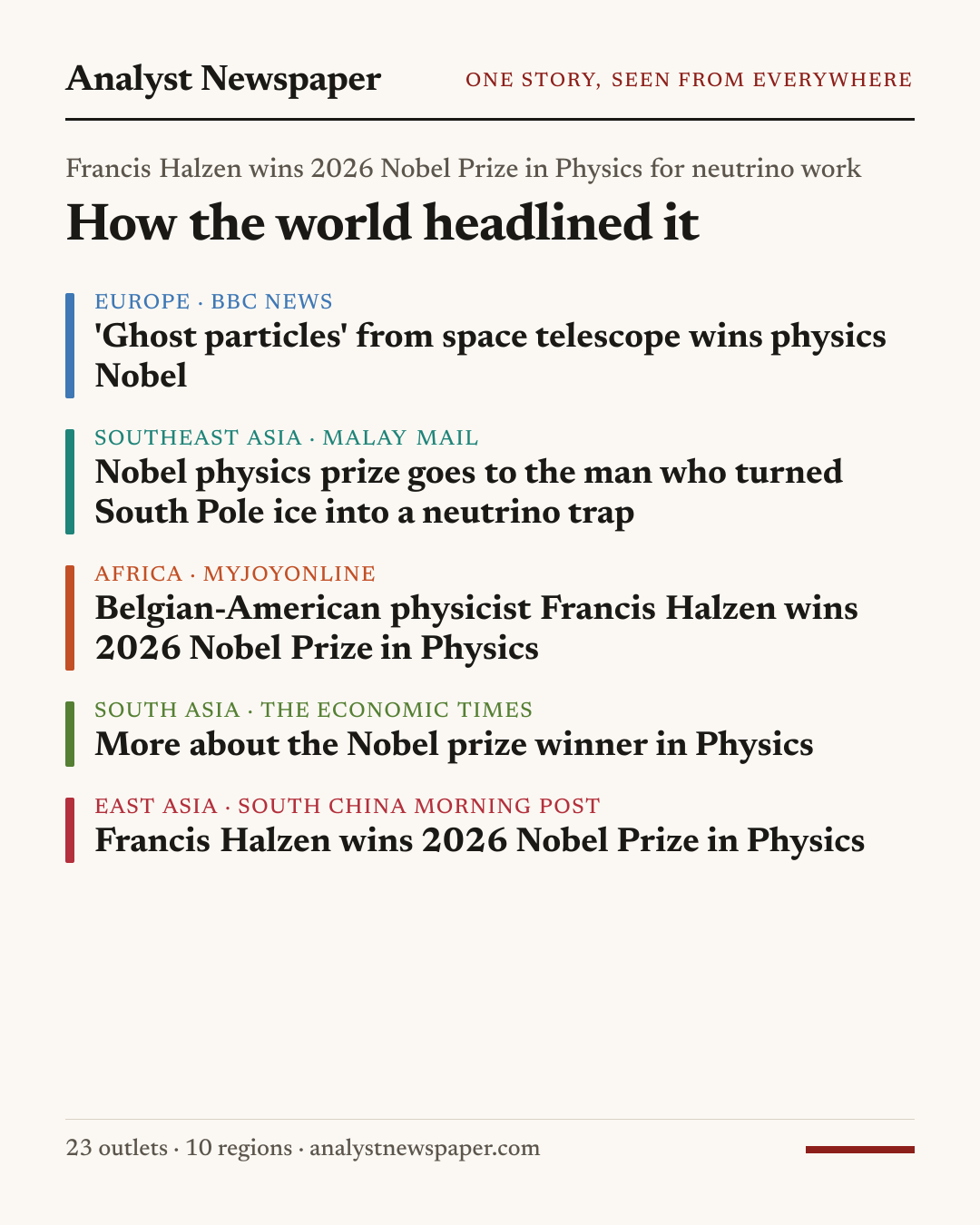
What happened
Francis Halzen won the 2026 Nobel Prize in Physics for decisive contributions to the IceCube Neutrino Observatory and the discovery of high-energy neutrinos of astrophysical origin.123456789101314172021
Halzen, born in Belgium, is affiliated with the University of Wisconsin–Madison, where according to the Economic Times he holds the titles of Vilas Research Professor and Gregory Breit Distinguished Professor of Physics.279
In the 1980s, Halzen realised that ice at the South Pole could be used to capture and track neutrinos, sometimes described as 'ghost particles'.1571419
The award was announced by the Royal Swedish Academy of Sciences in Stockholm on Tuesday and is the second Nobel Prize of the season, after Monday's medicine prize awarded to an American-German trio for brain research.213
What's agreed
Reported consistently by outlets in more than one region.
- Francis Halzen won the 2026 Nobel Prize in Physics.12345678910131417192021
- He was honoured for decisive contributions to the IceCube Neutrino Observatory and the discovery of high-energy neutrinos of astrophysical origin.2569142021
- Halzen is Belgian, or Belgian-American/Belgian-born depending on outlet phrasing, and is affiliated with the University of Wisconsin–Madison in the United States.127
- His key insight, dating to the 1980s, was that Antarctic ice at the South Pole could be used to detect neutrinos.5719
Where accounts differ
Each account is attributed to who makes it. We do not judge between them.
Halzen's nationality description
How it's framed
What each perspective puts first, based on headlines and summaries.
| Perspective | How it reads | What it puts first |
|---|---|---|
| Outlets using 'ghost'/'ghostly' particle framing | A large cluster of outlets across regions, including European, Southeast Asian, South Asian and African outlets, led with the poetic description of neutrinos as 'ghost' or 'ghostly messengers from space', often citing the Nobel committee or its secretary general.13481415161719 | ghost particles, ghostly messengers, South Pole ice, subatomic particles |
| Technical/institutional framingNorth America | NPR and the Economic Times (South Asia) emphasised Halzen's academic credentials, institutional affiliation, and prior prizes, with less focus on evocative language.79 | University of Wisconsin-Madison, Vilas Research Professor, prior awards, career history |
| European outlets placing award in Nobel-season contextEurope | Le Monde situated the physics prize within the broader Nobel season, referencing the preceding medicine prize, while other European outlets (BBC, DW, New Scientist) focused narrowly on the neutrino science itself.1342017 | Nobel season, sequencing of prizes, neutrino science |
| State-controlled outletsRussia & Eurasia | TASS (Russian state-controlled) reported the award in brief, neutral terms, describing Halzen as a US scientist and focusing on the technical citation without elaboration.3 | decisive contributions, IceCube Observatory, brief factual framing |
| Southeast Asian and African coverageSoutheast Asia | Outlets such as Malay Mail, Straits Times, VnExpress, and Channels Television emphasised the narrative of decades-long research under South Pole ice, often using vivid imagery of 'ghost particles' and a long scientific hunt.10151916 | decades of research, South Pole ice, ghost particle hunt |
What the coverage leaves out
- None of the outlets reviewed reported reactions from Halzen himself or from colleagues at the University of Wisconsin–Madison or the IceCube collaboration.
- None of the outlets reviewed detailed the size of the prize money or how it will be shared, if applicable.
- None of the outlets reviewed explained in detail how the IceCube Neutrino Observatory operates beyond the basic premise of using South Pole ice.
- Coverage did not include any dissenting or critical scientific perspectives on the significance of the award.
Why it matters
Sources (23)
Every outlet we drew on, grouped by where it is based. Read the originals for the full reporting.
North America
- 7NPRUSPublic broadcaster
Francis Halzen wins Nobel Prize in physics for work on high-energy neutrinos from space
Latin America
- 5Agência BrasilBRPublic broadcaster
Belgian who discovered smallest particle in the universe receives Physics Nobel
Translated from Portuguese: Belga que descobriu menor partícula do universo recebe Nobel da Física
Europe
- 4BBC NewsGBPublic broadcaster
- 13Le MondeFRPrivate
The 2026 Nobel Prize in Physics is awarded to Belgian Francis Halzen for his work on neutrinos
Translated from French: Le prix Nobel de physique 2026 est décerné au Belge Francis Halzen pour ses travaux sur les neutrinos
- 17New ScientistGBPrivate
Nobel prize in physics awarded for discovery of high-energy neutrinos
- 20Deutsche WelleDEPublic broadcaster
Nobel Physics Prize goes to Francis Halzen for neutrino work
- 22France 24FRPublic broadcaster
🔴 Nobel Prize in Physics awarded to Francis Halzen for ice research
Russia & Eurasia
- 3TASSRUState-controlled
Nobel Prize in physics awarded for ‘ghostly’ cosmic particles
Middle East & Turkey
- 6Anadolu AgencyTRState-controlled
Belgian physicist Francis Halzen wins 2026 Nobel Prize in Physics
Africa
- 1MyJoyOnlineGHPrivate
Belgian-American physicist Francis Halzen wins 2026 Nobel Prize in Physics
- 11Daily MaverickZAIndependent
- 16Channels TelevisionNGPrivate
Nobel Physics Prize Honours Work On ‘Ghost Messengers From Space’
South Asia
- 9The Economic TimesINPrivate
- 14DawnPKPrivate
Nobel physics prize honours work on 'ghost messengers from space'
- 18NDTVINPrivate
Francis Halzen Wins Physics Nobel For Astrophysical Neutrinos' Discovery
East Asia
- 2South China Morning PostHKPrivate
- 12The Japan TimesJPPrivate
Southeast Asia
- 10Malay MailMYPrivate
Nobel physics prize goes to the man who turned South Pole ice into a neutrino trap
- 15The Straits TimesSGPrivate
Nobel physics prize honours work on ‘ghostly messengers’ from outer space
- 19VnExpress InternationalVNPrivate
Physicist hunting 'ghost particles' under South Pole ice since the 1980s wins Nobel prize
- 21RapplerPHIndependent
- 23CNASGState-controlled
Oceania
- 8ABC News (Australia)AUPublic broadcaster
Nobel Prize in Physics honours work on 'ghost messengers from space'