New Studies Find Microplastics Chemically Reactive, Not Inert as Assumed
New studies suggest microplastics can chemically react rather than remain inert, but outlets differ on which biological effect, blood toxicity or liver disease, they highlight.
What happened
New research described by multiple outlets challenges the assumption that plastic is chemically inert, finding that microplastics can react with water and other molecules.24
A lab experiment found that microplastics generated harmful molecules when exposed to blood, which may damage cells.1
Separate research from Texas A&M University linked polyethylene microplastics, especially combined with a high-fat diet, to signs of fatty liver disease and changes in gene activity tied to fat metabolism and tissue repair.3
Outlets note that the broader effects of these reactive properties on human health remain an open question requiring further study.34
What's agreed
Reported consistently by outlets in more than one region.
Where accounts differ
Each account is attributed to who makes it. We do not judge between them.
Which biological system is most affected by reactive microplastics
New Scientist, citing a lab experiment
Microplastics generate harmful molecules when exposed to blood, which may damage cells.1
Times of India, citing Texas A&M University research
Polyethylene microplastics are linked to signs of fatty liver disease and altered gene activity related to fat metabolism, particularly alongside a high-fat diet.3
How it's framed
What each perspective puts first, based on headlines and summaries.
| Perspective | How it reads | What it puts first |
|---|---|---|
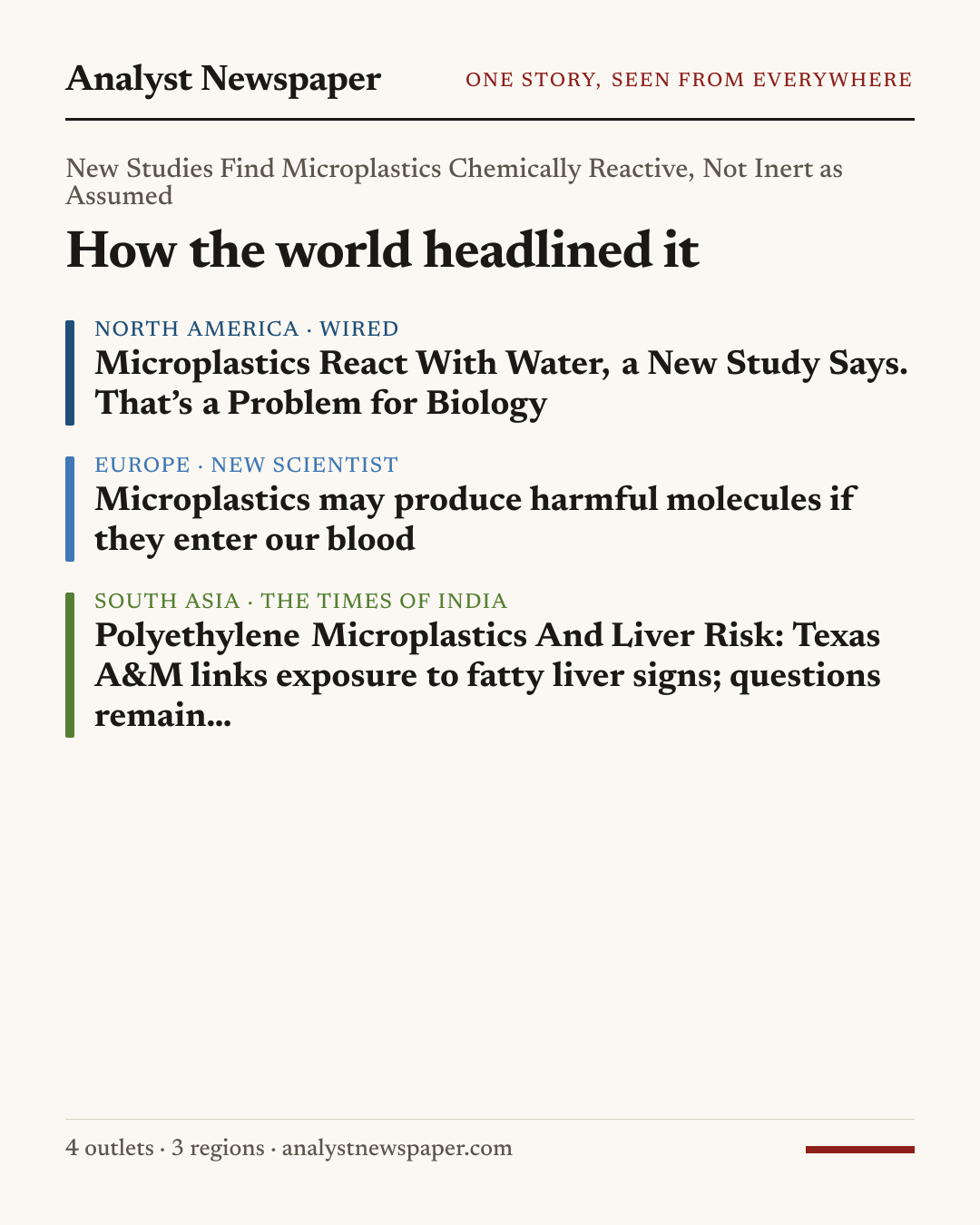
| US science and technology outletsNorth America | Emphasize a newly published study overturning the assumption that plastic is chemically inert, framing the finding as significant for biology broadly.24 | plastic reactivity, overturned assumption, damaging chemicals |
| UK science outletEurope | Focuses on a specific lab experiment showing microplastics react with blood to generate harmful molecules that could damage cells.1 | blood exposure, cellular damage, lab experiment |
| Indian outlet covering US university researchSouth Asia | Highlights a specific health outcome, fatty liver disease, linked to polyethylene microplastics in a Texas A&M study, while noting human health questions remain open.3 | fatty liver disease, gene activity changes, high-fat diet link, unresolved human health risk |
What the coverage leaves out
- None of the outlets reviewed specify the exact study, journal, or publication date behind the water-reactivity findings reported by Wired and Ars Technica.
- None of the outlets reviewed report on direct human clinical outcomes, as the research described is limited to lab experiments and animal or cell studies.
- None of the outlets reviewed detail the concentrations or exposure levels of microplastics used in the experiments, which could affect how applicable the findings are to real-world exposure.
Why it matters
Microplastics are widespread in the environment and have been found in human blood and tissue, raising questions about whether their chemical reactivity could affect human health.1234
What to watch
- Further investigation into whether polyethylene microplastics contribute to more severe liver damage, as indicated by researchers in the Texas A&M study.
- Additional studies on how microplastic reactivity with water and blood may translate into health effects in humans.
Sources (4)
Every outlet we drew on, grouped by where it is based. Read the originals for the full reporting.
North America
Europe
- 1New ScientistGBPrivate
Microplastics may produce harmful molecules if they enter our blood