Scientists Vote to Abolish the Leap Second
The world's timekeeping authorities have voted to end the leap second, but outlets differ on what will replace it and why the change matters.
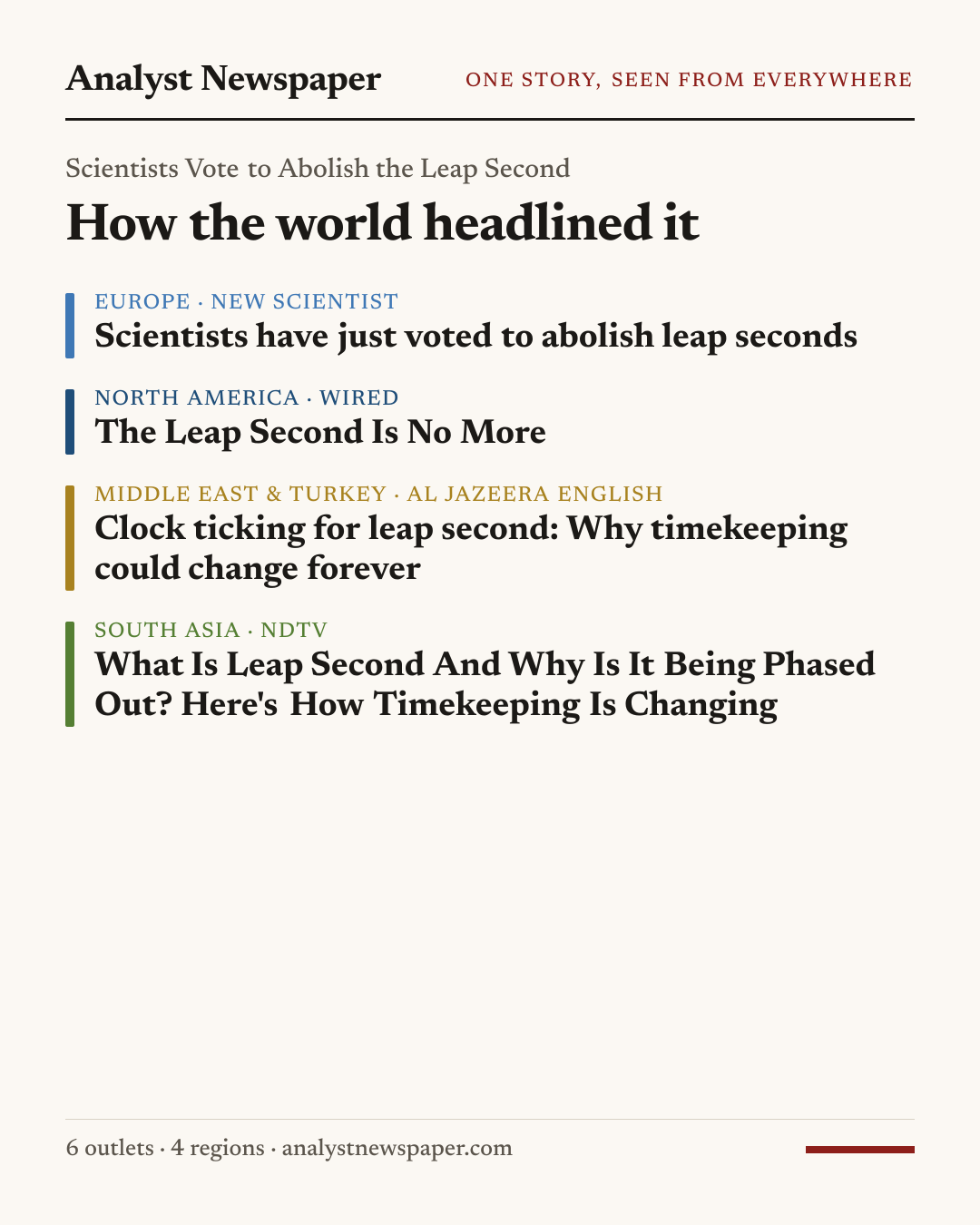
What happened
Scientists meeting in France voted to end the practice of adding leap seconds to universal time, a system used since 1972 to keep clocks aligned with Earth's rotation.146
The International Bureau of Weights and Measures (BIPM) carried out the vote, which outlets say aims to avoid technical problems for computer systems that have long found leap seconds disruptive.635
Reports differ on what mechanism will replace the leap second, with one outlet citing a leap hour and another describing a proposal to let time drift from Earth's rotation for centuries before any adjustment.45
What's agreed
Reported consistently by outlets in more than one region.
- Scientists voted to abolish the leap second, the practice of occasionally adding a second to clocks to keep them in sync with Earth's rotation.1346
- The vote took place this week (reported as Thursday, October 15) in France.146
- Leap seconds have been added since 1972 to keep universal time aligned with Earth's rotation.12
Where accounts differ
Each account is attributed to who makes it. We do not judge between them.
What will replace the leap second
How it's framed
What each perspective puts first, based on headlines and summaries.
| Perspective | How it reads | What it puts first |
|---|---|---|
| US tech and science outletsNorth America | Emphasize the practical and technical stakes for computer infrastructure, framing the change as resolving long-standing contention and risk of failures.36 | infrastructure risk, Y2K comparison, end of contention |
| UK science and tech pressEurope | Focus on the mechanics of the vote and the technical proposal to let UTC drift from Earth's rotation, framing it as a procedural/scientific decision.15 | vote details, technical proposal, historical use since 1972 |
| Middle East state-controlled outletMiddle East & Turkey | Frames the story around the general concept of leap seconds and the possibility of change, with less emphasis on technical specifics.2 | synchronization with Earth's rotation, possible future change |
| South Asian private pressSouth Asia | Frames the change as a replacement system (leap hour) intended to improve timekeeping, emphasizing the practical upgrade rather than risk mitigation.4 | leap hour replacement, improved timekeeping |
What the coverage leaves out
- None of the outlets reviewed reported detailed reactions from governments, industries, or international standards bodies beyond BIPM.
- None of the outlets reviewed specified the exact timeline for when the leap hour or UTC drift proposal would take effect.
- None of the outlets reviewed detailed the vote count or level of consensus among scientists at the meeting.
Why it matters
Leap seconds have been described as a long-running source of contention in the timekeeping community, partly because of the risk they pose to computer systems that must make ad hoc adjustments.35
The change is intended to avoid potential infrastructure problems, with one outlet comparing the concern to the Y2K bug scare.6
Sources (6)
Every outlet we drew on, grouped by where it is based. Read the originals for the full reporting.
North America
- 3WiredUSPrivate
- 6The VergeUSPrivate
Europe
- 1New ScientistGBPrivate
- 5The RegisterGBPrivate
Leap seconds face judgment day as time lords prepare to vote
Middle East & Turkey
- 2Al Jazeera EnglishQAState-controlled
Clock ticking for leap second: Why timekeeping could change forever