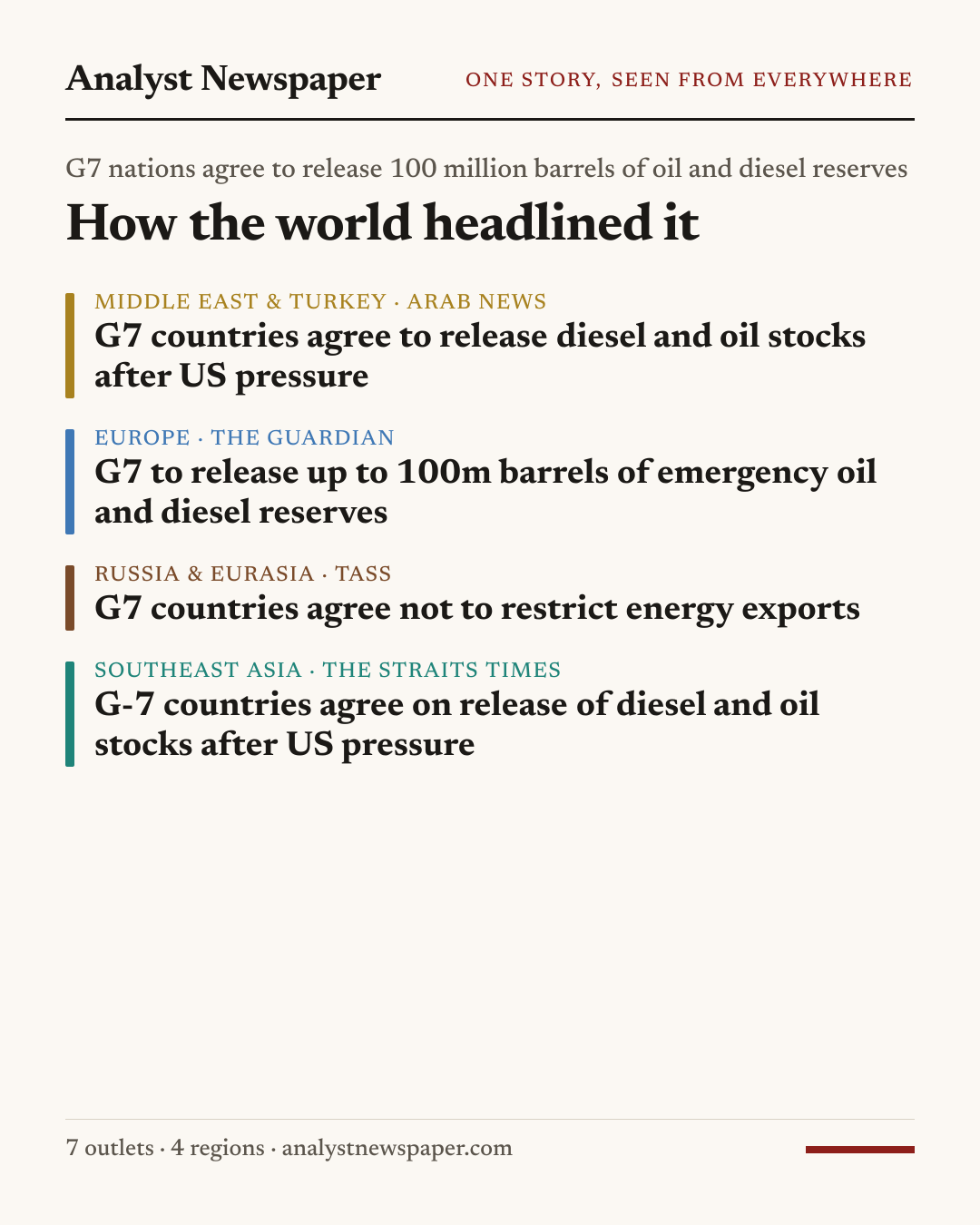
G7 nations agree to release 100 million barrels of oil and diesel reserves
G7 nations agreed to draw down emergency oil and diesel stocks, a move outlets link to US pressure, though they differ on how that pressure is characterized and whose initiative drove it.
What happened
G7 countries agreed to release up to 100 million barrels of emergency oil and diesel reserves, coordinated by the International Energy Agency over about four months, with a front-loaded diesel release in the first 20 days.2367
The G7 also reaffirmed it would not restrict energy exports among its members and urged other producers to avoid export bans.157
Outlets link the decision to pressure from the United States, including reported pressure from Donald Trump and a threatened diesel export ban, amid sharply rising fuel prices.2345
Following the announcement, oil prices softened, with Brent crude reported down 1.48 per cent at $100.8 per barrel.6
What's agreed
Reported consistently by outlets in more than one region.
- G7 countries agreed to release up to 100 million barrels of emergency oil and diesel reserves.234567
- The release will be coordinated through the International Energy Agency over roughly four months.267
- G7 members reaffirmed they will not restrict energy exports among themselves.1573
- The move comes amid high and rising oil and fuel prices.123
Where accounts differ
Each account is attributed to who makes it. We do not judge between them.
Nature and source of US pressure on the G7
The Guardian
Donald Trump personally pressured G7 nations to ease surging fuel prices.2
The Straits Times
The US stepped up pressure specifically on Europe and threatened a diesel export ban.4
Emmanuel Macron, via Le Monde
Trump had threatened to reduce US gas exports but was clear there would be no export ban, and the G7 jointly agreed no restrictions.5
Arab News
The US itself faces political pressure over rising costs, framing the US as under pressure rather than only applying it.3
How it's framed
What each perspective puts first, based on headlines and summaries.
| Perspective | How it reads | What it puts first |
|---|---|---|
| Russian state mediaRussia & Eurasia | TASS frames the story primarily as a G7 commitment to keep exporting energy amid volatile markets, with less emphasis on reserve releases or US pressure.1 | energy export commitment, market volatility, price rises |
| Western European outletsEurope | The Guardian and Le Monde center the story on the 100-million-barrel release and Trump's role in pressuring G7 leaders, quoting Macron directly on the no-export-ban guarantee.25 | Trump's pressure, coordinated drawdown, household and economic impact, Macron's statements |
| Middle East-based outletsMiddle East & Turkey | Arab News, The National and Anadolu Agency emphasize the scale of the release, the IEA coordination, the front-loaded diesel component, and the reaffirmed no-export-restriction pledge, with The National also noting the market reaction in oil prices.367 | 100 million barrels, diesel focus, IEA coordination, no export restrictions, market reaction |
| Southeast Asian outletsSoutheast Asia | The Straits Times frames the agreement more critically, stressing US pressure on Europe and the threatened diesel export ban as the driver of the decision.4 | US pressure on Europe, threatened export ban |
What the coverage leaves out
- None of the outlets reviewed detailed how the 100 million barrels will be allocated among individual G7 member countries.
- None of the outlets reviewed reported reactions from major oil-producing nations outside the G7, such as OPEC members.
- None of the outlets reviewed gave a specific figure or timeline for the threatened US diesel export ban beyond noting that it was threatened.
Why it matters
Sources (7)
Every outlet we drew on, grouped by where it is based. Read the originals for the full reporting.
Europe
- 2The GuardianGBPrivate
G7 to release up to 100m barrels of emergency oil and diesel reserves
- 5Le MondeFRPrivate
Translated from French: Emmanuel Macron annonce que les pays du G7 vont prélever sur leurs stocks « jusqu’à 100 millions de barils » pour faire baisser les prix
Russia & Eurasia
- 1TASSRUState-controlled
Middle East & Turkey
- 3Arab NewsSAPrivate
G7 countries agree to release diesel and oil stocks after US pressure
- 6The NationalAEPrivate
G7 members agree to release 100 million barrels of diesel and other reserves
- 7Anadolu AgencyTRState-controlled
G7 to release 100M barrels from emergency oil reserves over 4 months
Southeast Asia
- 4The Straits TimesSGPrivate
G-7 countries agree on release of diesel and oil stocks after US pressure