Hall and Woodford win 2026 Nobel Prize in Economics for stabilisation work
Robert E. Hall and Michael Woodford were awarded the 2026 Nobel Prize in Economics for work on stabilising economies, with outlets worldwide covering the announcement in largely similar terms.
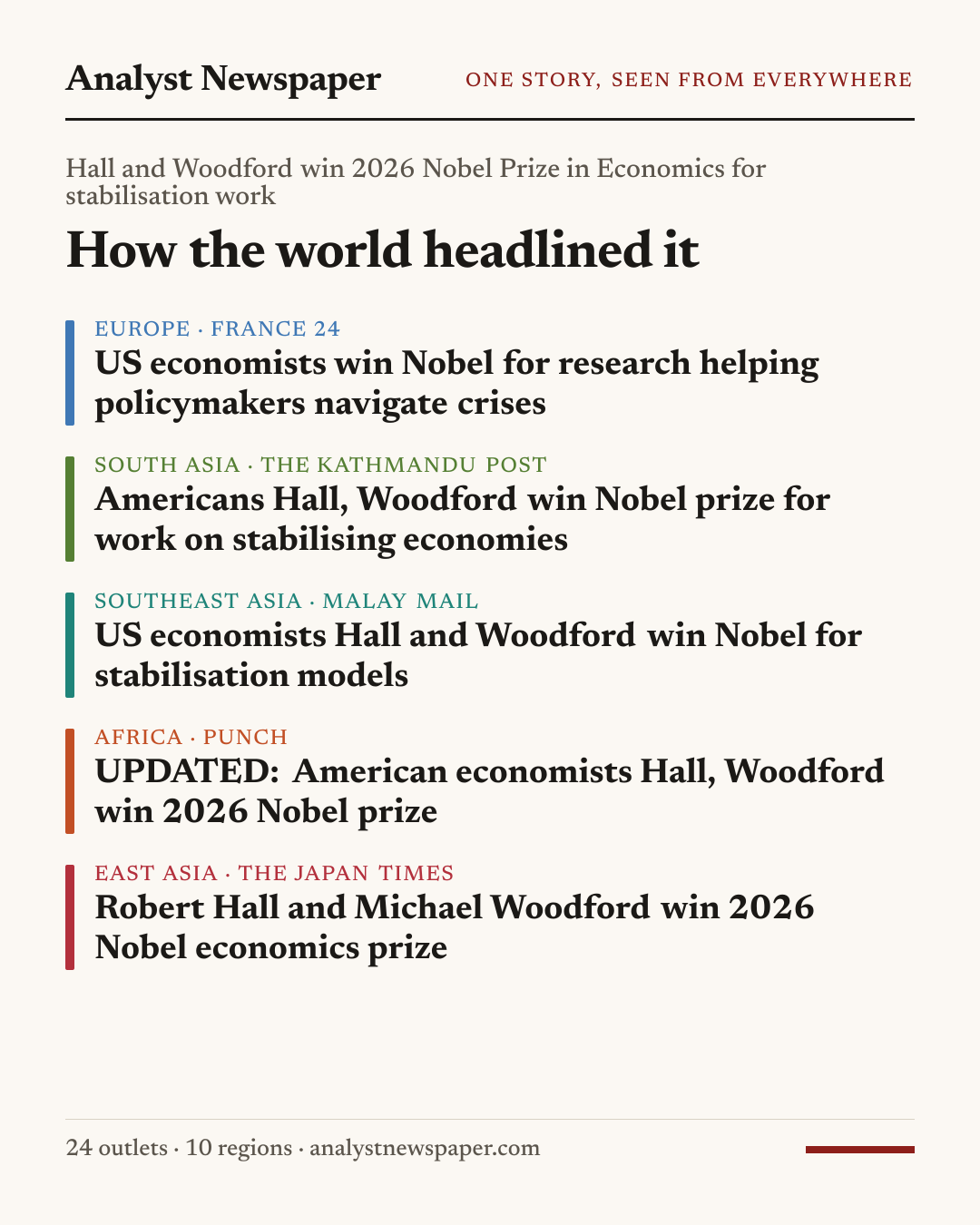
What happened
American economists Robert E. Hall of Stanford University and Michael Woodford of Columbia University have won the 2026 Nobel Prize in Economics.124722
The Royal Swedish Academy of Sciences recognised the pair for their work on the microeconomic foundations of macroeconomic stabilisation, covering how monetary and fiscal policy can manage economic fluctuations.231921
The Academy said the laureates developed macroeconomic models that improved the ability to implement effective stabilisation policy, with well-timed fiscal and monetary measures able to reduce peaks and troughs in the economy.2016
The award, formally called the Sveriges Riksbank Prize in Economic Sciences in Memory of Alfred Nobel, was the final Nobel prize given out this year.91215
What's agreed
Reported consistently by outlets in more than one region.
- Robert E. Hall of Stanford University and Michael Woodford of Columbia University won the 2026 Nobel Prize in Economics (formally the Sveriges Riksbank Prize in Economic Sciences in Memory of Alfred Nobel).123457891011121415171819202122
- The prize was awarded for work on the microeconomic foundations of macroeconomic stabilisation, covering how monetary and fiscal policy can manage economic fluctuations, recessions and inflation.234511192122
- The award was announced by the Royal Swedish Academy of Sciences in Stockholm.281521
- This was the final Nobel prize announced this year.291215
- Hall is affiliated with Stanford University in California and Woodford with Columbia University in New York.281422
Where accounts differ
Each account is attributed to who makes it. We do not judge between them.
How it's framed
What each perspective puts first, based on headlines and summaries.
| Perspective | How it reads | What it puts first |
|---|---|---|
| US and UK financial/business pressNorth America | Emphasise the practical and celebratory significance of the work, framing it as making macroeconomics relevant to real-world central banking and crisis management.471322 | crisis management, central banking relevance, policy tools |
| European outletsEurope | Highlight the theoretical rebuilding of macroeconomic analysis and its translation into tools for public policy, with some outlets using celebratory language.182213 | rebuilt macroeconomic framework, consumption and pricing decisions, policy tools |
| South Asian outletsSouth Asia | Focus heavily on direct quotations from the Swedish Academy's citation describing the models' effect on reducing economic peaks and troughs.152023 | Academy's own language, stabilisation policy implementation, peaks and troughs |
| Southeast Asian outletsSoutheast Asia | Present concise, largely wire-style factual accounts emphasising the stabilisation theme with minimal added interpretation.10162124 | stabilisation models, wire-style brevity |
| State-controlled outlets (Russia, Turkey, Qatar, Singapore)Russia & Eurasia | Provide brief, neutral factual summaries focused on the official Nobel citation language without added commentary or framing devices.361924 | official citation wording, neutral tone |
| African and East Asian privately owned outletsAfrica | Offer concise, largely neutral news-wire style reports centered on the basic facts of the award and its stated rationale.11121217 | straightforward reporting, basic facts |
What the coverage leaves out
- None of the outlets reviewed reported reactions from Hall or Woodford themselves, or any statements made by the laureates after the announcement.
- None of the outlets reviewed detailed the specific research papers or models that formed the basis of the award beyond general descriptions.
- None of the outlets reviewed reported on broader context such as how this award fits into current economic policy debates or events.
Why it matters
The laureates' models are described by the Royal Swedish Academy of Sciences as now used by central banks and governments around the world to guide fiscal and monetary policy decisions.519
The Academy said the models allow well-timed fiscal and monetary policy measures to reduce the economy's peaks and troughs.2016
Sources (24)
Every outlet we drew on, grouped by where it is based. Read the originals for the full reporting.
North America
Latin America
- 5ClarínARPrivate
The Economics Nobel Prize went to Americans Michael Woodford and Robert Hall
Translated from Spanish: El Nobel de Economía fue para los estadounidenses Michael Woodford y Robert Hall
Europe
- 4France 24FRPublic broadcaster
US economists win Nobel for research helping policymakers navigate crises
- 13Financial TimesGBPrivate
How Michael Woodford made modern macro relevant to central bankers
- 18Le MondeFRPrivate
Translated from French: Le « prix Nobel d’économie » aux Américains Robert Hall et Michael Woodford, qui ont reconstruit le cadre d’analyse macroéconomique
- 22The GuardianGBPrivate
Nobel Prize for economics awarded to Hall and Woodford for work on ‘smoothing’ crises
Russia & Eurasia
- 3TASSRUState-controlled
US scientists awarded Nobel Memorial Prize in Economic Sciences
Middle East & Turkey
- 6Anadolu AgencyTRState-controlled
- 14The Times of IsraelILPrivate
2 American economists win Nobel for work on managing economic shocks
- 19Al Jazeera EnglishQAState-controlled
Nobel economics prize awarded to Robert Hall and Michael Woodford
Africa
- 1PunchNGPrivate
UPDATED: American economists Hall, Woodford win 2026 Nobel prize
- 11VanguardNGPrivate
Americans Hall and Woodford win economics Nobel for stabilisation models
South Asia
- 9The Kathmandu PostNPPrivate
Americans Hall, Woodford win Nobel prize for work on stabilising economies
- 15NDTVINPrivate
Nobel Prize In Economics 2026 Awarded To US' Robert E Hall, Michael Woodford
- 20The HinduINPrivate
- 23The Economic TimesINPrivate
East Asia
- 2South China Morning PostHKPrivate
Robert Hall, Michael Woodford win 2026 Nobel Prize in economics
- 12The Japan TimesJPPrivate
Robert Hall and Michael Woodford win 2026 Nobel economics prize
- 17Taipei TimesTWPrivate
Southeast Asia
- 10Malay MailMYPrivate
US economists Hall and Woodford win Nobel for stabilisation models
- 16RapplerPHIndependent
Americans Hall and Woodford win Nobel economics prize for work on stabilization
- 21The Straits TimesSGPrivate
Americans Hall and Woodford win Nobel economics prize for work on stabilisation
- 24CNASGState-controlled
Americans Hall and Woodford win economics Nobel for stabilisation models
Oceania
- 8ABC News (Australia)AUPublic broadcaster
Breaking: Americans Hall and Woodford win Nobel economics prize for work on stabilisation