Henri Kagan and Kenso Soai win 2026 Nobel Prize in Chemistry
The Royal Swedish Academy of Sciences named Henri B. Kagan and Kenso Soai winners of the 2026 Nobel Prize in Chemistry; outlets worldwide largely agree on the basic facts but differ in how much detail and color they add on the science and its applications.
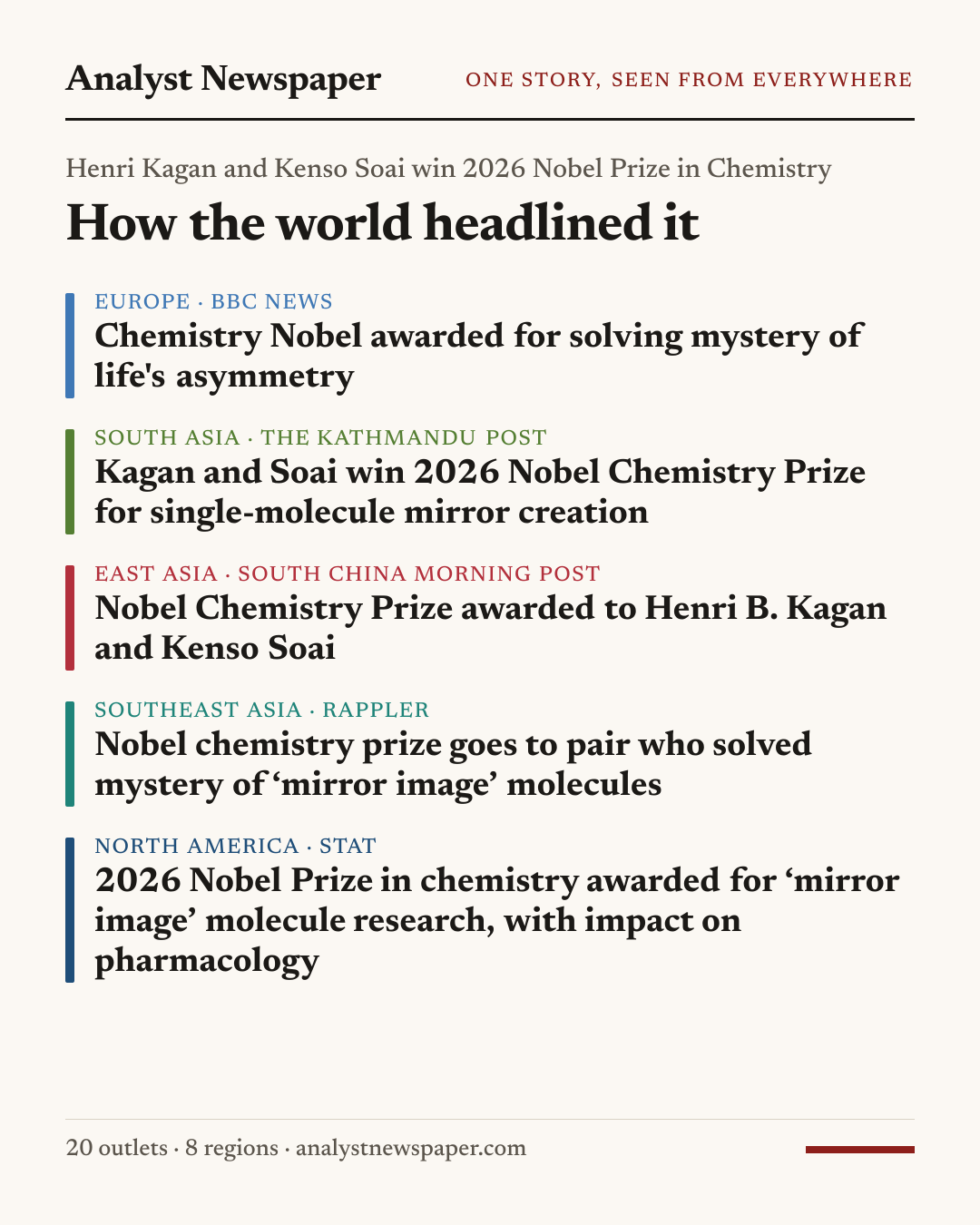
What happened
The Royal Swedish Academy of Sciences announced in Stockholm that the 2026 Nobel Prize in Chemistry has been awarded to Henri B. Kagan of France and Kenso Soai of Japan.115
The pair was honored for the discovery of non-linear effects and autocatalysis in asymmetric organic synthesis, explaining how chemical reactions can be driven to favor a single molecular mirror image.4691112
Kagan is affiliated with Universite Paris-Sud in Orsay, France, and Soai, 95, with the Tokyo University of Science.1
The chemistry prize, announced on a Wednesday, was the third of the 2026 Nobel awards, following the medicine and physics prizes announced earlier in the week.571216
What's agreed
Reported consistently by outlets in more than one region.
- Henri B. Kagan (France) and Kenso Soai (Japan) were awarded the 2026 Nobel Prize in Chemistry.1234567891011121314151617181920
- They were honored for the discovery of non-linear effects and autocatalysis in asymmetric organic synthesis, work explaining how chemical reactions can favor a single molecular mirror image.1469111215
- The research has significant relevance for pharmaceutical development and manufacturing.5817
- The chemistry prize was announced in Stockholm and was the third Nobel award of the week, following the medicine and physics prizes announced Monday and Tuesday.17121619
How it's framed
What each perspective puts first, based on headlines and summaries.
| Perspective | How it reads | What it puts first |
|---|---|---|
| Wire-style brief reportingEast Asia | Outlets such as South China Morning Post and The Japan Times give fuller biographical detail, including Soai's age and institutional affiliations, alongside the technical description of the discovery.19 | detailed affiliations, age of laureate, technical terminology |
| State-controlled agenciesRussia & Eurasia | TASS offers a minimal, fact-only announcement naming the laureates and their countries without elaborating on the science or its implications.2 | brief factual statement, nationality of laureates |
| State-controlled outlet in the Middle EastMiddle East & Turkey | Anadolu Agency frames the discovery in accessible terms, describing it as explaining how chemical reactions can favor one molecular mirror image.4 | plain-language explanation, molecular mirror image |
| Public broadcasters in Europe and OceaniaEurope | BBC and Deutsche Welle use concise framing around 'solving the mystery of life's asymmetry,' while France 24 and DW stick to short factual headlines.31820 | mystery of asymmetry, concise announcement |
| South Asian privately owned pressSouth Asia | Outlets including Dawn, NDTV, The Express Tribune and The Kathmandu Post emphasize the sequencing of Nobel week (medicine, physics, then chemistry) and include an extended quote from the award-giving body explaining mirror-image molecules using a hands analogy.7121619 | Nobel week sequence, explanatory quote, molecular mirror analogy |
| Southeast Asian independent and privately owned pressSoutheast Asia | Rappler, Malay Mail and The Straits Times highlight the practical application of the research for pharmaceutical manufacturing.81317 | pharmaceutical applications, mirror image molecules |
| US outletsNorth America | STAT and NPR emphasize the day of announcement (Wednesday) and STAT specifically foregrounds the impact on pharmacology in its headline.511 | announcement timing, pharmacology impact |
| Australian public broadcasterOceania | ABC News Australia uses more celebratory language, describing the discovery as 'spectacular' and noting it solved a mystery over a century old.6 | celebratory tone, century-old mystery, spectacular reaction |
| French domestic pressEurope | Le Monde, reporting from the laureate's home country, quotes the Nobel committee's technical description and notes the announcement was made in Stockholm.15 | home-country coverage, committee's technical wording |
What the coverage leaves out
- None of the outlets reviewed reported reactions from Kagan or Soai themselves, or statements from their institutions.
- None of the outlets reviewed detailed the full scientific history or prior research that the laureates' work built upon, beyond brief references to a long-standing chemical mystery.
- None of the outlets reviewed specified the monetary value of the 2026 prize or how it would be shared between the laureates.
Why it matters
Sources (20)
Every outlet we drew on, grouped by where it is based. Read the originals for the full reporting.
North America
Europe
- 3BBC NewsGBPublic broadcaster
Chemistry Nobel awarded for solving mystery of life's asymmetry
- 10New ScientistGBPrivate
Nobel prize in chemistry awarded for work on mirror molecules
- 15Le MondeFRPrivate
The 2026 Nobel Prize in Chemistry is awarded to Frenchman Henri Kagan and Japanese Kenso Soai
Translated from French: Le prix Nobel de chimie 2026 est décerné au Français Henri Kagan et au Japonais Kenso Soai
- 18Deutsche WelleDEPublic broadcaster
Nobel Prize in Chemistry goes to Henri B. Kagan and Kenso Soai
- 20France 24FRPublic broadcaster
🔴Nobel Prize in chemistry awarded to France's Henri Kagan, Japan's Kenso Soai
Russia & Eurasia
- 2TASSRUState-controlled
Nobel Prize in Chemistry 2026 awarded for discovery in asymmetric organic synthesis
Middle East & Turkey
- 4Anadolu AgencyTRState-controlled
France's Henri Kagan, Japan's Kenso Soai win 2026 Nobel Prize in Chemistry
South Asia
- 7The Kathmandu PostNPPrivate
Kagan and Soai win 2026 Nobel Chemistry Prize for single-molecule mirror creation
- 12DawnPKPrivate
- 16NDTVINPrivate
Nobel Prize In Chemistry 2026 Awarded To Henri B Kagan, Kenso Soai
- 19The Express TribunePKPrivate
Kagan and Soai win 2026 Nobel chemistry prize for single molecular mirror creation
East Asia
- 1South China Morning PostHKPrivate
Nobel Chemistry Prize awarded to Henri B. Kagan and Kenso Soai
- 9The Japan TimesJPPrivate
Japanese scientist Kenso Soai and France’s Henri B. Kagan win Nobel Prize in chemistry
- 14Nikkei AsiaJPPrivate
Japan's Kenso Soai and France's Henri Kagan win Nobel chemistry prize
Southeast Asia
- 8RapplerPHIndependent
Nobel chemistry prize goes to pair who solved mystery of ‘mirror image’ molecules
- 13Malay MailMYPrivate
Nobel chemistry prize goes to France’s Kagan and Japan’s Soai for solving molecular mirror puzzle
- 17The Straits TimesSGPrivate
Scientists Henri Kagan and Kenso Soai win 2026 Nobel chemistry prize
Oceania
- 6ABC News (Australia)AUPublic broadcaster
Nobel Prize in Chemistry awarded to duo for 'spectacular' chemical reaction