Italy decrees burqa ban in schools and 30% cap on foreign pupils
Rome's government presents the measures as integration tools, while critics call them an election-driven shift to the right. Coverage worldwide agrees on the substance but diverges sharply on how to characterise the government's motives.
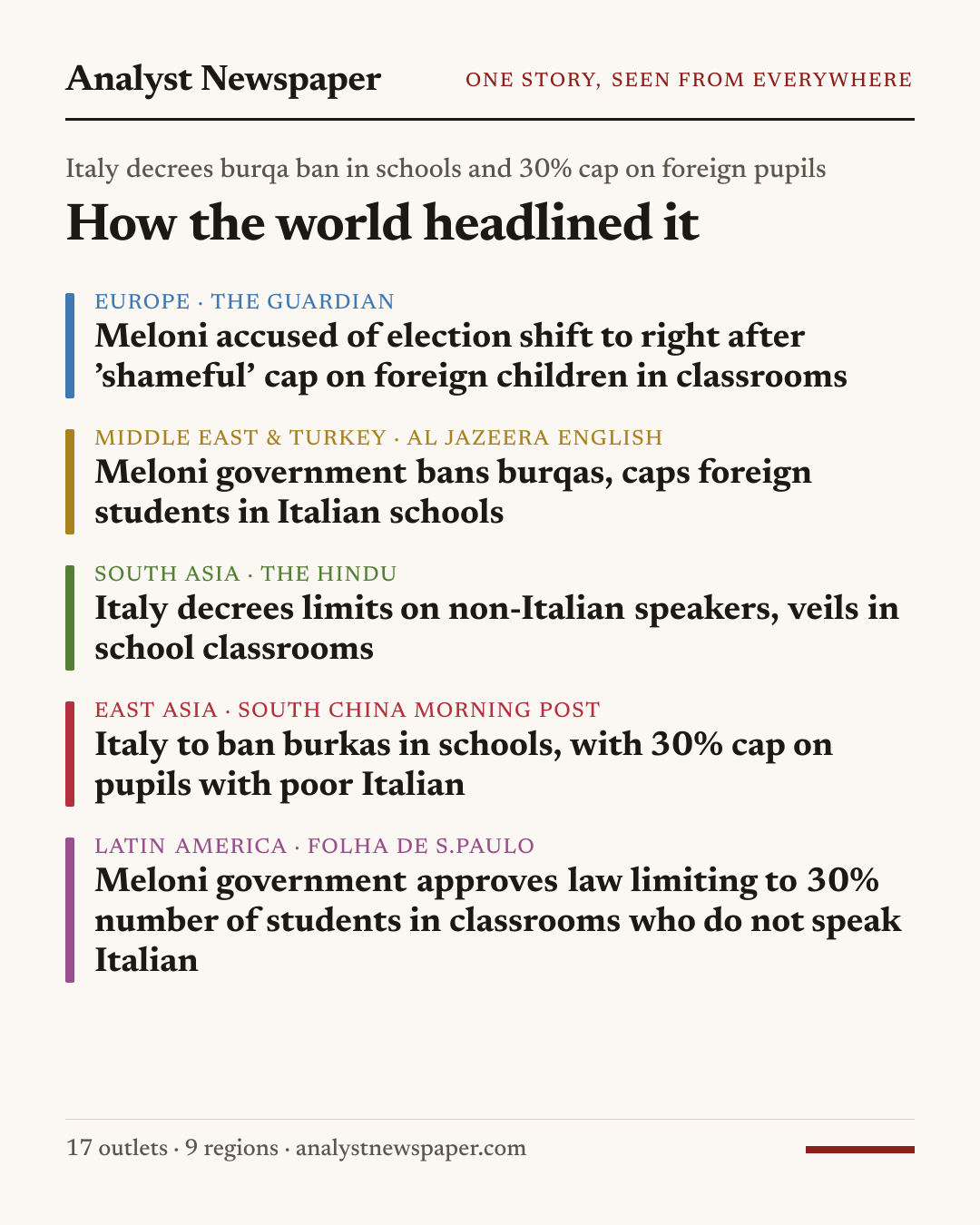
What happened
Italian Prime Minister Giorgia Meloni's cabinet adopted a decree law banning face coverings, including burqas and niqabs, in schools.1235111516
The decree caps the proportion of newly arrived students who lack adequate Italian at 30 percent per class, starting the next school year.235121416
The 30 percent quota in primary school applies to children who do not hold Italian citizenship, were not born in Italy, and have not attended Italian kindergarten for at least two years, according to the government in Rome.2
Failure to comply with the face-covering ban can be punished with a fine, reported as up to 1,000 euros or a converted equivalent of about $1,455.30.59
What's agreed
Reported consistently by outlets in more than one region.
- Italy's cabinet, led by Prime Minister Giorgia Meloni, passed a decree law banning burqas and niqabs in schools.1346101115
- The decree also caps the number of foreign students with insufficient command of Italian at 30 percent per classroom.235121416
- Meloni described the measures as common-sense tools intended to help integration rather than divide.415
- Integration of migrant children is a prominent political issue in Italy ahead of upcoming elections.647
Where accounts differ
Each account is attributed to who makes it. We do not judge between them.
How it's framed
What each perspective puts first, based on headlines and summaries.
| Perspective | How it reads | What it puts first |
|---|---|---|
| UK and US outlets emphasizing political controversyEurope | The Guardian frames the decree primarily through accusations from rights campaigners that it is a cynical, divisive election tactic, using strong critical language.4 | divisive rhetoric, far-right voters, shameful, running scared |
| US outlet framing as contested integration policyNorth America | The New York Times presents the cap as a measure the government says is about integration, while also giving space to critics who see it as courting anti-immigrant sentiment.7 | integration, anti-immigrant sentiment, critics vs government framing |
| Middle East and Turkey-based outlets citing government's integration rationaleMiddle East & Turkey | Anadolu Agency and Arab News foreground the Italian government's own stated aims, including preventing what it calls 'ghetto-like classrooms,' with limited critical framing.1317166 | promote integration, ghetto-like classrooms, commonsense measures |
| Russian state media framing as policy under Meloni's broader agendaRussia & Eurasia | RT frames the decree as part of Meloni pushing new integration rules, without featuring critical voices in the snippet.3 | integration rules, 30% cap, burqa ban |
| European public broadcasters presenting factual policy summary with Meloni's own framingEurope | Deutsche Welle and BBC News report the decree's content straightforwardly and include Meloni's description of the measures as helping integration, with BBC quoting her directly.1115 | new school rules, common-sense tools, integrate |
| South Asian and Southeast Asian outlets reporting core facts with penalty detailsSouth Asia | NDTV and The Hindu report the decree's provisions and Meloni's social media statement, with The Hindu also noting support from right-wing allies.148 | 30 percent cap, language tools, right-wing allies |
| African, Latin American and East Asian outlets emphasizing procedural factsAfrica | Vanguard, Folha de S.Paulo, Clarín, South China Morning Post and The Japan Times largely report the decree's mechanics, including fines and quota criteria, without foregrounding political controversy.1512210 | decree law, 30% cap, fines, face-covering ban |
What the coverage leaves out
- None of the outlets reviewed reported detailed reactions from Muslim community organizations or affected families in Italy.
- None of the outlets reviewed specified how many schools or students are currently affected by either the veil ban or the language quota.
- None of the outlets reviewed reported the full text or enforcement mechanism of the decree beyond the fine amounts.
- None of the outlets reviewed detailed the government's plan for 'more tools for learning' Italian referenced by Meloni.
Why it matters
Migration and integration have become a major campaign issue in Italy ahead of upcoming elections, according to Al Jazeera English.6
The Guardian reports that Meloni leads the far-right Brothers of Italy party, within the context of criticism that the decree is intended to court far-right voters.4
What to watch
- How Italy's opposition parties and rights groups respond as the decree moves toward implementation, per the criticism reported by The Guardian and The New York Times.
- Whether the measures become a factor in Italy's next general election, referenced by The Guardian and Al Jazeera English.
Sources (17)
Every outlet we drew on, grouped by where it is based. Read the originals for the full reporting.
North America
- 7The New York TimesUSPrivate
Italy Moves to Cap Number of Foreign Students in Its Classrooms
Latin America
- 5Folha de S.PauloBRPrivate
Translated from Portuguese: Governo Meloni aprova lei que limita a 30% número de alunos em salas de aula que não falam italiano
- 12ClarínARPrivate
Translated from Spanish: Confirmado: Meloni limitó por decreto la cantidad de alumnos por aula que no manejen bien el italiano y vetó el burka y el niqab
Europe
- 4The GuardianGBPrivate
Meloni accused of election shift to right after ’shameful’ cap on foreign children in classrooms
- 11Deutsche WelleDEPublic broadcaster
- 15BBC NewsGBPublic broadcaster
Italy ministers agree to ban burqa and niqab in school and cap foreigners in class
Russia & Eurasia
- 3RTRUState-controlled
Middle East & Turkey
- 6Al Jazeera EnglishQAState-controlled
Meloni government bans burqas, caps foreign students in Italian schools
- 13Anadolu AgencyTRState-controlled
Italy approves school decree banning burqa, capping foreign pupils
- 16Arab NewsSAPrivate
Italy bans burqas in schools, caps numbers of foreign students per class
Africa
- 1VanguardNGPrivate
Italy bans burqas in schools, caps number of foreign students per class
South Asia
- 8The HinduINPrivate
Italy decrees limits on non-Italian speakers, veils in school classrooms
- 14NDTVINPrivate
Italy Bans Burqa, Caps Number Of Foreign Students In Schools
- 17The Express TribunePKPrivate
Italy approves school decree banning burqa, capping foreign pupils
East Asia
- 2South China Morning PostHKPrivate
Italy to ban burkas in schools, with 30% cap on pupils with poor Italian
- 10The Japan TimesJPPrivate
Meloni’s government plans to ban face veils in Italy’s schools
Southeast Asia
- 9The Straits TimesSGPrivate
Italy bans burqas in schools, caps numbers of foreign students per class