Italy's parliament approves Meloni's contested electoral reform
Rome's overhaul introduces a fully proportional system with bonus seats for winning coalitions. Supporters call it a path to stability, opponents call it a power grab, and the measure now heads to the Constitutional Court.
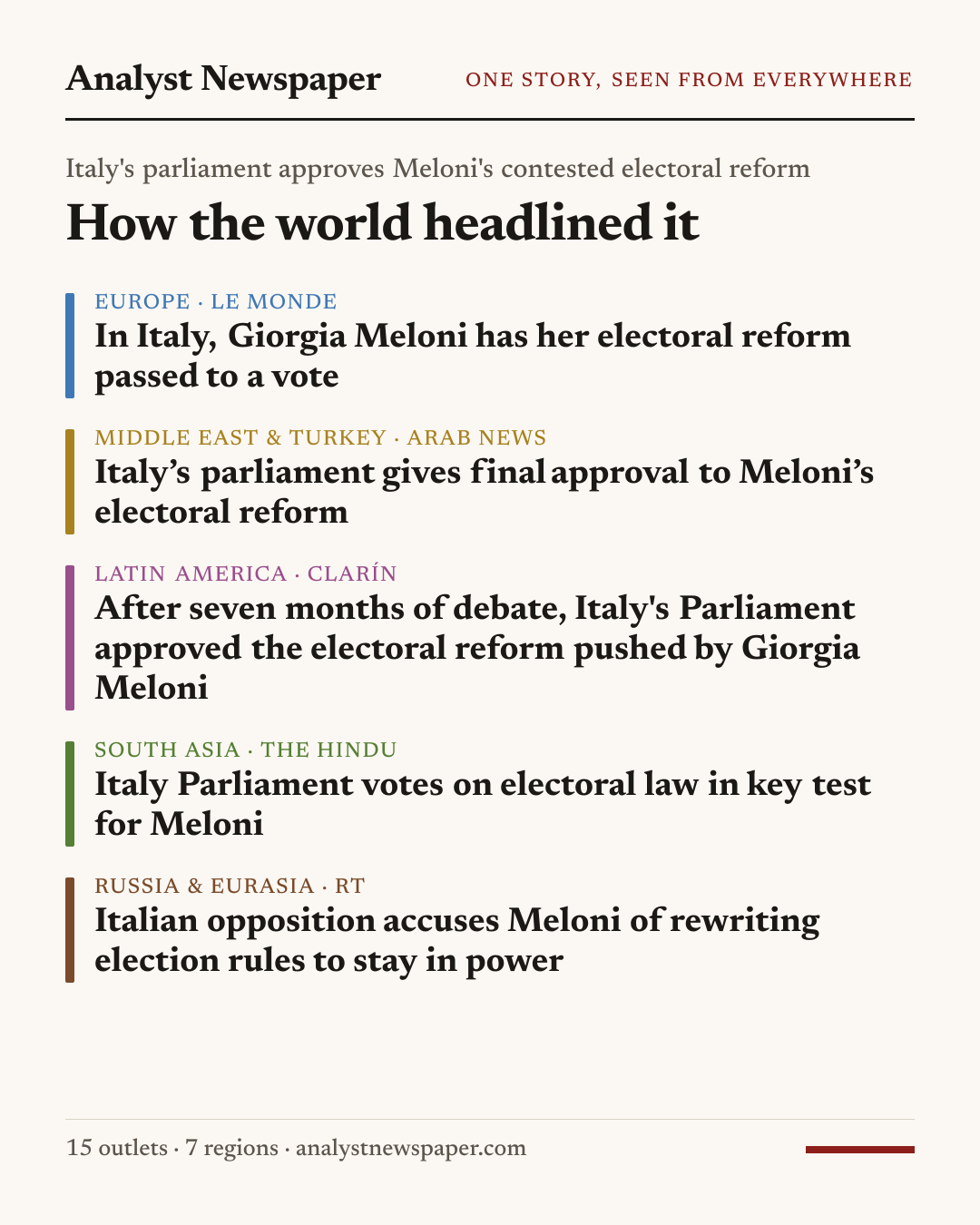
What happened
Italy's parliament gave final approval to an electoral reform pushed by Prime Minister Giorgia Meloni, shifting the system to a fully proportional model with bonus seats, or a majority prize, for any coalition winning more than 42% of the vote.4681114
The Chamber of Deputies approved the reform with 227 votes in favor and 164 against, after seven months of parliamentary debate.3
The vote took place by secret ballot; Meloni had reportedly threatened to resign if lawmakers rejected the reform.1510
Opposition parties have said they will challenge the law before Italy's Constitutional Court.3814
What's agreed
Reported consistently by outlets in more than one region.
- Italy's parliament gave final approval to the electoral reform.478101112
- The reform introduces a fully proportional voting system with a majority bonus, or 'bonus seats,' for coalitions winning more than 42% of the vote.4681114
- Opposition parties and critics say the reform is designed to help Meloni's coalition retain or cement power after the next election.17812
- Meloni and her supporters say the reform will bring greater political stability to Italy.5812
- The reform is described as controversial or fiercely contested across coverage.5121415
- Opposition parties plan to challenge the law in court.3814
Where accounts differ
Each account is attributed to who makes it. We do not judge between them.
How it's framed
What each perspective puts first, based on headlines and summaries.
| Perspective | How it reads | What it puts first |
|---|---|---|
| Russian state mediaRussia & Eurasia | Frames the reform primarily through the opposition's accusation that Meloni is rewriting election rules to stay in power, without presenting the government's stability rationale in the same depth.1 | rewriting election rules, power retention, opposition accusation |
| European outlets (public broadcaster and private press)Europe | Present both the stability rationale and the power-grab criticism, often noting the bonus-seat mechanism, the 42% threshold, and the looming Constitutional Court challenge in detail.28121415 | bonus seats, 42% threshold, constitutional challenge, stability vs power retention |
| Middle East and Turkey outlets, including state-controlled mediaMiddle East & Turkey | Emphasize the controversy and constitutional implications of the law, with some highlighting critics' charge that it is undemocratic, and one noting Meloni's claim of coalition unity after a secret ballot.41013 | constitutional implications, undemocratic claim, coalition unity, contested reform |
| South Asian outletsSouth Asia | Report the reform largely in neutral, factual terms, focusing on the 42% threshold mechanism and the vote as a political test for Meloni without emphasizing either side's framing.611 | 42% threshold, political test, factual description |
| Latin American outletsLatin America | Focus on procedural detail, including the length of debate, vote tallies, restrictions on overseas voting, and the opposition's planned court appeal.39 | seven months of debate, vote count, votes from abroad, court appeal |
| Southeast Asian outletSoutheast Asia | Centers on the opposition's claim that the law was conceived to cement the coalition's grip on power, highlighting opposition unity as fragile.7 | cement grip on power, opposition unity, opposition politicians' view |
| North American outletNorth America | Frames the law as presenting two contrasting views, stability for supporters against a described threat to democracy for critics, without favoring either.5 | stability argument, threat to democracy, contrasting views |
What the coverage leaves out
- None of the outlets reviewed reported detailed reactions from specific opposition party leaders beyond general references to 'opposition parties' or 'critics.'
- None of the outlets reviewed explained the full legal grounds on which the Constitutional Court challenge will be based.
- None of the outlets reviewed provided polling data or public opinion on the reform.
- Coverage does not clarify whether the Senate vote and Chamber of Deputies vote are the same event or separate stages, leaving the exact final approval process somewhat unclear.
Why it matters
The reform comes months before Italy's next parliamentary elections, which multiple outlets note are scheduled for 2027.9
Italy has a history of short-lived governments, which supporters of the law cite as justification for the stability-focused redesign.5
What to watch
- The Constitutional Court appeal that opposition parties say they will file against the law.
- Italy's next parliamentary elections, expected in 2027.
Sources (15)
Every outlet we drew on, grouped by where it is based. Read the originals for the full reporting.
North America
- 5The New York TimesUSPrivate
Italy Weighs Controversial Law Giving Bonus Seats to Election Winners
Latin America
- 3ClarínARPrivate
Translated from Spanish: Tras siete meses de debate, el Parlamento de Italia aprobó la reforma electoral impulsada por Giorgia Meloni
- 9Folha de S.PauloBRPrivate
Italy approves Meloni's electoral reform that facilitates majorities and limits votes from abroad
Translated from Portuguese: Itália aprova reforma eleitoral de Meloni que facilita maiorias e limita votos do exterior
Europe
- 2Le MondeFRPrivate
In Italy, Giorgia Meloni has her electoral reform passed to a vote
Translated from French: En Italie, Giorgia Meloni fait voter sa réforme électorale
- 8The GuardianGBPrivate
Giorgia Meloni wins vote on controversial ‘bonus seat’ changes to electoral system
- 12BBC NewsGBPublic broadcaster
Italy overhauls electoral system after fiercely contested debate
- 14El PaísESPrivate
Italy approves Meloni's controversial electoral reform and moves closer to early elections
Translated from Spanish: Italia aprueba la controvertida reforma electoral de Meloni y se acerca a unas elecciones anticipadas
- 15Financial TimesGBPrivate
Giorgia Meloni faces critical test in controversial electoral reform vote
Russia & Eurasia
- 1RTRUState-controlled
Italian opposition accuses Meloni of rewriting election rules to stay in power
Middle East & Turkey
- 4Arab NewsSAPrivate
Italy’s parliament gives final approval to Meloni’s electoral reform
- 10Anadolu AgencyTRState-controlled
Italy’s parliament gives final approval to contested electoral reform
- 13Al Jazeera EnglishQAState-controlled
Italian law to give election winners bonus seats: Why that’s controversial
South Asia
- 6The HinduINPrivate
Italy Parliament votes on electoral law in key test for Meloni
- 11The Times of IndiaINPrivate
Italy passes Meloni’s electoral reform, sets 42% threshold for parliamentary majority
Southeast Asia
- 7The Straits TimesSGPrivate
New Italy election law puts fragile opposition unity to the test