Japan expands Russia sanctions, targets oil shipping fleet
Japan expanded sanctions on Russia on 2 October, targeting oil-shipping vessels and dozens of companies and individuals, with outlets differing on the exact scope of entities listed and the sanctions' wider significance.
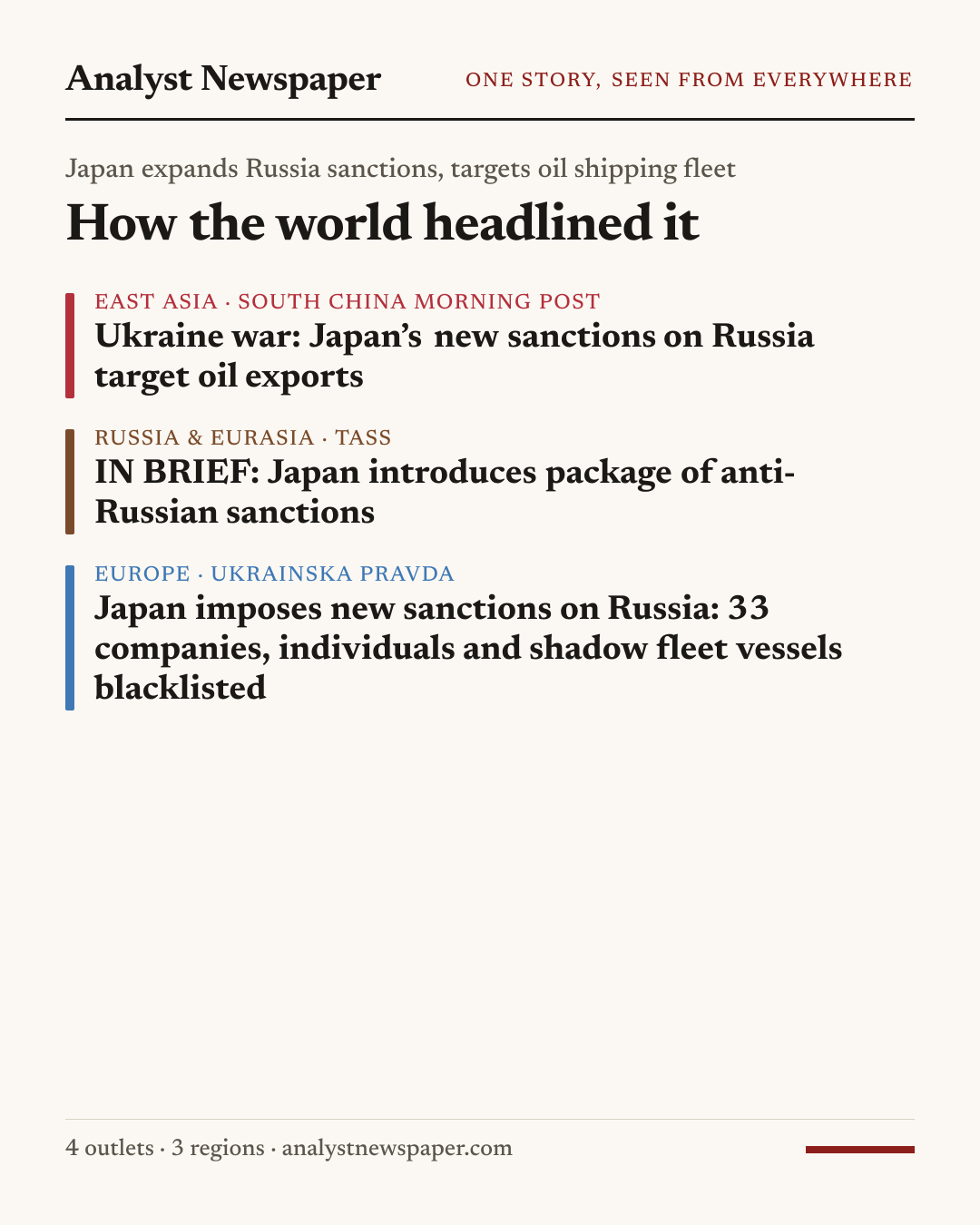
What happened
Japan's government announced additional sanctions against Russia on Friday, 2 October, over the war in Ukraine.134
The sanctions restrict services, including insurance and maritime support, to 35 vessels identified as part of a shadow fleet used to transport sanctioned Russian oil.12
Ukrainska Pravda reports the measures also added 33 Russian companies and nine individuals to Japan's sanctions list.3
Nikkei Asia describes the action as Japan's first sanctions move since Russian President Vladimir Putin visited a disputed island.4
What's agreed
Reported consistently by outlets in more than one region.
Where accounts differ
Each account is attributed to who makes it. We do not judge between them.
Number and type of entities added to the sanctions list
South China Morning Post
Reports the measures focus on restricting services to 35 vessels in the shadow fleet, without specifying a separate count of companies or individuals.1
Ukrainska Pravda
Reports the sanctions list was expanded to include 33 Russian companies and nine individuals, in addition to shadow fleet vessels.3
TASS, state-controlled Russian outlet
Reports the measures were introduced for the first time against 35 ships, without mentioning companies or individuals.2
How it's framed
What each perspective puts first, based on headlines and summaries.
| Perspective | How it reads | What it puts first |
|---|---|---|
| East Asian outlets (Hong Kong and Japan based)East Asia | Emphasize Japan's alignment with international sanctions enforcement against Russian oil exports and, in the Japanese outlet's case, connect the move to a separate territorial dispute with Russia.14 | shadow fleet, oil exports, disputed isle, first sanctions since Putin trip |
| Russian state mediaRussia & Eurasia | TASS offers a brief, factual account focused narrowly on the number of ships affected, without elaborating on the broader context of the war or territorial issues.2 | 35 ships, first-time restrictive measures |
| Ukrainian outletEurope | Ukrainska Pravda frames the sanctions within the context of Russian aggression against Ukraine, emphasizing the specific number of companies and individuals blacklisted.3 | 33 companies, nine individuals, aggression against Ukraine |
What the coverage leaves out
- None of the outlets reviewed named the specific companies or individuals added to the sanctions list.
- None of the outlets reviewed reported a response from the Russian government to the new sanctions.
- None of the outlets reviewed provided details on the disputed island referenced by Nikkei Asia or explained its connection to the current sanctions.
- None of the outlets reviewed reported the expected economic or diplomatic impact of the sanctions.
Why it matters
The sanctions are described as part of international efforts to curb evasion of existing restrictions on Russian oil exports stemming from the invasion of Ukraine.1
Nikkei Asia notes the sanctions are Japan's first such action since Russian President Vladimir Putin visited a disputed island, linking the move to broader Japan-Russia tensions beyond Ukraine.4
Sources (4)
Every outlet we drew on, grouped by where it is based. Read the originals for the full reporting.
Europe
- 3Ukrainska PravdaUAPrivate
Russia & Eurasia
- 2TASSRUState-controlled
IN BRIEF: Japan introduces package of anti-Russian sanctions
East Asia
- 1South China Morning PostHKPrivate
Ukraine war: Japan’s new sanctions on Russia target oil exports
- 4Nikkei AsiaJPPrivate
Japan hits Russia 'shadow fleet' in 1st sanctions since Putin trip to disputed isle