Japan withdraws 9.9-magnitude quake alert after overestimating 6.9 quake
Japan's meteorological agency withdrew an emergency alert for a 9.9-magnitude earthquake within minutes, after the actual quake near the Kuril Islands measured 6.9. Coverage varies in tone, from procedural descriptions to more dramatic framing of public fear and system reliability.
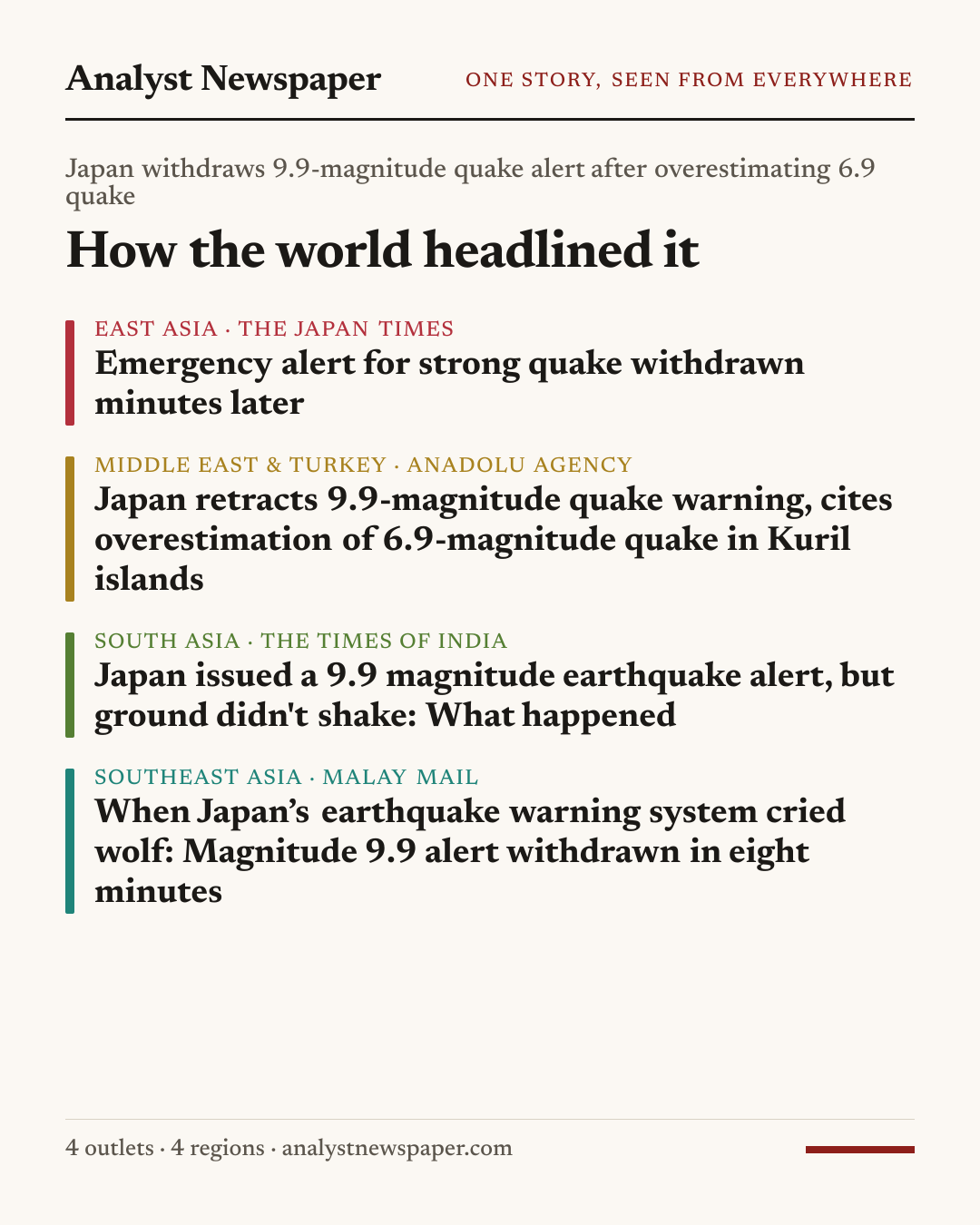
What happened
Japan's Meteorological Agency issued an emergency alert warning of a magnitude 9.9 earthquake following a quake near the Kuril Islands.12
The agency retracted the alert within minutes, with some reports specifying eight minutes, after determining the actual quake measured magnitude 6.9.234
The agency apologized for the error and said the cause of the overestimation is under investigation.2
The alert caused temporary disruptions to transportation in Japan, according to one report.3
What's agreed
Reported consistently by outlets in more than one region.
- Japan's Meteorological Agency issued an emergency alert warning of a magnitude 9.9 earthquake, triggered by an actual quake in the Kuril Islands/Kamchatka Peninsula area.1234
- The alert was retracted within minutes, with sources specifying around eight minutes after issuance.234
- The triggering quake was measured at magnitude 6.9, far smaller than the 9.9 figure in the alert.23
- The initial alert warned of strong shaking across parts of Japan.13
Where accounts differ
Each account is attributed to who makes it. We do not judge between them.
How it's framed
What each perspective puts first, based on headlines and summaries.
| Perspective | How it reads | What it puts first |
|---|---|---|
| Japanese domestic pressEast Asia | Focuses on the factual sequence of the alert being issued and withdrawn, with minimal editorializing.1 | alert issued, alert withdrawn minutes later, shaking warning across regions |
| State-controlled Turkish outletMiddle East & Turkey | Presents the episode in neutral, procedural terms, emphasizing the agency's apology and the ongoing investigation into the error.2 | apology, investigation, overestimation |
| South Asian private pressSouth Asia | Emphasizes the public fear and disruption caused by the alert, using dramatic language and detailing transportation impacts.3 | fear and panic, transportation disruption, massive scale of error |
| Southeast Asian private pressSoutheast Asia | Uses a "cried wolf" framing to question public trust in future alerts, implying skepticism about the warning system without making a direct reliability judgment.4 | cried wolf framing, public trust in alerts, catastrophic alert language |
What the coverage leaves out
- None of the outlets reviewed reported the specific technical cause of the magnitude overestimation.
- None of the outlets reviewed detailed the scale or specifics of the transportation disruptions beyond stating they occurred.
- None of the outlets reviewed reported any injuries or damage resulting from the actual 6.9-magnitude quake.
- None of the outlets reviewed gave an exact precise location (country or region) consistently, with differing references to the Kuril Islands versus Kamchatka Peninsula, Russia.
Why it matters
Sources (4)
Every outlet we drew on, grouped by where it is based. Read the originals for the full reporting.
Middle East & Turkey
- 2Anadolu AgencyTRState-controlled
South Asia
- 3The Times of IndiaINPrivate
Japan issued a 9.9 magnitude earthquake alert, but ground didn't shake: What happened
East Asia
- 1The Japan TimesJPPrivate