Meta removes terms language that suggested it could scrape sites for AI training
Meta has edited its commercial terms after criticism over language suggesting it could use content from business customers' sites, including news sites, to train its AI. Outlets differ on how to characterize Meta's motive and whether its practices have actually changed.
What happened
Meta revised its commercial terms, removing language from a web-crawling provision that suggested it could use content from business customers' domains, web pages, or URLs to train its AI.1234
The Verge reported that the change came after public backlash over the original language.4
Anadolu Agency reported the change followed concerns specifically over AI scraping of news websites, and said Meta clarified the provision's use for advertising and business products.2
A Meta spokesperson told TechCrunch that the updated terms did not reflect a change in how Meta crawls the web.3
What's agreed
Reported consistently by outlets in more than one region.
Where accounts differ
Each account is attributed to who makes it. We do not judge between them.
Why Meta made the change and whether it reflects a shift in practice
The Verge
Meta updated its terms after public backlash over language suggesting it could scrape content from sites, including news sites, for AI training.4
Anadolu Agency
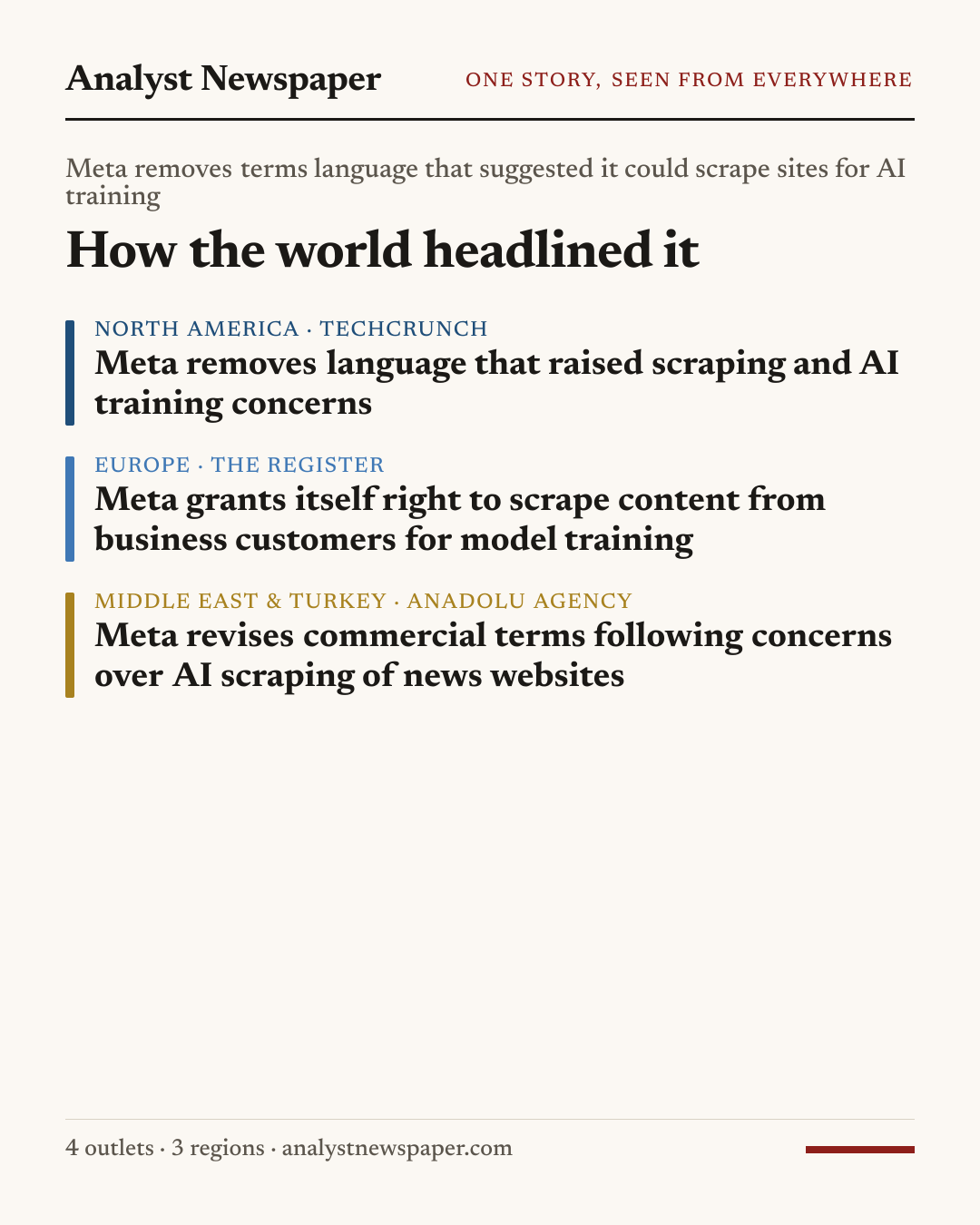
Meta revised its terms following concerns over AI scraping of news websites specifically, clarifying the provision applies to advertising and business products.2
Meta, via TechCrunch
A Meta spokesperson said the updated terms did not reflect any actual change in how Meta crawls the web.3
The Register
Meta had granted itself the right to scrape content from business customers for model training, characterized by the outlet as the company assuming that authority for itself.1
How it's framed
What each perspective puts first, based on headlines and summaries.
| Perspective | How it reads | What it puts first |
|---|---|---|
| UK technology trade pressEurope | The Register frames the episode critically, emphasizing that Meta had unilaterally assumed the right to use customer content for AI training before the change.1 | self-granted rights, critical framing of Meta's conduct |
| Turkish state-controlled wire serviceMiddle East & Turkey | Anadolu Agency frames the change as a direct response to concerns about news content scraping, presenting it in neutral, procedural terms as a clarification of business-use terms.2 | news industry concerns, procedural clarification |
| US technology pressNorth America | TechCrunch and The Verge report the change neutrally, with TechCrunch highlighting Meta's denial of any practical change and The Verge framing the move as a response to backlash, quoting the specific removed contractual language.34 | Meta's official denial of change, public backlash, specific contract language removed |
What the coverage leaves out
- None of the outlets reviewed reported when the original language was first introduced or how long it had been in place.
- None of the outlets reviewed detailed the specific concerns or complaints that prompted the change, beyond general references to backlash or news industry concerns.
- None of the outlets reviewed reported statements from news publishers or industry groups about the original or revised terms.
- None of the outlets reviewed described what, if any, practical effect the removal of the language has on Meta's actual web-crawling or AI training practices.
Why it matters
The change concerns Meta's commercial terms governing business customers, specifically a provision related to web-crawling and use of content from domains, web pages, or URLs.4
Sources (4)
Every outlet we drew on, grouped by where it is based. Read the originals for the full reporting.
North America
- 3TechCrunchUSPrivate
Meta removes language that raised scraping and AI training concerns
- 4The VergeUSPrivate
Meta removes language that may have allowed it to scrape news sites
Europe
- 1The RegisterGBPrivate
Meta grants itself right to scrape content from business customers for model training
Middle East & Turkey
- 2Anadolu AgencyTRState-controlled
Meta revises commercial terms following concerns over AI scraping of news websites