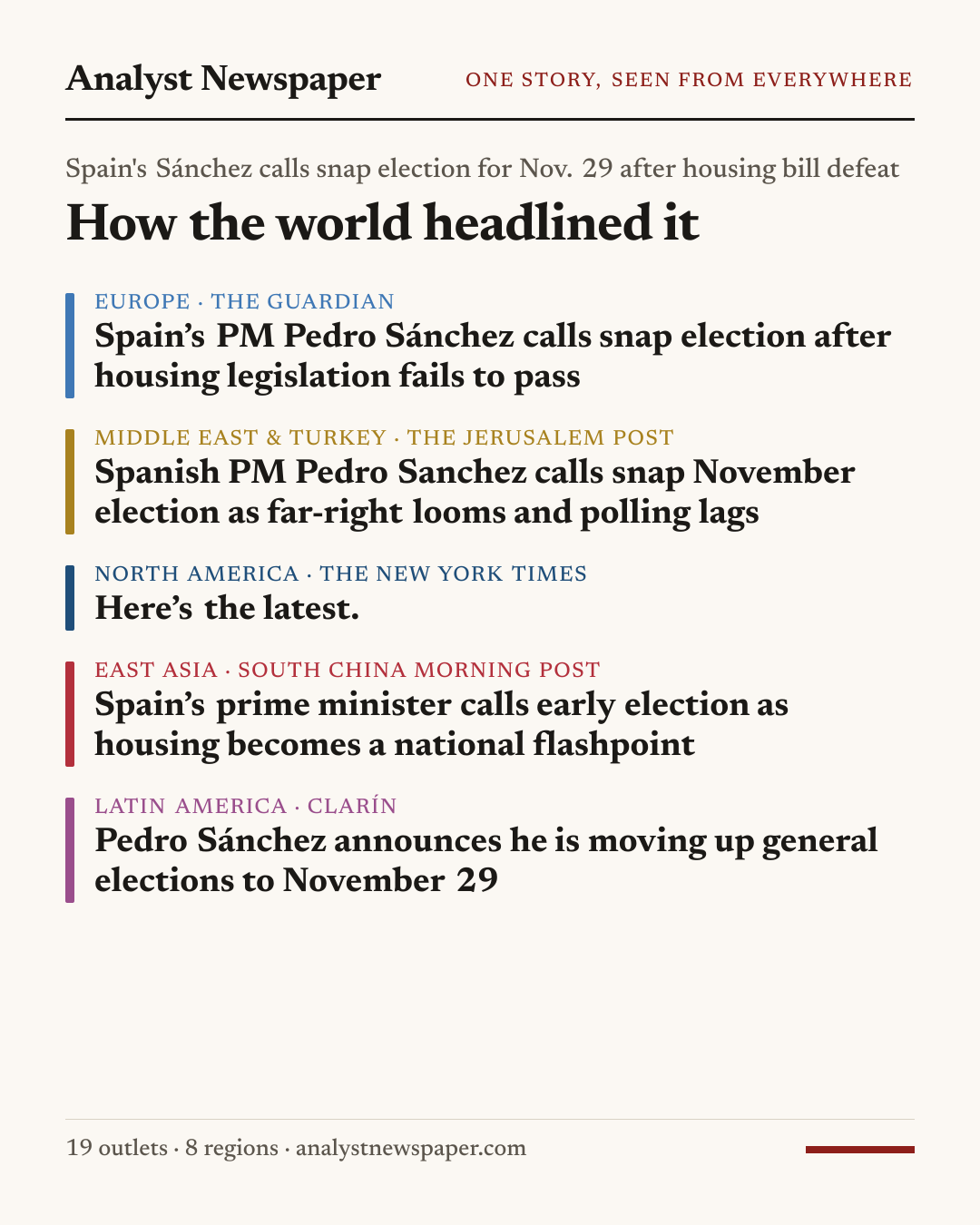
Spain's Sánchez calls snap election for Nov. 29 after housing bill defeat
Coverage agrees on the timeline but differs in emphasis, some outlets foreground the housing-policy defeat as the immediate cause, while others, in their own framing, point to Sánchez's broader political challenges, including a fragmented parliament and lagging polls.
What happened
Spanish Prime Minister Pedro Sánchez announced a snap general election to be held on November 29.123910121819
The announcement came days after rightwing parties in parliament voted down emergency housing legislation proposed by Sánchez's minority government.12891013151719
Sánchez communicated the decision via a televised address on Monday morning.21517
Sánchez had previously said he intended to serve out his full term, with elections otherwise scheduled for 2027.14
What's agreed
Reported consistently by outlets in more than one region.
Where accounts differ
Each account is attributed to who makes it. We do not judge between them.
Characterization of Sánchez's political position and motive (framings below reflect individual articles, not full outlet editorial positions)
Politico Europe
Frames Sánchez as hoping the housing affordability crisis can help him defy unfavorable polls and extend his time in power.12
The Jerusalem Post
Frames Sánchez as facing a surging far-right and lagging polls, having never won a majority and relying on fragile, patchwork coalitions.4
Anadolu Agency
Reports Sánchez is seeking a broader progressive majority and framing the vote as a choice between further reforms and a far-right rollback.10
The Kathmandu Post
Describes Sánchez as betting on a stronger left-wing mandate while his government is weakened by housing protests, corruption scandals, and a fragmented parliament.7
How it's framed
What each perspective puts first, based on headlines and summaries.
| Perspective | How it reads | What it puts first |
|---|---|---|
| UK and Western European outletsEurope | Coverage emphasizes the parliamentary defeat on housing legislation as the proximate cause, generally in neutral, factual tone.2916171819 | housing legislation defeat, snap election timeline, televised address |
| Middle East-based outlets, neutral/factual coverageMiddle East & Turkey | Reports the election as a direct consequence of parliament's rejection of housing relief measures, without additional characterization of Sánchez's political standing.1315 | housing measures rejected, televised address |
| The Jerusalem PostMiddle East & Turkey | A single Jerusalem Post article frames Sánchez's position more pointedly, citing a rising far-right, lagging polls, and reliance on fragile coalitions.4 | far-right surge, fragile coalitions, lagging polls |
| Anadolu AgencyMiddle East & Turkey | Frames the vote as Sánchez seeking a broader progressive majority, presenting the choice as between further reforms and a far-right rollback.10 | progressive majority, far-right rollback |
| South China Morning Post (Hong Kong)East Asia | A single Hong Kong-based outlet situates the election within a broader housing crisis narrative, citing the televised eviction of an elderly woman as a specific trigger for public outrage.1 | housing crisis, public outrage, eviction case |
| South Asian outletSouth Asia | Frames the election as a calculated bet by Sánchez for a stronger left-wing mandate amid multiple pressures including corruption scandals and a fragmented parliament.7 | left-wing mandate, corruption scandals, fragmented parliament |
What the coverage leaves out
- None of the outlets reviewed detailed the specific content of the rejected emergency housing legislation.
- None of the outlets reviewed reported reactions from opposition party leaders to the election announcement.
- None of the outlets reviewed provided current polling figures for Sánchez's party or rivals.
- None of the outlets reviewed detailed the corruption scandals referenced by one source as weakening the government.
Why it matters
The vote comes after growing public anger over housing affordability, including protests across Spanish cities and outrage over the televised eviction of an elderly woman in Madrid.1
Sánchez has governed since 2018 without ever winning a parliamentary majority, relying on coalition arrangements spanning the far-left to the right, according to The Jerusalem Post.4
What to watch
- The November 29 election date itself, as confirmed across multiple outlets.
- Whether housing policy remains the dominant campaign issue, as suggested by Politico Europe and other outlets.
Sources (19)
Every outlet we drew on, grouped by where it is based. Read the originals for the full reporting.
North America
- 5The New York TimesUSPrivate
- 11CNBCUSPrivate
Spain's PM Sanchez calls snap election after housing crisis protests
Latin America
- 3ClarínARPrivate
Pedro Sánchez announces he is moving up general elections to November 29
Translated from Spanish: Pedro Sánchez anuncio que adelanta las elecciones generales al 29 de noviembre
Europe
- 2The GuardianGBPrivate
Spain’s PM Pedro Sánchez calls snap election after housing legislation fails to pass
- 9Le MondeFRPrivate
Translated from French: En Espagne, Pedro Sanchez, fragilisé par le rejet de ses mesures sur le logement, convoque des élections anticipées le 29 novembre
- 12Politico EuropeBEPrivate
- 14Deutsche WelleDEPublic broadcaster
- 16Sky NewsGBPrivate
- 17RTÉ NewsIEPublic broadcaster
- 18France 24FRPublic broadcaster
- 19Financial TimesGBPrivate
Middle East & Turkey
- 4The Jerusalem PostILPrivate
Spanish PM Pedro Sanchez calls snap November election as far-right looms and polling lags
- 10Anadolu AgencyTRState-controlled
Spain’s Sanchez calls early elections after housing measures rejected
- 13Al Jazeera EnglishQAState-controlled
Spanish Prime Minister Pedro Sanchez announces snap election
- 15Arab NewsSAPrivate
Spain PM to make public address after housing measures rejected: office
South Asia
- 7The Kathmandu PostNPPrivate
Spanish Prime Minister Sanchez calls snap election for November 29
East Asia
- 1South China Morning PostHKPrivate
Spain’s prime minister calls early election as housing becomes a national flashpoint
Southeast Asia
- 8CNASGState-controlled
Spain PM calls early election after parliament rejects housing measures
Oceania
- 6ABC News (Australia)AUPublic broadcaster
Breaking: Spanish Prime Minister Pedro Sanchez announces early election