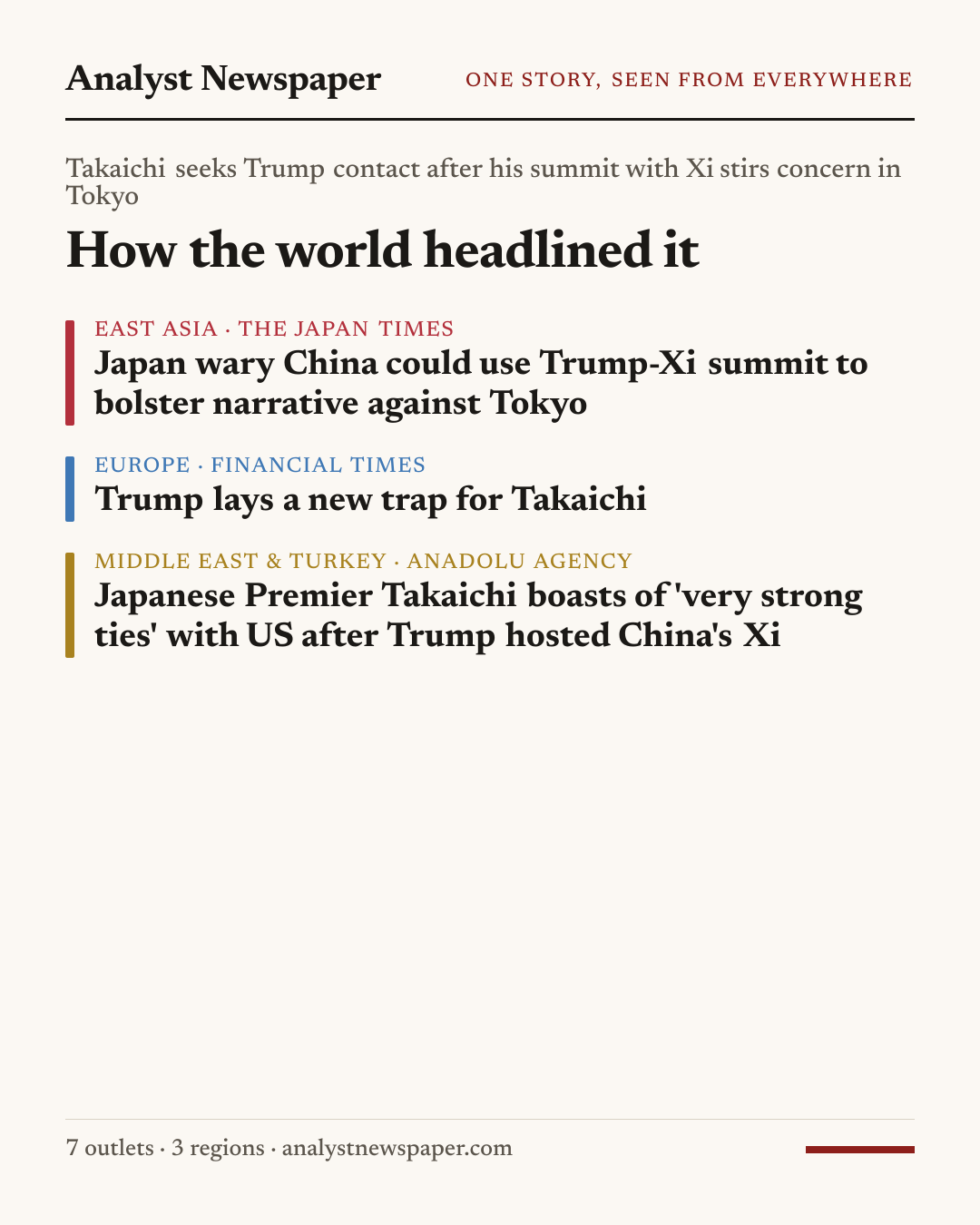
Takaichi seeks Trump contact after his summit with Xi stirs concern in Tokyo
Japanese, Western, Chinese and Turkish state media cover Trump's summit with Xi Jinping differently: most Japanese and Western coverage conveys concern in Tokyo, while Anadolu Agency's account, centered on Takaichi's own remarks, is comparatively neutral.
What happened
Japanese Prime Minister Sanae Takaichi sought or held contact with US President Donald Trump regarding China, coinciding with Trump's summit hosting Chinese President Xi Jinping at the White House, Xi's first state visit there in over a decade, according to Japanese and Taiwanese outlets.146
During the summit, Trump repeatedly invoked the US-China wartime alliance against Japan in World War II, remarks South China Morning Post described as sending "shock waves" through Tokyo, and which Nikkei Asia's headline said "raised eyebrows" in Japan.45
Takaichi publicly emphasized very strong US-Japan ties but declined to comment directly on the Trump-Xi meeting, according to Anadolu Agency.3
Chinese state media reported Beijing's criticism of separate remarks by Takaichi on removing so-called enemy state clauses.7
Where accounts differ
Each account is attributed to who makes it. We do not judge between them.
Whether Trump's summit with Xi poses a substantive threat to Japan's interests
Japan Times and South China Morning Post
Trump's rhetoric and the summit itself represent a real diplomatic risk, with Trump's wartime remarks sending shock waves through Tokyo and Japan fearing China could use the summit to bolster a narrative against it.14
Financial Times
The Financial Times frames the summit as creating a diplomatic trap for Takaichi, warning that middle powers risk appearing as a vassal state.2
Anadolu Agency, citing Takaichi's own remarks
Takaichi publicly stressed very strong US-Japan ties and declined to comment on the Trump-Xi meeting, suggesting no public alarm from her.3
How it's framed
What each perspective puts first, based on headlines and summaries.
| Perspective | How it reads | What it puts first |
|---|---|---|
| Japanese privately owned pressEast Asia | Japanese outlets frame the story around anxiety in Tokyo, focusing on Takaichi's efforts to reach Trump and reaction to his wartime rhetoric. South China Morning Post describes the remarks as sending "shock waves" through Tokyo, and Nikkei Asia's headline says they "raised eyebrows" in Japan.145 | wary of narrative against Tokyo, shock waves in Tokyo, raised eyebrows |
| European privately owned pressEurope | The Financial Times frames the summit as part of a pattern of Trump pressuring middle powers, using the terms "trap" and "vassal state."2 | trap for Takaichi, vassal state, middle power pressure |
| Turkish state-controlled mediaMiddle East & Turkey | Anadolu Agency presents a more neutral account centered on Takaichi's own public statements, highlighting her assertion of strong US ties and her refusal to comment on the Trump-Xi meeting.3 | strong US-Japan ties, no comment on Trump-Xi meeting |
| Taiwanese privately owned pressEast Asia | Taipei Times gives a neutral, factual account describing the Takaichi-Trump talk as timely ahead of the Xi summit, without alarmed framing.6 | timely talk, ahead of summit |
| Chinese state-controlled mediaEast Asia | CGTN reports Chinese criticism of Takaichi, emphasizing Beijing's objection to her remarks on enemy state clauses rather than the Trump-Xi summit itself. No other outlet in this set covers this exchange, so it is presented here as a single-source Chinese state media report rather than a disputed topic.7 | China condemns Takaichi, enemy state clauses |
What the coverage leaves out
- None of the outlets reviewed reported the outcome or content of any actual call between Takaichi and Trump.
- None of the outlets reviewed detailed what specifically was agreed or discussed between Trump and Xi at the summit beyond wartime rhetoric.
- None of the outlets reviewed explained in detail what the 'enemy state clauses' referenced by CGTN entail.
- None of the outlets reviewed included a direct US government response to Japanese concerns about the summit.
- No outlet outside Chinese state media reported on or disputed CGTN's account of Beijing's criticism of Takaichi's remarks.
Why it matters
The coverage centers on a Trump-Xi summit at the White House, Xi's first state visit to Washington in over a decade, and how it intersects with Japan-US-China relations under new Japanese PM Sanae Takaichi.4
Japanese and Taiwanese outlets report that Takaichi sought or held contact with Trump concerning China, either seeking a call or in talks, around the time of his summit with Xi Jinping.146
Japanese outlets report that Trump repeatedly invoked the US-China wartime alliance against Japan while hosting Xi, and that the remarks drew a negative reaction in Japan.45
What to watch
- Whether Takaichi and Trump hold a phone call and what is discussed regarding China.
- Any further Japanese government response to Trump's wartime alliance remarks.
- Further Chinese state media commentary on Takaichi's stance toward Beijing.
Sources (7)
Every outlet we drew on, grouped by where it is based. Read the originals for the full reporting.
Europe
- 2Financial TimesGBPrivate
Middle East & Turkey
- 3Anadolu AgencyTRState-controlled
Japanese Premier Takaichi boasts of 'very strong ties' with US after Trump hosted China's Xi
East Asia
- 1The Japan TimesJPPrivate
Japan wary China could use Trump-Xi summit to bolster narrative against Tokyo
- 4South China Morning PostHKPrivate
Will the Trump-Xi wartime ally nostalgia prompt a Japanese rethink on China ties?
- 5Nikkei AsiaJPPrivate
Trump remarks on China as WWII 'ally' raise eyebrows in Japan
- 6Taipei TimesTWPrivate
Takaichi has ‘timely’ talk with Trump about China ahead of his planned summit with Xi
- 7CGTNCNState-controlled
China slams Takaichi's remarks on removing 'enemy state clauses'