Three scientists win 2026 Nobel Prize in medicine for optogenetics work
Three scientists have been awarded the 2026 Nobel Prize in Physiology or Medicine for work on light-gated ion channels and optogenetics, with outlets differing mainly in which aspect of the discovery or the laureates' nationalities they foreground.
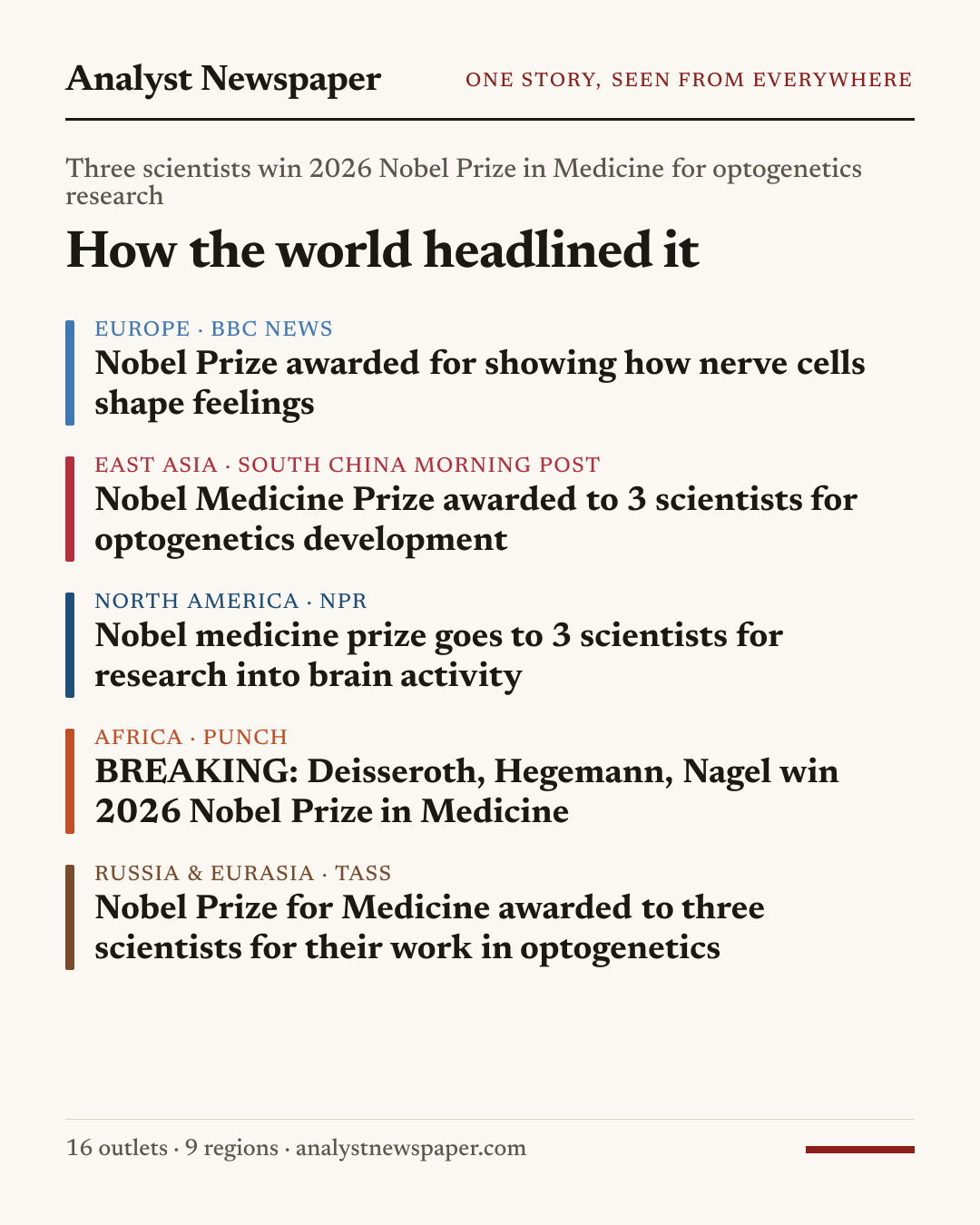
What happened
Karl Deisseroth, Peter Hegemann and Georg Nagel were awarded the 2026 Nobel Prize in Physiology or Medicine.123456
The Nobel committee cited their discoveries concerning light-gated ion channels and optogenetics.1236
Deisseroth is American, while Hegemann and Nagel are German nationals.36
The prize carries a monetary award of 12 million Swedish kronor, about $1.2 million.2
What's agreed
Reported consistently by outlets in more than one region.
How it's framed
What each perspective puts first, based on headlines and summaries.
| Perspective | How it reads | What it puts first |
|---|---|---|
| East Asian and Southeast Asian pressEast Asia | Outlets in this group state the fact of the award plainly, with The Japan Times and The Straits Times emphasizing the official citation for light-gated ion channels and optogenetics.13 | award announcement, official citation wording |
| European public broadcastersEurope | France 24 and Deutsche Welle, both public broadcasters, foreground the laureates' nationalities and institutional details such as prize money, framing the win partly around national achievement (German and US scientists).26 | nationality of laureates, prize money figure |
| European privately owned outletsEurope | Le Monde and New Scientist, both privately owned, emphasize the scientific significance and applications of the discovery, such as its implications for understanding memory, emotion and behavior, or for controlling genes with light.45 | scientific mechanism, applications of optogenetics, neuroscience implications |
What the coverage leaves out
- None of the outlets reviewed reported reactions from the laureates themselves.
- None of the outlets reviewed detailed the specific research timeline or when the key discoveries were made.
- None of the outlets reviewed described the selection process or other finalists considered for the prize.
Why it matters
Sources (6)
Every outlet we drew on, grouped by where it is based. Read the originals for the full reporting.
Europe
- 2France 24FRPublic broadcaster
Nobel Prize in medicine jointly awarded to Karl Deisseroth, Peter Hegemann and Georg Nagel
- 4Le MondeFRPrivate
Translated from French: Le Nobel de médecine 2026 récompense l’Américain Karl Deisseroth et les Allemands Peter Hegemann et Georg Nagel pour leurs travaux sur les canaux ioniques
- 5New ScientistGBPrivate
Nobel prize for medicine goes to trio who developed optogenetics
- 6Deutsche WelleDEPublic broadcaster
East Asia
- 1The Japan TimesJPPrivate
Scientists win Nobel Prize in medicine for work on ‘light-gated ion channels and optogenetics’
Southeast Asia
- 3The Straits TimesSGPrivate
American Deisseroth and Germans Hegemann and Nagel win 2026 Nobel medicine prize