Trump Administration Imposes Sweeping Sanctions on International Criminal Court
The Trump administration's sweeping new sanctions on the International Criminal Court, announced hours after a former ICC judge won the Nobel Peace Prize, have drawn sharply different reactions from the court's defenders and the US government.
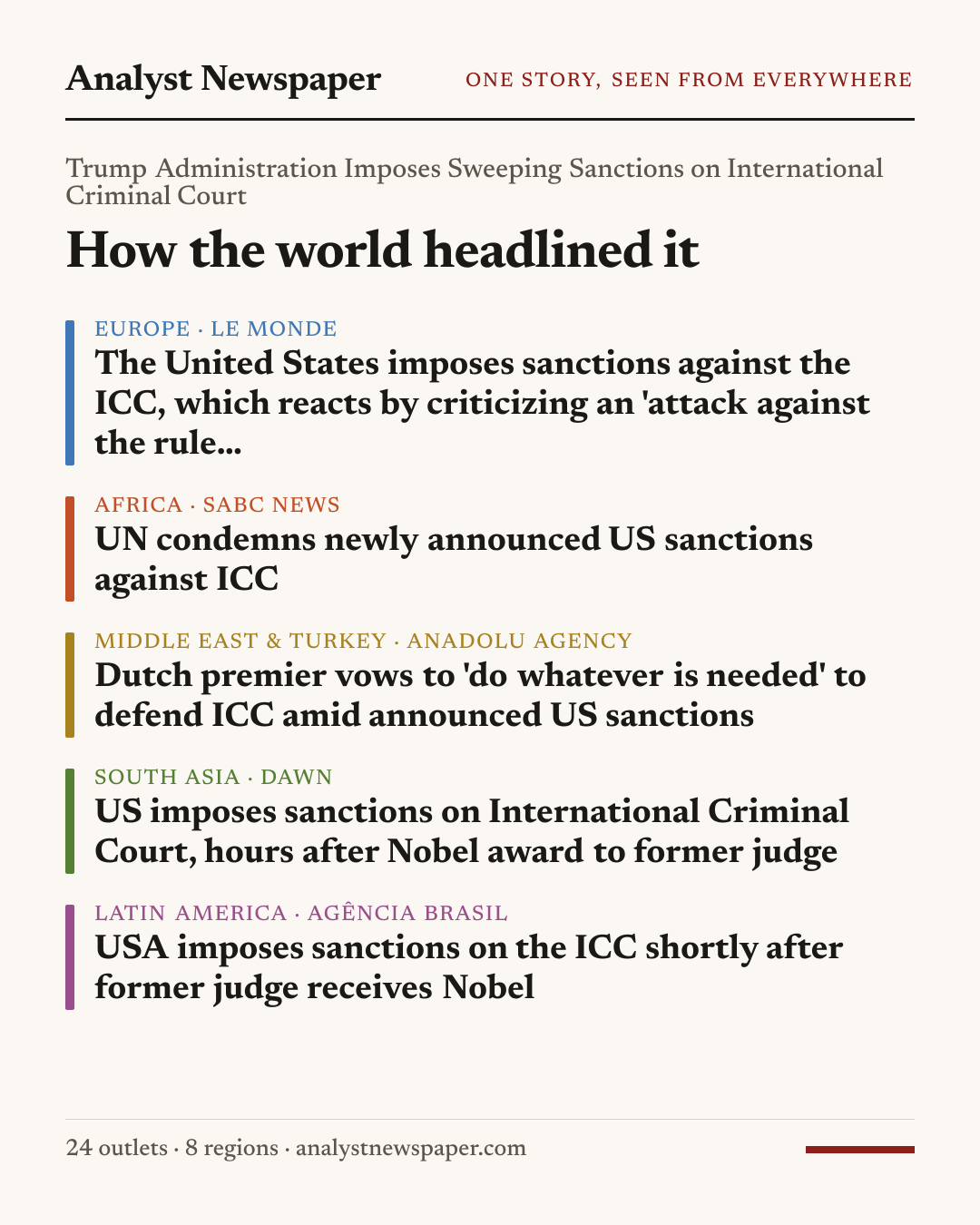
What happened
The Trump administration announced new, sweeping sanctions against the International Criminal Court on Friday, in an escalation of its long-running campaign against the tribunal.611131624
Secretary of State Marco Rubio said the sanctions would ban transactions with the ICC and aim to cut off its resources, calling it a 'rogue court.'131819
The announcement came hours after former ICC judge Navi Pillay of South Africa was awarded the Nobel Peace Prize.234715
The ICC rejected the sanctions as an assault on the rule of law, while the European Union and the Dutch prime minister pledged support for the court.351416
What's agreed
Reported consistently by outlets in more than one region.
- The Trump administration imposed new sanctions on the International Criminal Court on Friday (Oct 9).2346781113162124
- The sanctions were announced hours after former ICC judge Navi Pillay, a South African jurist, was awarded the Nobel Peace Prize.234712151718192023
- Secretary of State Marco Rubio announced the sanctions and said Washington would ban transactions with the ICC, aiming to cut off its resources and cripple its operations.7131819
- The move is part of a broader, escalating Trump administration campaign against the ICC, which it has previously sanctioned over prosecutors and judges.2131624
- The ICC rejected the sanctions, describing them as an attack on the rule of law and the international legal order.3141621
- The European Union criticized the sanctions and said it was ready to help the ICC continue its work.316
- ICC Deputy Prosecutor Nazhat Shameem Khan said the sanctions would not halt the tribunal's work.24
Where accounts differ
Each account is attributed to who makes it. We do not judge between them.
Why the US is sanctioning the ICC
How it's framed
What each perspective puts first, based on headlines and summaries.
| Perspective | How it reads | What it puts first |
|---|---|---|
| US and allied outletsNorth America | Coverage centers on the factual announcement and its timing relative to the Nobel Prize, with the New York Times noting the coincidence without strong editorializing.6 | timing with Nobel Prize, factual announcement |
| European outlets, including public broadcastersEurope | European coverage emphasizes EU pushback and support for the ICC, often framing the US move as an 'attack' on the rule of law, and highlights Dutch and EU pledges to defend the court.35162421 | EU condemnation, defense of rule of law, diplomatic rift with allies |
| Middle Eastern outletsMiddle East & Turkey | Coverage from this region, including state-controlled Al Jazeera, highlights the 'rogue court' framing used by the US and notes the ICC's past arrest warrants against Israeli officials as context for US hostility.18132223 | rogue court framing, Netanyahu arrest warrants, US-Israel alignment |
| South Asian outletsSouth Asia | Outlets emphasize Pillay's biography and her prior warnings about political attacks on the court, alongside the ICC's defiant statement that 'history will judge this moment.'71419 | Pillay's record, ICC's defiant statement, political attacks on the court |
| African outletsAfrica | African coverage, including South African outlets, stresses the striking timing of sanctions following a South African Nobel laureate's award, and reports UN condemnation of the move.115209 | South African Nobel laureate, timing as 'strange', UN condemnation |
| Latin American outletsLatin America | Coverage frames the sanctions as a reaction to Pillay's Nobel win, emphasizing the diplomatic rift with European allies and the explicit goal to 'defund' the court.41217 | diplomatic collision with Europe, defunding the ICC, Pillay's award |
| East and Southeast Asian outletsEast Asia | Coverage highlights the diplomatic collision with European allies and the ICC's defiant response that the sanctions will not stop its work.2108 | collision with European allies, ICC defiance |
What the coverage leaves out
- None of the outlets reviewed detailed the specific legal mechanisms or full list of entities targeted by the sanctions beyond the 180-day trading restriction mentioned by the Financial Times.
- None of the outlets reviewed reported reactions from non-European governments beyond general references to 'European allies,' such as from Africa, Asia, or Latin America's own governments (as opposed to media commentary).
- None of the outlets reviewed explained in detail what prompted the timing of the announcement relative to the Nobel Prize, beyond noting the coincidence.
Why it matters
The Trump administration has long been hostile to the ICC, previously sanctioning its prosecutors and judges, and has accused the court of unfairly targeting Americans and Israeli officials for war crimes charges.22122
Washington has specifically denounced the ICC over arrest warrants issued for Israeli Prime Minister Benjamin Netanyahu and a past investigation into US soldiers' actions in Afghanistan.2223
What to watch
- How the European Union's pledge to help the ICC 'carry out its work' translates into concrete measures.
- Whether companies affected by the 180-day trading deadline described by the Financial Times alter their dealings with the ICC.
- Further statements from the ICC or Nobel laureate Navi Pillay in response to the sanctions.
Sources (24)
Every outlet we drew on, grouped by where it is based. Read the originals for the full reporting.
North America
- 6The New York TimesUSPrivate
Trump Administration Hits International Criminal Court With Severe Sanctions
Latin America
- 4Agência BrasilBRPublic broadcaster
USA imposes sanctions on the ICC shortly after former judge receives Nobel
Translated from Portuguese: EUA impõem sanções ao TPI pouco depois de ex-juíza receber Nobel
- 12ClarínARPrivate
Translated from Spanish: Fuerte reacción de Trump tras el Nobel de la Paz a Navi Pillay: lanza sanciones contra la Corte Penal Internacional que integró la jurista para desfinanciarla
- 17Folha de S.PauloBRPrivate
Translated from Portuguese: EUA impõem novas sanções ao Tribunal Penal Internacional após Nobel da Paz a jurista sul-africana
Europe
- 3Le MondeFRPrivate
Translated from French: Les Etats-Unis imposent des sanctions contre la CPI, qui réagit en critiquant une « attaque contre l’Etat de droit »
- 11Financial TimesGBPrivate
- 16France 24FRPublic broadcaster
International Criminal Court faces 'test of resilience' as US imposes sweeping sanctions
- 21The GuardianGBPrivate
- 24Deutsche WelleDEPublic broadcaster
US imposes sanctions aiming to 'dismantle' International Criminal Court
Middle East & Turkey
- 5Anadolu AgencyTRState-controlled
Dutch premier vows to 'do whatever is needed' to defend ICC amid announced US sanctions
- 13The NationalAEPrivate
- 18Al Jazeera EnglishQAState-controlled
‘Rogue court’: US sanctions ICC hours after ex-judge wins Nobel Prize
- 22The Jerusalem PostILPrivate
US imposes sanctions on International Criminal Court, hours after former judge wins Nobel
Africa
- 1SABC NewsZAPublic broadcaster
- 9PunchNGPrivate
Trump sanctions ICC over prosecution of Americans, vows to cripple court
- 15Daily MaverickZAIndependent
STRANGE TIMING: US imposes sanctions on ICC hours after South African judge wins Nobel Peace Prize
- 20Channels TelevisionNGPrivate
US Imposes Sanctions On ICC After Nobel Peace Award To Its Former Judge
South Asia
- 7DawnPKPrivate
US imposes sanctions on International Criminal Court, hours after Nobel award to former judge
- 14The HinduINPrivate
ICC rejects U.S. sanctions, says 'history will judge this moment'
- 19NDTVINPrivate
"Rogue": US Sanctions World Court Hours After Ex-Judge Wins Peace Nobel
- 23The Express TribunePKPrivate
US imposes sanctions on ICC hours after former judge wins Nobel Peace Prize
East Asia
- 2South China Morning PostHKPrivate
- 10Nikkei AsiaJPPrivate
Nobel laureate Pillay calls sanctions on ICC judges 'shocking'
Southeast Asia
- 8The Straits TimesSGPrivate
Reactions to US imposing sanctions on International Criminal Court