Trump administration finalizes rollback of Biden-era fuel economy standards
The Trump administration has finalized a rollback of Biden-era fuel economy standards, with outlets differing in emphasis on what the change means for emissions and electric vehicle adoption.
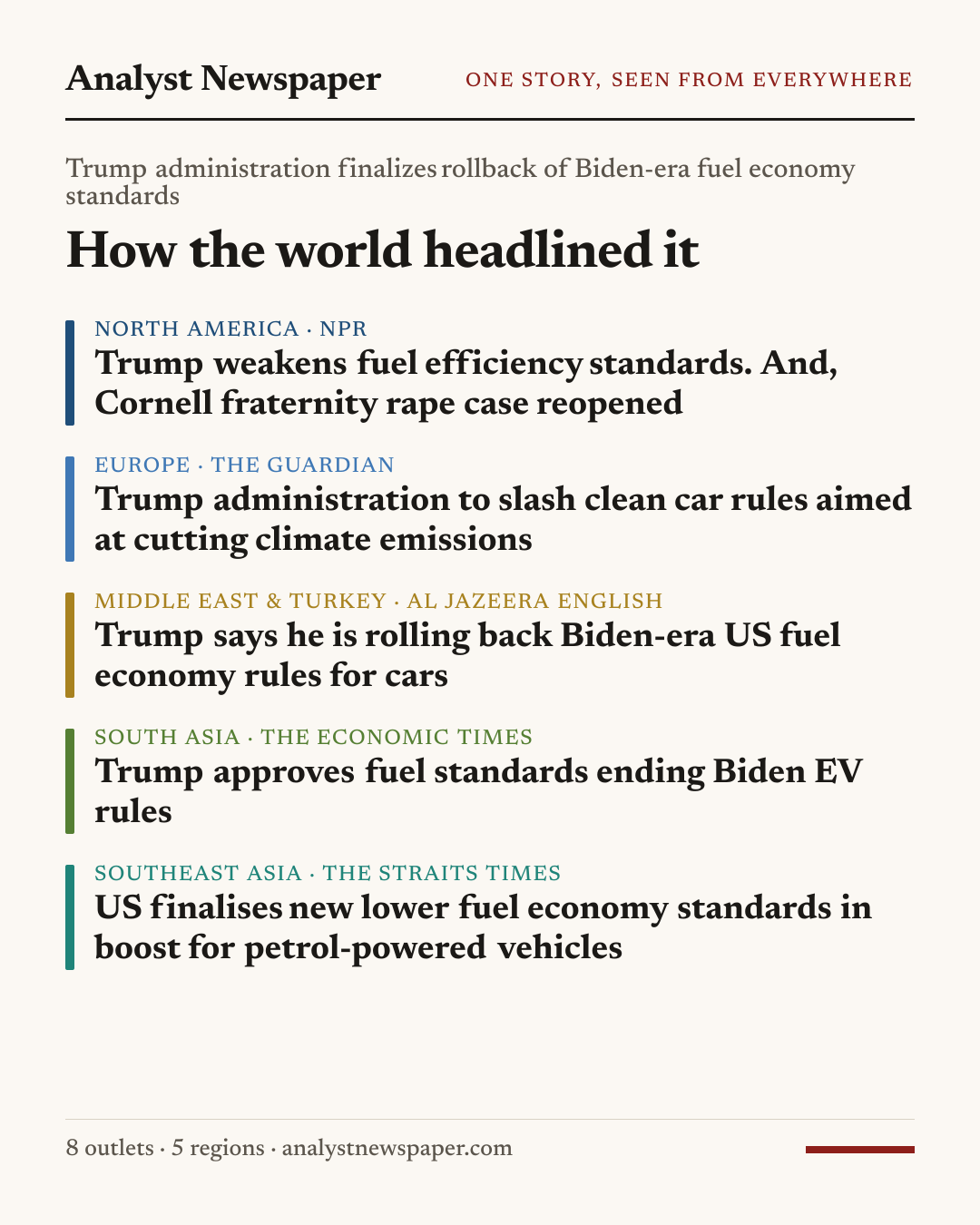
What happened
The Trump administration has finalized new fuel economy standards that weaken Biden-era rules aimed at cutting vehicle emissions and encouraging electric vehicle adoption.1378
President Trump said he approved the changes, which he described as ending a Biden-era 'EV mandate.'28
The new rule lowers the current Corporate Average Fuel Economy standard to roughly 35 mpg, down from the 40 mpg level set in 2020, and undoes a Biden-era target that would have required fleet average fuel economy to reach 50.4 miles per gallon by model year 2031.67
The US Department of Transportation called the move among the largest deregulatory actions under the second Trump administration.7
What's agreed
Reported consistently by outlets in more than one region.
- The Trump administration finalized new fuel economy standards that weaken or roll back Biden-era rules for cars and light trucks.1345678
- The Biden-era standards had been designed to cut emissions and push automakers toward electric vehicles.18
- The new standards benefit gasoline-powered vehicles by easing fuel efficiency requirements.567
Where accounts differ
Each account is attributed to who makes it. We do not judge between them.
Whether the policy is characterized as ending an 'EV mandate' or simply reversing stricter rules
Trump, via Al Jazeera English
Trump described the change as ending a so-called 'EV mandate' that steered consumers toward electric vehicles.2
CNBC
The change is described as reversing the Biden administration's stricter policies meant to spur electric vehicle adoption, without using the term 'mandate'.8
How it's framed
What each perspective puts first, based on headlines and summaries.
| Perspective | How it reads | What it puts first |
|---|---|---|
| US outlets emphasizing environmental criticism or the scale of deregulationNorth America | The Guardian notes that environmentalists criticized the move as relaxing pollution controls, while The Verge highlights the Department of Transportation's own description of the rule as among the largest deregulatory actions under the administration.17 | environmentalist criticism, deregulation scale, weakening standards |
| US outlets emphasizing regulatory and numerical detailNorth America | NPR, Ars Technica and CNBC report the change primarily through specific figures and administrative details of the policy reversal.368 | fuel efficiency numbers, policy reversal, regulatory action |
| Middle East outlet centering Trump's own framingMiddle East & Turkey | Al Jazeera English, a state-controlled outlet, frames the story around Trump's own characterization of the change as ending an 'EV mandate,' centering his framing rather than independent assessment.2 | Trump's framing, EV mandate, consumer choice |
| South Asian business pressSouth Asia | The Economic Times offers a brief, neutral factual account focused on the policy outcome, without added context on environmental impact.4 | policy change, Biden rules ended |
| Southeast Asian pressSoutheast Asia | The Straits Times frames the change in terms of its effect on petrol-powered vehicles and its consequences for fuel consumption and emissions.5 | petrol vehicles benefit, fuel consumption increase, emissions increase |
What the coverage leaves out
- None of the outlets reviewed reported detailed reactions from automakers to the new standards.
- None of the outlets reviewed reported the specific legal or procedural process by which the rule was finalized, beyond the Department of Transportation's own characterization.
- None of the outlets reviewed reported potential legal challenges to the new standards.
- None of the outlets reviewed provided detailed data on projected emissions or fuel consumption changes beyond general statements.
Why it matters
The change affects requirements on automakers for model years 2022 through 2031, according to reporting on the announcement.1
The US Department of Transportation described the action as among the largest deregulatory moves under the second Trump administration, according to its own statement.7
The 35 mpg and 50.4 mpg figures reported by different outlets are not conflicting claims about the same measure: one describes the new, lowered CAFE stringency level, while the other describes the Biden-era 2031 target that the new rule undoes.67
Sources (8)
Every outlet we drew on, grouped by where it is based. Read the originals for the full reporting.
North America
- 3NPRUSPublic broadcaster
Trump weakens fuel efficiency standards. And, Cornell fraternity rape case reopened
- 6Ars TechnicaUSPrivate
- 7The VergeUSPrivate
- 8CNBCUSPrivate
Trump says he approved new fuel economy standards rolling back Biden-era rules
Europe
- 1The GuardianGBPrivate
Trump administration to slash clean car rules aimed at cutting climate emissions
Middle East & Turkey
- 2Al Jazeera EnglishQAState-controlled
Trump says he is rolling back Biden-era US fuel economy rules for cars
South Asia
- 4The Economic TimesINPrivate
Southeast Asia
- 5The Straits TimesSGPrivate
US finalises new lower fuel economy standards in boost for petrol-powered vehicles