US, Russia and China pursue separate plans for lunar nuclear reactors
Coverage agrees the US targets 2030 and a Russia-China alliance targets 2036 for lunar nuclear reactors, but outlets differ on how much weight to give safety warnings versus the reactors' purpose of powering future Moon bases.
What happened
Coverage reports that the United States aims to install a nuclear reactor on the Moon by 2030, while a Russia-China alliance is working on a separate joint reactor project targeted for 2036.1234
Some outlets note that leading scientists have raised safety concerns about the danger of these plans.24
The Hindu connects the US plans to the Artemis Accords, which envisage temporary safety zones meant to prevent harmful interference on the Moon.3
What's agreed
Reported consistently by outlets in more than one region.
How it's framed
What each perspective puts first, based on headlines and summaries.
| Perspective | How it reads | What it puts first |
|---|---|---|
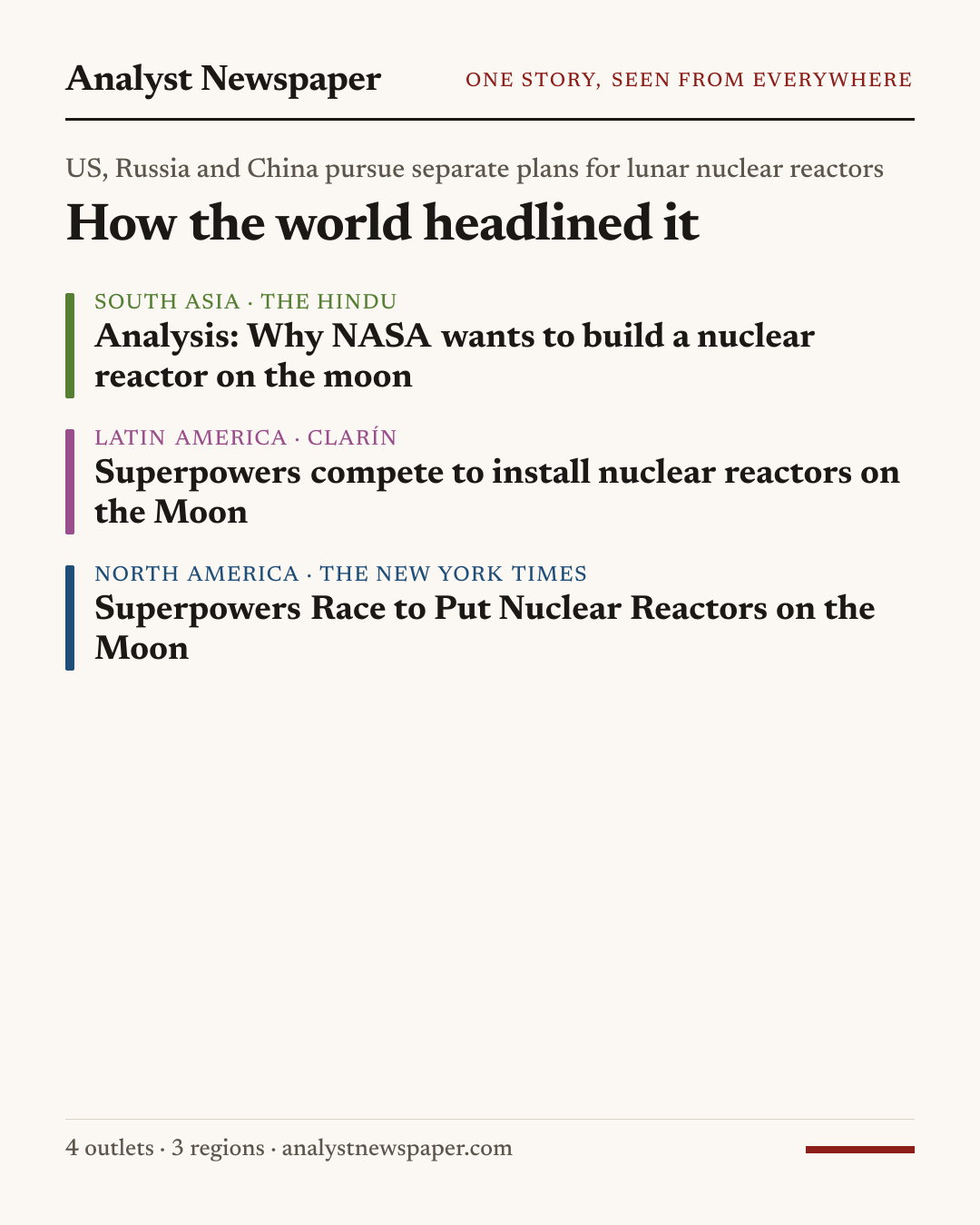
| Latin American privately owned pressLatin America | Clarín presents the story primarily as a factual account of competing timelines between superpowers, without elaborating on risk or policy framework.1 | competition between superpowers, differing target dates |
| US privately owned pressNorth America | The New York Times frames the story as a 'race' and foregrounds warnings from scientists about danger, giving prominent weight to safety concerns.2 | race framing, scientific danger warnings |
| South Asian privately owned pressSouth Asia | Indian outlets split in focus: The Hindu examines NASA's motivations and the Artemis Accords' safety-zone framework, while NDTV frames it as a three-way race among US, China and Russia and balances potential benefits for Moon bases against safety concerns.34 | NASA's rationale, Artemis Accords safety zones, three-way race, benefits versus risks |
What the coverage leaves out
- None of the outlets reviewed detailed what specifically makes the scientists consider the danger great.
- None of the outlets reviewed reported official responses from the Russian or Chinese governments on the safety concerns raised.
- None of the outlets reviewed described the technical specifications or design of either reactor project.
Why it matters
Sources (4)
Every outlet we drew on, grouped by where it is based. Read the originals for the full reporting.
North America
- 2The New York TimesUSPrivate
Latin America
- 1ClarínARPrivate
Superpowers compete to install nuclear reactors on the Moon
Translated from Spanish: Las superpotencias compiten por instalar reactores nucleares en la Luna