US Supreme Court opens term with Big Oil bid to block climate lawsuits
The Supreme Court term opens with oil companies trying to block local climate damage lawsuits, a case outlets describe as having stakes well beyond Colorado.
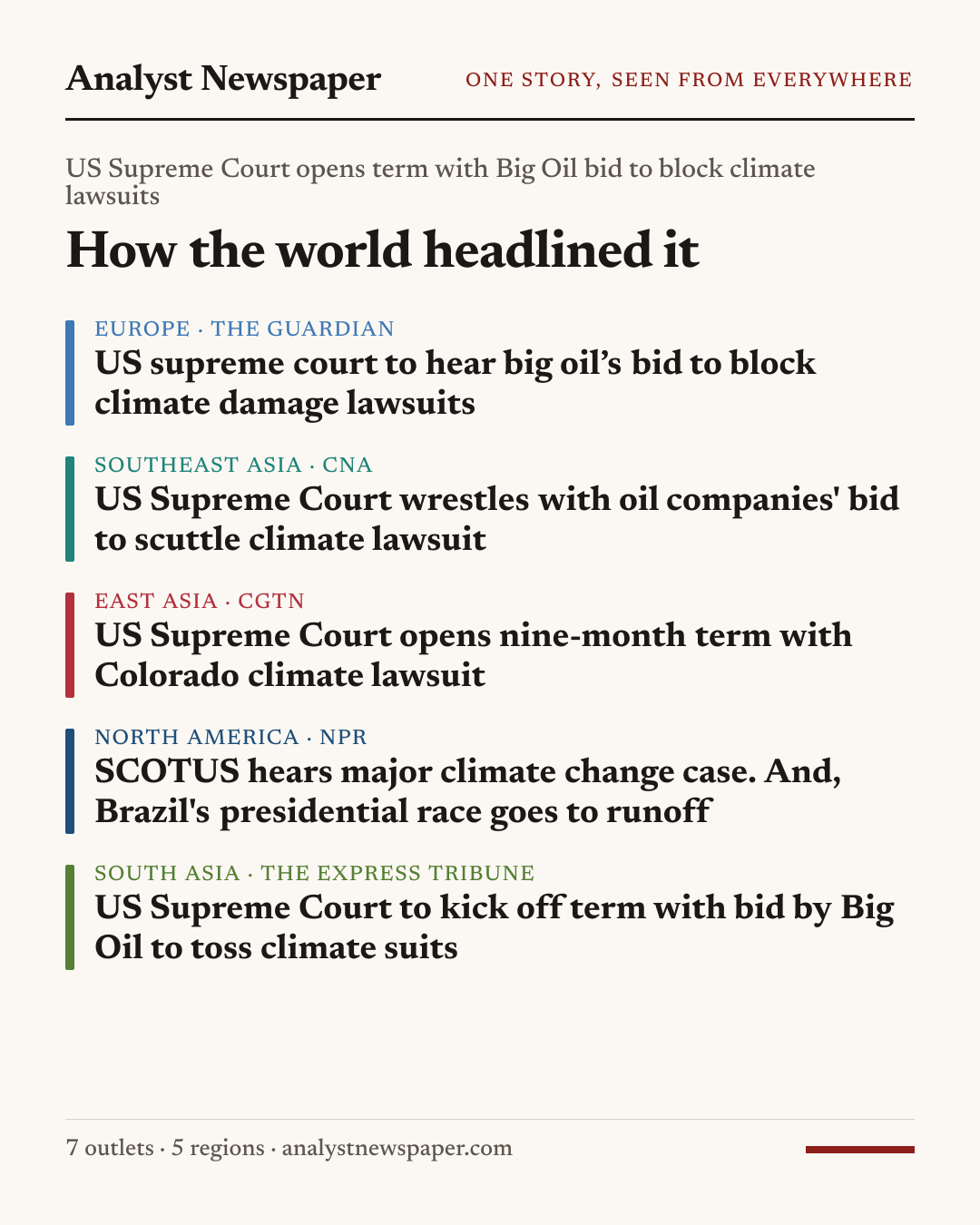
What happened
The US Supreme Court began its new nine-month term hearing arguments in a case where ExxonMobil and Suncor Energy are seeking to stop climate damage lawsuits from proceeding in state courts.1234567
The dispute originates from Boulder County, Colorado, where local officials sued the two companies, accusing them of contributing to climate change and seeking to recover related costs.25
Outlets note the case could have implications beyond this specific dispute, given that dozens of similar lawsuits have been filed by other state and local governments around the country.347
What's agreed
Reported consistently by outlets in more than one region.
- The US Supreme Court opened its new nine-month term hearing a case in which oil companies ExxonMobil and Suncor Energy seek to block climate damage lawsuits.1234567
- The case stems from Boulder County, Colorado, where local officials sued ExxonMobil and Suncor Energy in state court, seeking to hold them accountable for costs linked to climate change.25
How it's framed
What each perspective puts first, based on headlines and summaries.
| Perspective | How it reads | What it puts first |
|---|---|---|
| US public broadcasterNorth America | NPR frames the case as a major, wide-reaching legal event, describing it as a blockbuster that could affect more than climate policy, paired in the same roundup with unrelated international news.3 | blockbuster case, wide-reaching impact, national significance |
| European business and general pressEurope | The Financial Times and the Guardian emphasize the high stakes for Big Oil and frame the companies as seeking to block accountability efforts, with the Guardian using more charged language about oil firms trying to strike down lawsuits.26 | pivotal case, Big Oil, blocking accountability, climate crisis costs |
| State-controlled Asian mediaEast Asia | CGTN, a Chinese state-controlled outlet, describes the case in largely neutral, procedural terms, focusing on the fact that the Supreme Court's term begins with this climate case without evaluative language.1 | procedural description, term opening, neutral tone |
| Southeast Asian outletsSoutheast Asia | CNA, a Singaporean state-controlled outlet, and the privately owned Straits Times both describe the legal and factual background evenly, with the Straits Times additionally placing the case in context of past tobacco and opioid litigation models.57 | legal background, comparison to past litigation, neutral framing |
| South Asian coverageSouth Asia | The Express Tribune highlights the scale of the issue, noting that nearly 60 state and local governments are pursuing similar suits against fossil fuel companies, framing the case as part of a broader pattern of litigation.4 | scale of litigation, multiple governments, Big Oil defense strategy |
What the coverage leaves out
- None of the outlets reviewed reported the specific legal arguments presented by either side during the oral arguments.
- None of the outlets reviewed reported statements from ExxonMobil or Suncor Energy responding to the allegations.
- None of the outlets reviewed reported a timeline for when the Supreme Court might rule on the case.
- None of the outlets reviewed detailed how the nearly 40 to 60 other similar climate lawsuits might be affected by the ruling's specifics.
Why it matters
The case could affect how climate damage claims are handled by courts across the US, since it addresses whether such suits should be heard in state or federal court.3
Around 40 similar lawsuits have been filed following a litigation model previously used successfully against tobacco and opioid producers.7
Nearly 60 state and local governments are reported to be pursuing similar cases against fossil fuel companies.4
What to watch
- How the Supreme Court rules on whether climate damage claims should be heard in state or federal court.
- Potential effects on the reported nearly 40 to 60 other similar climate lawsuits pending around the country.
Sources (7)
Every outlet we drew on, grouped by where it is based. Read the originals for the full reporting.
North America
- 3NPRUSPublic broadcaster
SCOTUS hears major climate change case. And, Brazil's presidential race goes to runoff
Europe
- 2The GuardianGBPrivate
US supreme court to hear big oil’s bid to block climate damage lawsuits
- 6Financial TimesGBPrivate
Big Oil goes to US Supreme Court over pivotal climate damages claim
South Asia
- 4The Express TribunePKPrivate
US Supreme Court to kick off term with bid by Big Oil to toss climate suits
East Asia
- 1CGTNCNState-controlled
US Supreme Court opens nine-month term with Colorado climate lawsuit
Southeast Asia
- 5CNASGState-controlled
US Supreme Court wrestles with oil companies' bid to scuttle climate lawsuit
- 7The Straits TimesSGPrivate
US Supreme Court hears bid to shut the door on climate suits