WHO: Global Life Expectancy Nearly Back to Pre-Pandemic Levels
The World Health Organization's latest Global Health Estimates show life expectancy nearing 2019 levels, but outlets differ in what they highlight, from the retreat of Covid-19 to a persistent gap in healthy years and the rising toll of non-communicable disease.
What happened
The World Health Organization's Global Health Estimates report shows global life expectancy reached 73.3 years in 2023, close to the pre-pandemic figure of 73.4 years in 2019, after dropping to 71.5 years in 2021 during the pandemic.785
COVID-19 fell out of the world's top 10 causes of death in 2023, ranking 14th with an estimated 0.9 million deaths, just two years after topping the list.3
Non-communicable diseases, led by ischaemic heart disease and stroke, caused 74% of global deaths in 2023, with heart disease and stroke alone accounting for more than 16 million deaths.16
WHO also reported that while overall life expectancy has recovered, gains in healthy years of life have lagged, with anxiety disorders up nearly 45% and depressive disorders up about 20% since 2019.4
Global life expectancy had fallen to 71.5 years in 2021 during the coronavirus pandemic.5
COVID-19 dropped out of the world's top 10 causes of death in 2023, after having topped the list two years earlier.3
What's agreed
Reported consistently by outlets in more than one region.
- Global life expectancy has nearly returned to pre-pandemic levels, reaching 73.3 years in 2023 compared with 73.4 years in 2019, according to WHO's Global Health Estimates.57824
- Non-communicable diseases, including cardiovascular disease, remain the dominant cause of death globally even as life expectancy recovers.126
- Ischaemic heart disease and stroke were the leading causes of death in 2023, together accounting for more than 16 million deaths.62
How it's framed
What each perspective puts first, based on headlines and summaries.
| Perspective | How it reads | What it puts first |
|---|---|---|
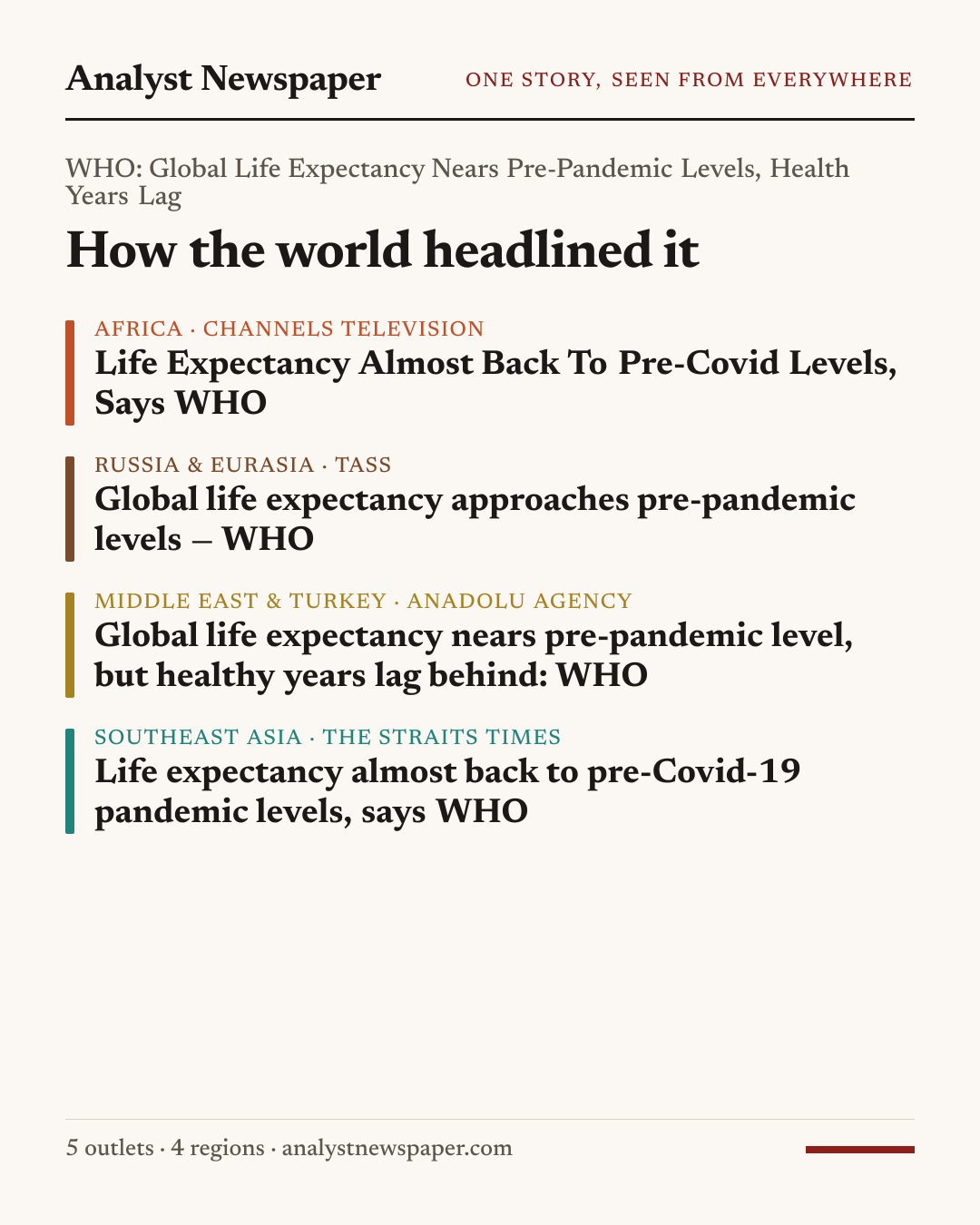
| Nigerian private and independent pressAfrica | Nigerian outlets (Premium Times, Vanguard, Nairametrics, Channels Television) give the broadest coverage of the WHO report, detailing both the life expectancy rebound and the underlying disease data, including non-communicable disease deaths and specific cause-of-death rankings.1678 | life expectancy figures, non-communicable disease burden, top causes of death breakdown |
| Russian state mediaRussia & Eurasia | TASS frames the story around the headline recovery of global life expectancy to pre-pandemic levels, paired with a note on cardiovascular disease as the leading killer, without further detail.2 | pre-pandemic recovery, cardiovascular disease as leading cause of death |
| Turkish state mediaMiddle East & Turkey | Anadolu Agency takes a more critical angle, emphasizing that while life expectancy is recovering, healthy years are lagging and mental health conditions such as anxiety and depression have worsened sharply since 2019.4 | gap between life expectancy and healthy years, rising anxiety and depression rates, critical framing of mental health trends |
| European independent health pressEurope | Health Policy Watch focuses specifically on Covid-19's fall from the top 10 global causes of death, highlighting the scale of the shift from its peak ranking during the pandemic.3 | Covid-19's drop in death rankings, historical comparison to pandemic peak |
| Southeast Asian privately owned pressSoutheast Asia | The Straits Times frames the story around the trajectory of life expectancy, contrasting the pandemic-era low of 71.5 years in 2021 with the near-full recovery.5 | pandemic-era low point, recovery trajectory |
What the coverage leaves out
- None of the outlets reviewed reported regional or country-level breakdowns of life expectancy recovery.
- None of the outlets reviewed explained why COVID-19 deaths declined so sharply between its 2021 peak and 2023.
- None of the outlets reviewed detailed the specific data sources or methodology behind WHO's Global Health Estimates.
- None of the outlets reviewed addressed how the mental health trends cited by Anadolu Agency relate to the overall life expectancy figures.
Why it matters
Sources (8)
Every outlet we drew on, grouped by where it is based. Read the originals for the full reporting.
Europe
- 3Health Policy WatchCHIndependent
COVID-19 Drops Out of World’s Top 10 Causes of Death for First Time since Pandemic Began
Russia & Eurasia
- 2TASSRUState-controlled
Middle East & Turkey
- 4Anadolu AgencyTRState-controlled
Global life expectancy nears pre-pandemic level, but healthy years lag behind: WHO
Africa
- 1Premium TimesNGIndependent
Non-communicable diseases caused 74% of global deaths in 2023 – WHO
- 6VanguardNGPrivate
- 7NairametricsNGPrivate
Global life expectancy rebounds near pre-COVID-19 level at 73.3 years —WHO
- 8Channels TelevisionNGPrivate
Southeast Asia
- 5The Straits TimesSGPrivate
Life expectancy almost back to pre-Covid-19 pandemic levels, says WHO